A hollow dowel pin is a locating or joining element with an open or tubular cross-section, but the phrase is not a complete product specification. It can describe a thin-wall tube, a tubular locating part, or a search term used for a different spring-pin family. Before selecting one, confirm the cross-section, joint function, hole fit, wall condition and inspection requirement.
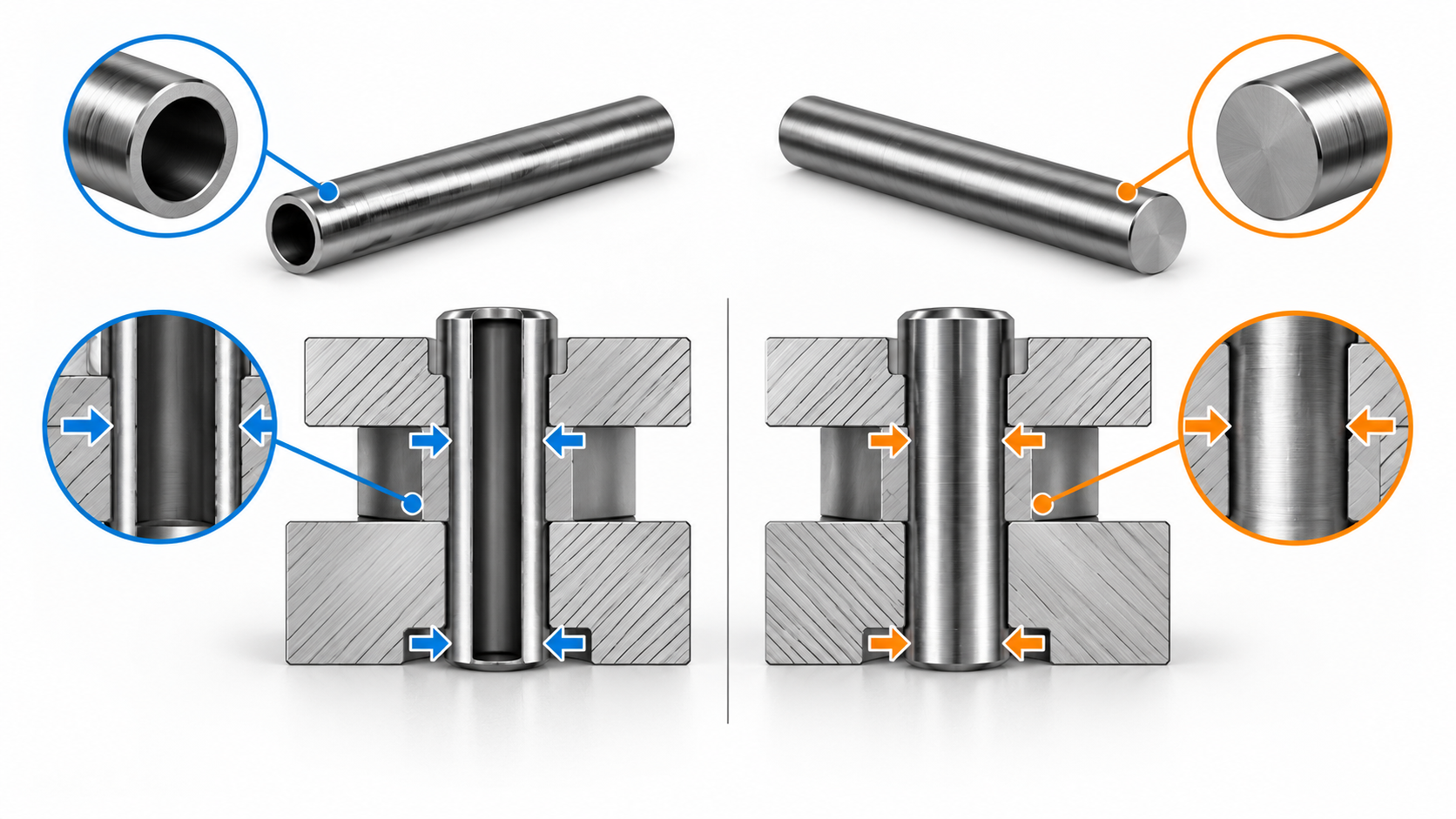
| Term | What it usually describes | What must be confirmed |
|---|---|---|
| Hollow or tubular pin | An open internal section or tube-like construction | Wall, end form, stiffness, hole fit and actual product source |
| Slotted spring pin | A spring pin with a longitudinal slot and compressible section | Standard, free diameter, hole range and host material |
| Coiled spring pin | A strip rolled into a coil to provide compliance | Coil duty, hole range, installation and service load |
| Solid dowel pin | A solid cylindrical or tapered locating element | Diameter designation, fit, length, material and removal plan |
That distinction matters because a hollow steel dowel pin may be searched by a buyer who actually needs a slotted spring pin. The ISO 8752 slotted spring-pin guide is a separate route. Do not transfer its hole range or installation behavior to a tubular or solid part.
A hollow section can be considered when mass, access, internal clearance or a particular manufacturing route matters. The benefit is application-dependent. Removing material from the center changes stiffness, local stress, contact behavior and the way the pin reacts to insertion. A design that only needs location may have different requirements from one that must withstand repeated impact or side loading.
Check the host materials and the joint’s load path before treating a hollow construction as a lighter substitute. The pin may locate parts, carry shear, provide a passage or combine several functions. Each role changes the evidence needed from the supplier.
Also separate the reason for the open section from the name used in the purchase request. A tube selected for access is not automatically a spring pin, and a spring pin selected for compliance is not automatically a hollow locating tube. Ask for a section view or sample when the internal geometry affects the assembly.
Define the nominal outside diameter, length, hole condition and assembly direction. Then confirm whether the hole is through or blind, whether the pin seats against a shoulder, and whether removal is expected. Do not borrow a solid-pin fit or a spring-pin hole range simply because the outside diameter looks similar.
For a tubular part, inspect the ends and wall condition as well as the outside surface. A burr, collapsed edge or local ovality can affect insertion even when an outside measurement appears acceptable. If the hole is made through stacked components, confirm that the alignment process does not change the final path.
Potential applications include alignment fixtures, lightweight subassemblies, sleeves, access-sensitive joints and parts where an internal passage is useful. These are application categories, not a claim that one catalog part suits all of them. The actual pin must be traced to a drawing, product record or approved sample.
TG Eugene’s DIN 1 cylindrical locating-pin page and DIN 7 taper-pin page document solid locating families. They are useful comparison paths, not proof that those products are hollow. If the required geometry is not represented, treat the request as drawing-controlled.
For a new design, identify the failure mode that the hollow construction is meant to avoid. If the answer is mass, clearance, access or compliance, record that purpose beside the geometry. The supplier can then review the right evidence rather than choosing a visually similar solid part.
During approval, compare the proposed section with the actual mating parts and inspection access. A hollow section may be easy to describe but difficult to measure after assembly. Define the acceptance feature before release so production does not rely on appearance alone.
If a hollow design is supplied as a drawing-controlled part, keep the section view, material callout and inspection note together. The outside diameter by itself cannot identify the internal feature or its service purpose.
Use TG Eugene’s service route when the term “hollow dowel pin” is the only information available, when the wall is thin, or when a solid part is being replaced. Include the application sketch and the current hole data. A drawing review prevents a search phrase from being mistaken for a confirmed product family.
No. “Roll pin” commonly refers to a spring-pin family, while hollow or tubular may describe a different construction. Confirm the standard, cross-section and hole requirement before comparing them.
Only after the joint is reviewed. The change can affect mass, stiffness, clearance, insertion force, fit and service behavior. It is not a diameter-only substitution.