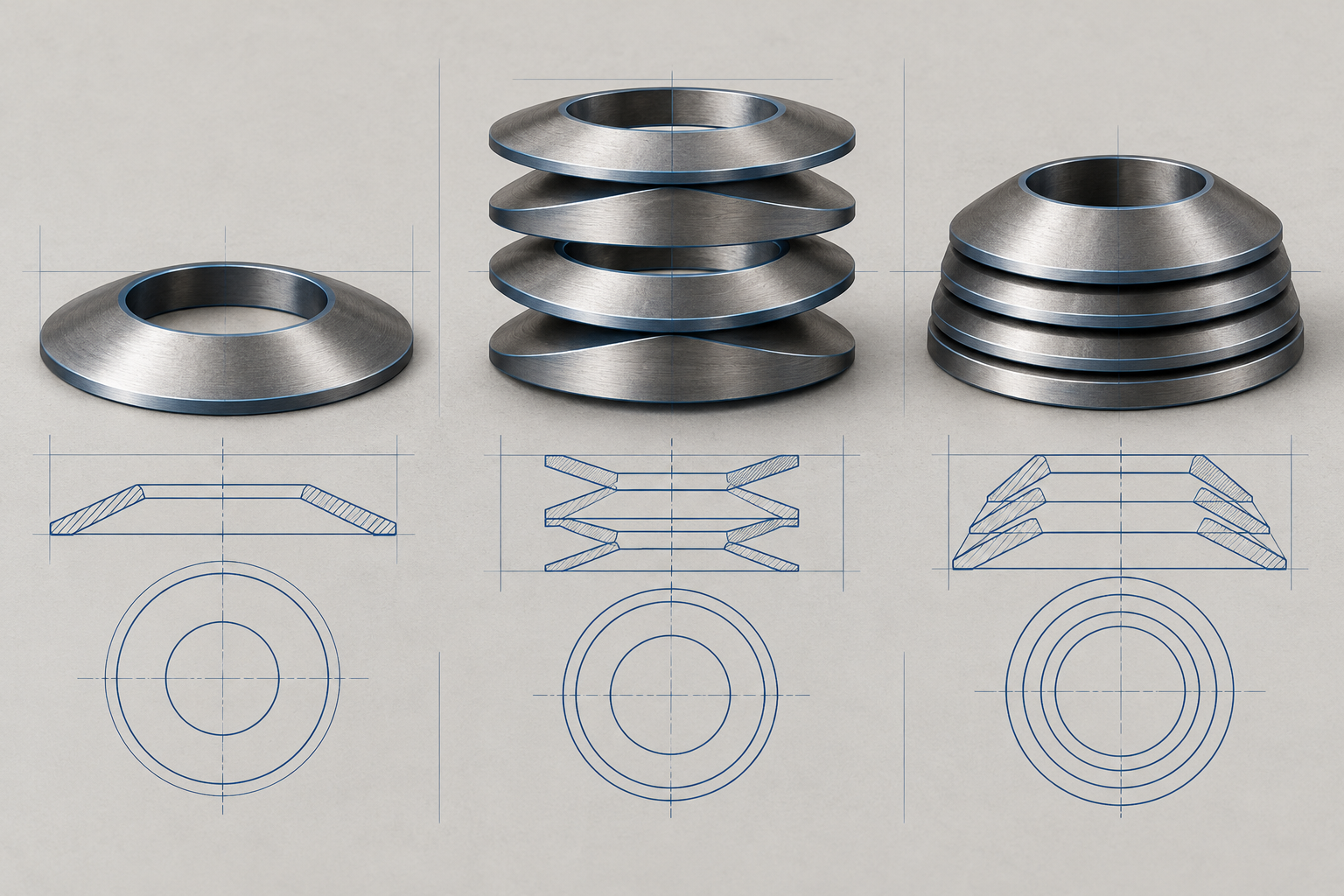
A Belleville spring washer is the common name for a conical disc spring washer family. The phrase also appears as Belleville washer, disc spring washer, conical disc spring washer, and Belleville disc spring washer. These names identify the product family, but they do not complete a purchasing specification.
Before selecting a part, define the working load, travel, free height, diameter limits, stack arrangement, material or finish requirement, and inspection record. Eugene’s DIN 2093 Belleville disc spring family is a useful starting route for that review; the final fit and performance still depend on the selected size and application.
The product name refers to a conical disc spring washer family. It does not by itself identify the diameter, thickness, free height, material condition, or load-travel curve, so those details still belong in the drawing or RFQ.
That distinction matters when a replacement is being sourced. A washer that fits the same bolt or housing should not be treated as interchangeable until its cone height, section, and working position have been checked. Treat the existing drawing, sample, and working condition as the specification source instead of selecting by outside appearance.
Describe what the spring must do before discussing a catalog description. Record the target preload, working load, available travel, operating height, cycle or movement expectation, and whether the washer works alone or in a stack. If the assembly uses multiple washers, state the direction and intended series or parallel arrangement.
| Selection input | What to provide | Why it matters |
|---|---|---|
| Load and travel | Target force, working height, travel, and tolerance | Defines the required spring response |
| Stack | Number of washers and series or parallel direction | Defines the arrangement that must be checked against the design requirement |
| Geometry | Outside diameter, inside diameter, thickness, free height, and fit | Controls the envelope and seating condition |
| Verification | Dimensions, material record, visual finish, and any load-travel check | Defines how the order will be accepted |
For a new design, record the available radial and axial envelope before requesting sizes. For a replacement, measure the installed washer and the surfaces that locate it. Outside diameter and inside diameter are only part of the check: thickness, free height, seating diameter, guide condition, and neighboring hardware should all be included in the fit review.
The phrase Belleville washer sizes is useful for finding a catalog family, but a generic size list is not a release drawing. Confirm the applicable standard or series, nominal dimensions, tolerances, and revision. If a drawing calls for DIN 2093, include the relevant dimensional and performance requirements instead of assuming every conical washer is interchangeable.
For a replacement, capture the original part’s installed direction and seating surfaces before removing it. Note whether the spring is guided by a bolt, mandrel, bore, or shoulder, and record any spacer or flat washer that shares the load path. This information helps distinguish a dimensional fit from a functional fit. A new washer should be checked against the complete joint, not against one diameter taken in isolation.
Environment should be described alongside the spring function. Note moisture, salt, cleaning chemicals, temperature cycling, contact with dissimilar metals, storage, and whether the washer is exposed or enclosed. These conditions help define the material and finish discussion, but they do not replace the load-travel and geometry specification.
Do not use “corrosion resistant” as a complete material requirement. The supplier needs the approved material designation or range, condition, finish, and any required material documentation. A material label alone does not replace the geometry, heat-treatment, surface-condition, or stack information needed for a controlled review.
For a DIN 2093 request, start with Eugene’s DIN 2093 Belleville disc spring product family, then compare the intended arrangement with the existing Belleville washer stack guidance. The quotation review should confirm the actual dimensions, material, finish, quantity, inspection, packing, and delivery requirements. Include the complete technical brief in your quotation request so the supplier can review the configuration against the stated inputs.
A product-family page cannot establish a universal load, spring rate, fatigue life, corrosion life, temperature limit, or mass by size. Those values require the selected configuration and an agreed verification method. If the application is safety-critical, exposed to unusual chemicals, or subject to high cycling, include those conditions in the RFQ before release.
A Belleville spring washer is therefore selected as a complete spring system, not as a generic conical washer. Define the working condition first, match the geometry and stack, then confirm material, finish, inspection, quantity, and destination market with the supplier. This is a direct way to turn a broad search into an RFQ that can be reviewed against a real configuration.
Provide the standard or drawing, dimensions, working load and travel, stack arrangement, material or finish, quantity, inspection needs, and destination market. A product name alone is not a complete release specification.
No. Diameter is only one part of the fit review. Confirm thickness, free height, working position, stack direction, neighboring hardware, and the required inspection basis before accepting a replacement.