Is titanium a magnetic material? In an ordinary magnet test, the practical answer is no: a hand magnet usually will not stick to titanium as it does to carbon steel. More precisely, titanium is weakly paramagnetic. It has a very small attraction to an applied magnetic field, rather than the strong ferromagnetic response associated with common carbon steels.
A magnet check can help screen an unidentified metal part, but it cannot confirm a titanium grade. Several other materials also show little obvious attraction. For a replacement pin, ring, bracket or other component, keep the magnetic observation separate from the material specification and the evidence needed to accept the part.
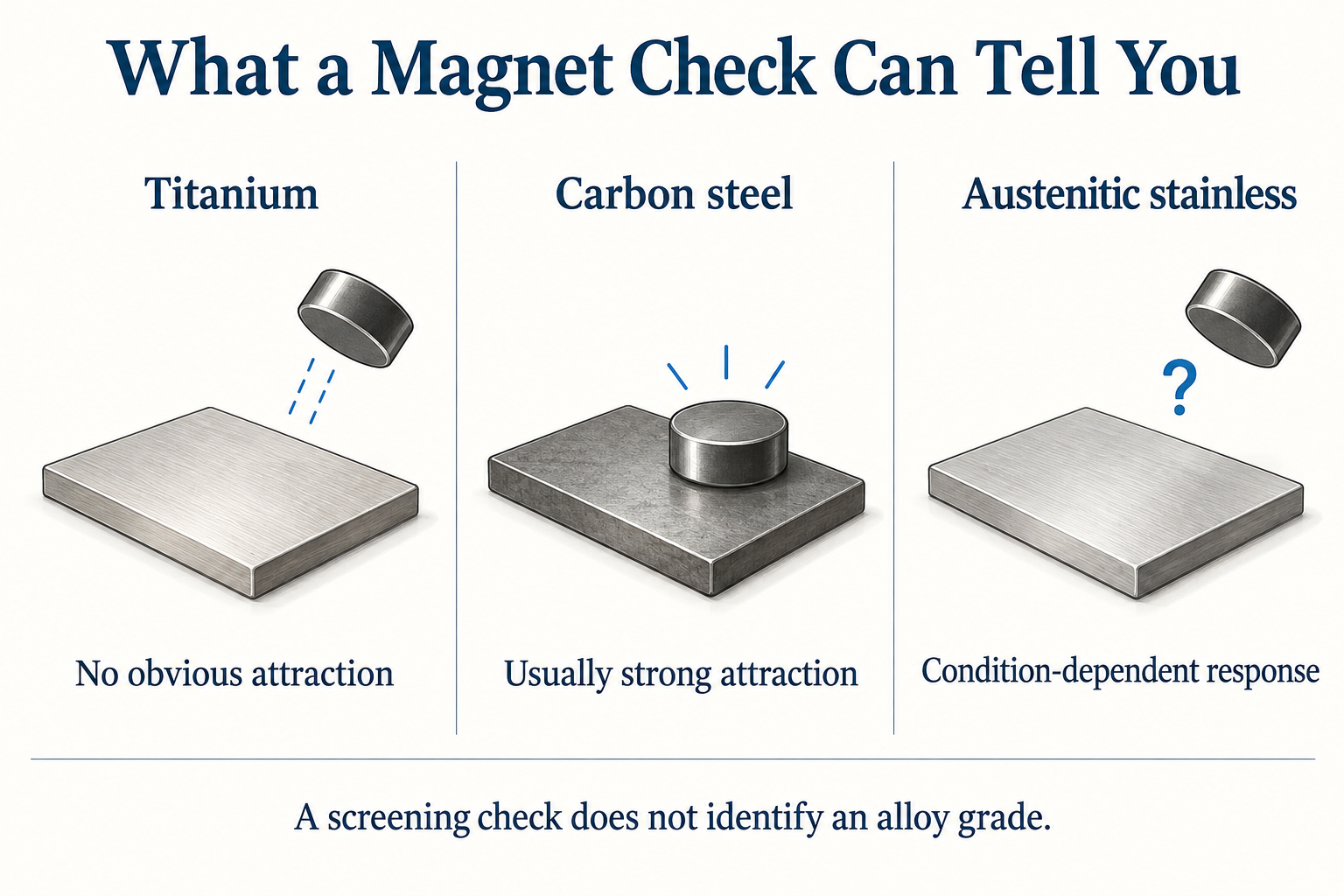
Titanium belongs to the paramagnetic group. It responds weakly to an applied magnetic field, while ferromagnetic materials such as common carbon steels respond much more strongly. The difference explains why a familiar workshop magnet may cling to a steel sample but show no obvious attraction to titanium.
“Non-magnetic” is therefore useful shorthand for everyday handling. It is less useful as a complete requirement for a sensitive application. If magnetic behavior matters to the design, specify the relevant material condition and verification requirement rather than relying on whether a magnet sticks.
| Material | Typical hand-magnet observation | What still needs checking |
|---|---|---|
| Titanium | No obvious sticking under an ordinary check | Alloy identity, condition and the required magnetic behavior |
| Carbon steel | Usually strong attraction | Exact steel grade, treatment and component requirements |
| Austenitic stainless steel | Can show little attraction; processing may change the response | Grade, manufacturing condition and local variations |
A silver-gray surface does not settle the question. Neither does a single “sticks” or “does not stick” observation. The table is a qualitative comparison, not an identification chart for every alloy.
Start by identifying what is being tested. A loose, single-material sample is easier to interpret than an assembly containing screws, inserts, coatings or neighboring steel parts. A response from the assembly may not come from the surface that appears to be titanium.
Record the observation in plain terms: where attraction occurred, whether it was obvious or slight, and whether it changed across the part. Avoid turning that description into a grade name. “No obvious attraction at the tested surface” is an observation; “confirmed titanium” is a different conclusion.
| Observation | Useful next check |
|---|---|
| No obvious attraction | Compare the part marking and material documentation with the drawing. |
| Strong attraction across an allegedly titanium part | Check the identification and whether the item includes another material before accepting it. |
| Attraction only near a screw, insert or joint | Establish which component is responding; do not assign the result to the entire assembly. |
| Material records and the observation disagree | Resolve the discrepancy through the agreed material-verification method. |
The item may include a different metal, or the material identification may be wrong. Stainless steel also needs careful interpretation: austenitic grades are different from ferritic and martensitic grades, and manufacturing can alter the response of some austenitic material. A magnet is not a reliable shortcut for distinguishing every stainless grade from titanium.
These possibilities are reasons to investigate the part’s construction and records. They do not justify assuming that an unexplained response proves one particular alloy, defect or substitution.
A useful material callout connects the grade or specification, supply condition, required documentation and any application-specific magnetic requirement. A component drawing adds geometry, fit, finish and function. Knowing that a metal does not visibly attract a magnet does not answer those other questions.
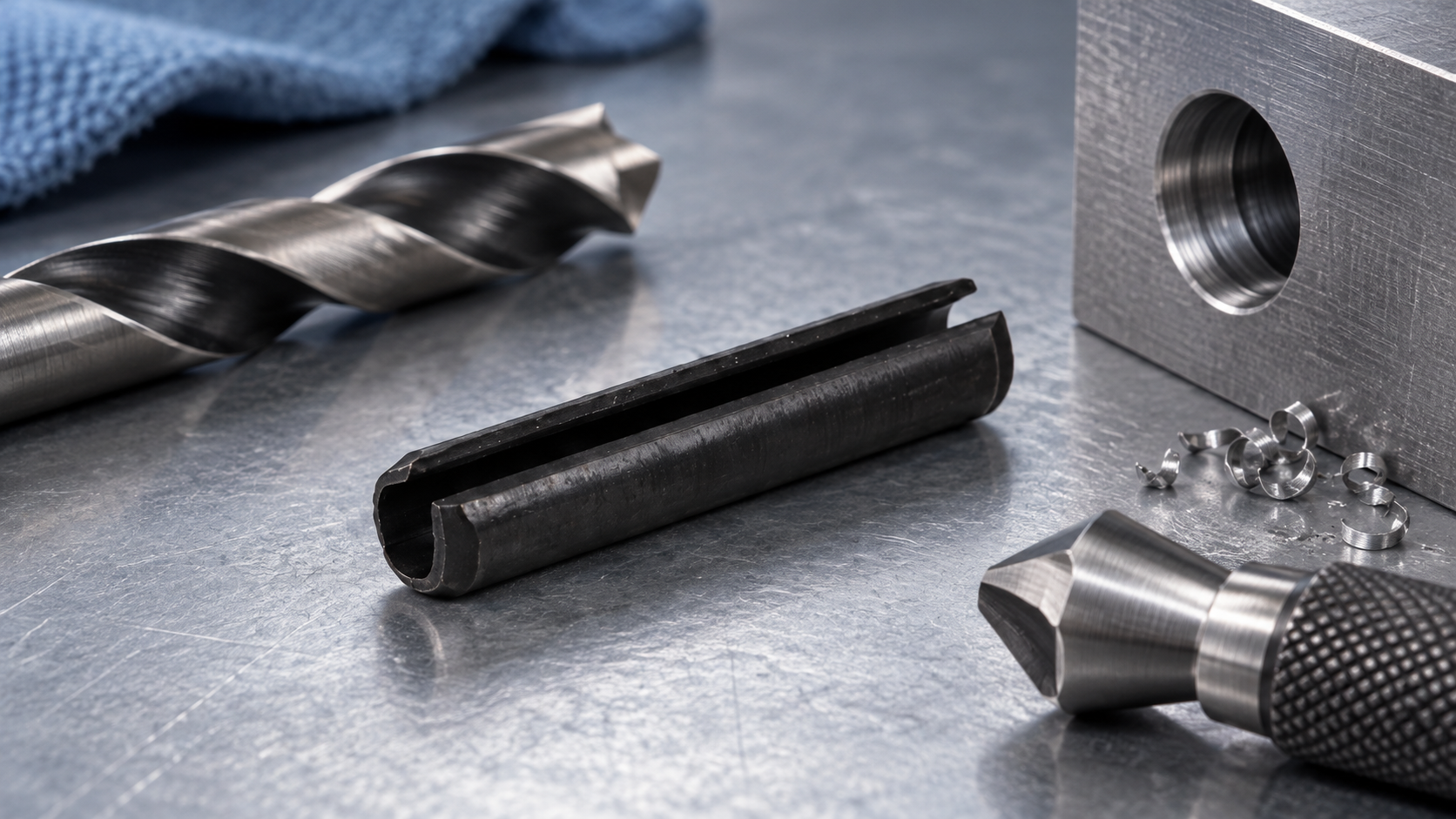
For example, Eugene’s ISO 8752 slotted spring pin is listed in a 65Mn spring-steel, black-oxide product family. That is a different material and component decision from identifying titanium. Start with the material and part actually specified, then verify the evidence required for that application.
For a stainless replacement, the stainless steel spring-pin guide separates material selection from hole fit and joint loading. A magnet observation belongs to the material review; it does not define the installation fit.
SDM Magnetics — titanium and paramagnetism
Atlas Steels — magnetic response of stainless steels
Beiyu Titanium — magnetic properties and grade-verification limits