Brass nuts favor electrical conductivity, easy machining and a generally non-ferromagnetic material. Common carbon- and alloy-steel nuts usually offer greater strength and hardness than common brass alternatives, making steel a frequent choice for mechanically loaded joints. Corrosion resistance depends on the brass alloy or the steel grade and finish; neither material is the best choice for every environment.
For a comparison of brass nuts and steel nuts, material properties must be tied to the actual alloy, grade and finish. A plain carbon-steel nut, a coated steel nut and a stainless-steel nut should not be treated as one option simply because they all contain steel.
| Decision factor | Brass nut | Steel nut | What to specify |
|---|---|---|---|
| Material identity | A copper-zinc alloy family with different compositions and conditions | A broad family covering different grades and conditions | Exact alloy or grade and applicable product requirement |
| Strength and hardness | Common grades are softer and have lower strength than many steel fastener options | Carbon/alloy-steel grades offer a broad strength and hardness range | Actual nut grade, proof-load requirement where applicable, and mating fastener |
| Electrical and thermal conductivity | Often advantageous when the component must conduct electricity or heat | Often chosen primarily for mechanical performance; check the specified grade | Required conductive function, contact surface and finish |
| Corrosion | No iron rust, but corrosion and dezincification remain possible | Behavior depends on the steel type, finish and environment | Exposure, coating and the metals in contact |
| Magnetic response | Generally non-ferromagnetic | Varies by steel family and condition | Actual magnetic requirement if relevant |
| Machinability | Free-cutting grades suit machined threaded components | Depends on grade and condition; steel nuts can also use forming routes | Material grade, manufacturing route and thread requirements |
This is a selection framework, not a table of allowable loads. The next step is to turn the dominant requirement into a material and fastener callout that can be checked.
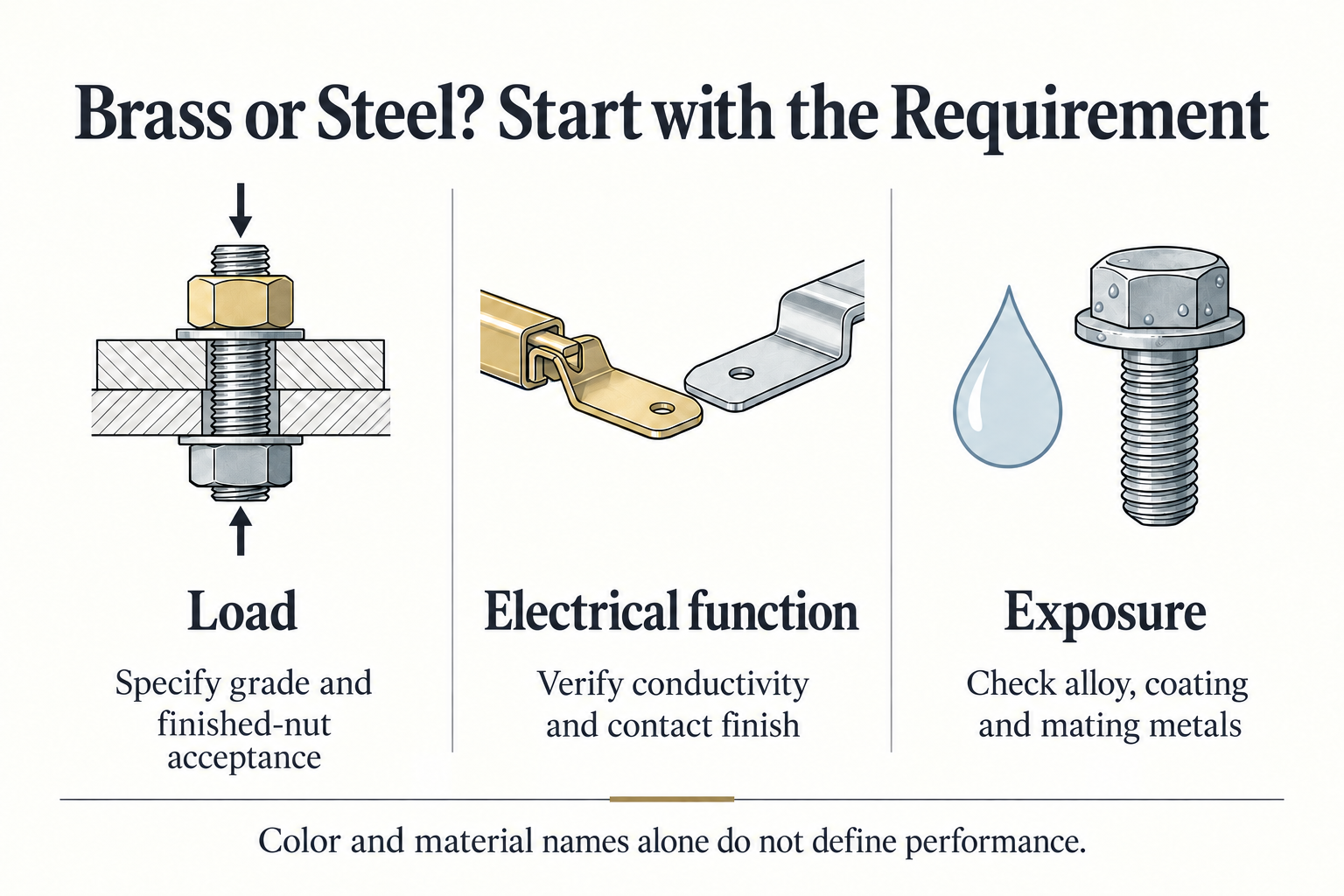
Strength is the main reason to start with steel for many loaded joints. Hardness also matters when the nut must resist local deformation during assembly. A softer brass alternative can be appropriate for its electrical or environmental properties, but it should not inherit a steel nut’s mechanical rating merely because its thread fits.
A raw-material strength value does not establish a nut’s load capacity. The finished component and its mating fastener must meet the requirements selected for the joint. When comparing quotations, check that both suppliers are answering the same grade, thread, product and acceptance requirements.
For example, ISO 898-2:2022 covers specified property classes and proof loads for steel nuts within its scope. It does not qualify brass nuts, and its mechanical requirements do not establish corrosion resistance or torque/clamp-force behavior. Choose the applicable finished-nut requirement rather than copying a raw-material or bolt value.
If a proposed brass substitution is based only on matching thread size, the material review is incomplete. Confirm the required mechanical performance and compatible hardware before deciding whether the substitution is acceptable. A visually identical nut can still represent a different engineering choice.
Brass combines a conductive copper-alloy base with practical machinability. That makes it useful for threaded connection components, whereas a steel nut may be selected mainly to maintain mechanical clamping. Establish whether the nut is intended to carry current, retain a separate conductive connection, or do both. Those are different design tasks.
Brass is widely used for conductive fastener and connector components. That makes it a relevant candidate when the nut has an electrical role as well as a mechanical one. The exact alloy and the surface at the connection still matter; a general conductivity description does not establish a current rating.
State what the connection must do and which surfaces make contact. Include the intended coating or plating in that review. Comparing only the bulk material misses an important part of an electrical connection’s specification.
Thermal conductivity can also matter when heat must move through the component, but it is a separate requirement from electrical conductivity. Do not use a general statement that brass conducts well to assign an operating temperature or current limit. Use the selected alloy’s data and the assembled connection’s requirements.
Brass does not form iron rust, but it can still corrode. In susceptible brass and exposure conditions, dezincification removes zinc and leaves a copper-rich structure. Severe attack can weaken the material.
For steel, distinguish bare carbon steel, coated steel and the selected stainless grade. For either material, describe moisture, salts, cleaning chemicals and the metals in contact with the nut. An indoor dry assembly and an exposed mixed-metal connection are different selection problems.
Surface color is a poor basis for approving a replacement. Record the specified material and finish, then compare the proposed alternative with that combination. A brass-colored surface does not, on its own, identify the underlying material; nor does a silver surface establish a particular stainless grade.
For related steel components, the phosphate-coating guide for retaining rings illustrates why finish and post-treatment need their own specification. That component-specific discussion is not a coating qualification for every threaded nut.
Free-cutting brass is useful when a threaded component is machined from stock. Machinability concerns producing the part: forming the thread, controlling the cut and obtaining the required geometry. It does not mean that the finished thread can tolerate the same assembly load as a steel nut.
C360 brass is a copper-zinc-lead alloy associated with good machinability. C464, often called naval brass, contains copper, zinc and tin and is used where its corrosion characteristics are relevant. These are examples of different brass families, not interchangeable specifications for every brass nut. Specify the actual alloy before transferring properties from a material guide.
Steel also needs a grade and condition. A low-carbon material suitable for forming is a different manufacturing choice from a steel selected for a higher-strength fastener requirement. When comparing offers, distinguish a material-stock specification from the property requirements of the finished nut.
Consider a bracket joint whose drawing already calls for a specified steel nut. A brass nut with the same thread may assemble physically, but it changes the material and may change the joint’s mechanical performance. Keep the specified steel grade unless the replacement is assessed against the actual load and acceptance requirements. The matching thread is only a dimensional starting point.
For a threaded connection with an electrical role, brass is a relevant candidate because of its conductive material properties. Identify the current path and contact surfaces before choosing a finish. A nut that merely holds a conductive terminal in place has a different role from a component that is itself part of the intended current path. Check the mechanical requirement alongside that electrical function.
For an outdoor assembly, compare the complete proposed combination: brass alloy and mating metals, or steel grade and protective finish. Identify water, salts and cleaning exposure. Brass’s resistance to iron rust does not eliminate dezincification risk in susceptible conditions, and a coated steel option depends on the specified coating system. Judge the combination against the exposure rather than selecting by color.
The same assembly may also use pins, washers or shaft-retaining rings. Specify those components by their own function. Eugene’s DIN 471 external circlip family, for example, addresses retention in a shaft groove; it is not a substitute for a threaded nut.
For a supplier comparison, put the exact material or grade, finish, thread and product requirements, quantity and acceptance documents on one request. That makes the offers comparable without assuming that a generic brass or steel label defines the finished part.
Voehrs — brass-nut material information
Falcon CNC Swiss — brass fasteners, conductivity and contact finishes
AMPP — dealloying and dezincification of brass
Huyett — steel and brass fastener material properties and alloy examples