A metal dowel pin is selected by the complete joint requirement, not by the word “steel” alone. Material family, environment, fit, host material, surface condition and inspection evidence all affect whether a pin is suitable for a locating job. The safest sourcing request states these inputs together.
Steel dowel pins, alloy steel dowel pins and stainless options can look similar in a catalog image while serving different design boundaries. The article below gives a screening method without turning one listed material or product label into a universal grade, hardness or corrosion claim.
Metal locating pins should therefore be compared by their complete application record, not by appearance or a broad material name.
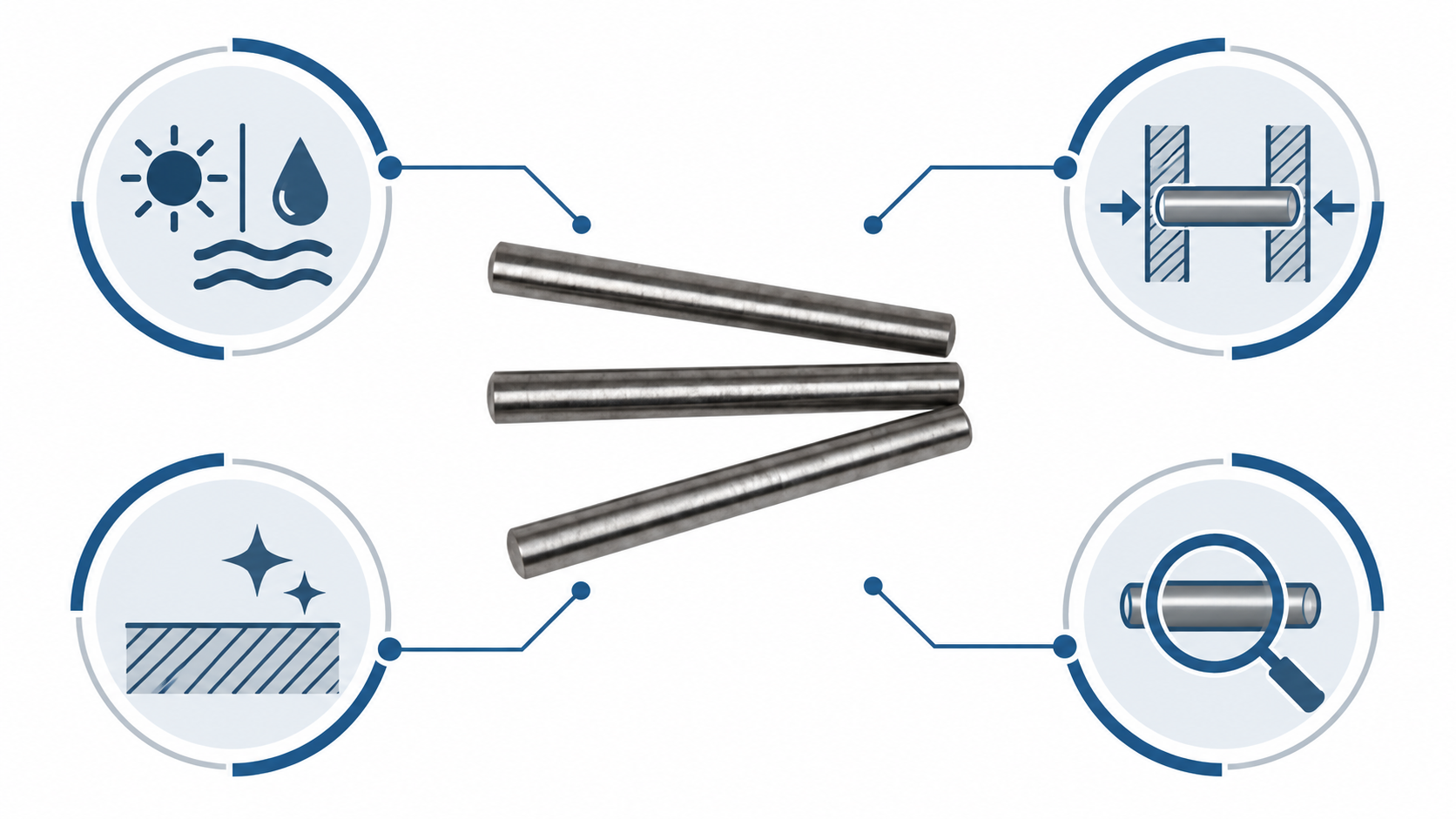
The pin material contributes to strength, hardness, wear behavior, machinability and corrosion response. It also interacts with the host material, lubrication, temperature, cleaning process and service cycle. A material name without a condition, finish and inspection basis is an incomplete specification.
For a locating pin, dimensional stability and fit may matter more than a headline strength value. For a corrosive environment, surface condition and the compatibility of the pin and host may matter more than a nominal alloy family. The design authority should define the governing requirement before the buyer compares quotes.
| Selection question | What to compare | Evidence to request |
|---|---|---|
| What load and wear exist? | Material condition, hardness range and contact duty | Approved specification, certificate or controlled test basis |
| What environment exists? | Moisture, chemicals, temperature and cleaning exposure | Finish requirement and compatibility review |
| What fit is required? | Pin geometry, hole limits and host material | Drawing revision and inspection method |
| What must be traceable? | Heat, lot, process and nonconformance handling | Lot records and inspection report format |
| What happens at service? | Removal, replacement and repeatability | Assembly instruction and replacement boundary |
Do not assume that “alloy steel” means the same composition or condition from one supplier to another. Likewise, “stainless” does not remove the need to review fit, galling risk, surface condition or host compatibility. Ask for the exact specification that controls the supplied part.
Moisture, washdown, chemical exposure and temperature can change the practical material decision. Start with the environment and the required service condition, then check whether the selected surface and host material remain compatible. If corrosion protection is needed, define whether it is achieved by material selection, a finish, an operating control or a combination.
Do not use a broad corrosion label as a substitute for a service boundary. A part that is acceptable in a dry assembly may need a different review in a wet or chemically exposed assembly. Record the exposure and cleaning process in the RFQ so the supplier is evaluating the same duty.
Steel dowel pins are commonly used as rigid locating elements, but the useful selection question is how the pin and hole behave together. A pin can be strong enough while the host hole deforms, or it can be dimensionally correct while the assembly lacks enough wall or edge distance. Review the pin and the receiving member as one interface.
For a cylindrical locating-pin request, state the diameter and length from the drawing, the fit at each member, the surface requirement, the material condition and the inspection method. Avoid asking for a “hard metal locating pin” without those controls. That wording creates room for unapproved substitutions.
Surface finish can influence insertion, friction, wear and corrosion behavior. Hardness can influence wear and indentation, but a hardness number is meaningful only when the test method, location and material condition are defined. Tolerance must be read with the mating-hole requirement; it is not a free-standing quality score.
A buyer should also separate product identity from inspection evidence. A supplier page can show a product family, while the order record should control the actual revision, lot, material and inspection requirement. If the project needs a certificate or report, state that before quotation.
Material condition also affects how a pin behaves during installation and service. A drawing should distinguish the required condition from a casual material description, and it should identify any test or certificate that must accompany the lot. This prevents a visually similar substitute from being accepted without a technical review.
When a project changes from a prototype to repeat production, revisit the material decision with the real hole process and inspection capability. A material that worked in a hand-built sample may still need tighter process controls, different surface protection or a documented incoming inspection step in production.
For a repeat order, connect the material decision to the lot records that will actually travel with the parts. The purchase file should identify the approved material condition, finish, inspection method and any certificate requirement. Incoming inspection can then compare the delivered lot with the same basis used during quotation. This is especially useful when several suppliers use similar catalog language, because it keeps a low-cost substitution from changing the locating behavior or corrosion boundary without a documented review.
TG Eugene’s DIN 1 cylindrical dowel pin page is a product-family route for a technical review. The page should be read together with the application drawing and order requirements. Do not infer that one listed configuration proves every diameter, tolerance, heat treatment or service result.
Related stainless-steel or taper-pin choices should be evaluated as separate product and fit decisions. If the drawing is incomplete, the Service process can be used to structure the missing material, fit and inspection questions before the quotation is finalized.
No. Diameter, length, fit, end form, material condition and hole requirements can differ even when the pins look similar. Use the controlled drawing and approved specification.
Not automatically. Corrosion exposure, wear, fit, galling, host material and the required inspection basis all matter. Choose the material that fits the actual duty.
Confirm geometry, material, condition, finish, fit, inspection, traceability, quantity and revision. A clear RFQ is more useful than a material name without application limits.