A spiral retaining ring and a conventional circlip can perform the same basic job: both create a removable shoulder in a groove. They do not create that shoulder in the same way. A spiral ring is coiled from flat wire into one or more turns, while a typical axial circlip is stamped as an open ring and often includes plier lugs. That difference changes installation access, radial clearance, groove contact and the drawing checks required before release.
Neither design is automatically better. Choose from the actual assembly: shaft or bore, available access, thrust direction, rotation, end play, material and finish, service method, and the catalog data for the selected ring. A family name alone cannot approve the groove.
A multi-turn spiral retaining ring wraps around the groove and presents a lug-free retaining surface. Conventional tapered-section circlips are open stamped rings; external styles expand over a shaft and internal styles contract into a bore. Their lugs give pliers a defined installation point, but those lugs also consume radial space.
| Decision | Spiral retaining ring | Conventional axial circlip |
|---|---|---|
| Construction | Coiled flat wire; may use one or multiple turns. | Stamped open ring, commonly tapered toward the free ends. |
| Groove contact | A multi-turn design can provide continuous circumferential contact. | A correctly selected tapered ring is designed to seat around its specified groove. |
| Radial envelope | No plier lugs projecting into the surrounding envelope. | Lugs and plier access must be included in the assembly space. |
| Installation route | Usually wound into the groove turn by turn. | Expanded or contracted with the specified pliers or production tooling. |
| Removal | A removal feature is engaged and the ring is unwound. | Pliers engage the lug holes and move the ring clear of the groove. |
The table describes construction, not capacity. Load capability depends on the exact ring section, material, groove, shaft or housing material, edge margin and operating condition. A smaller spiral ring does not automatically outperform a larger circlip, and the reverse is also unsafe to assume.
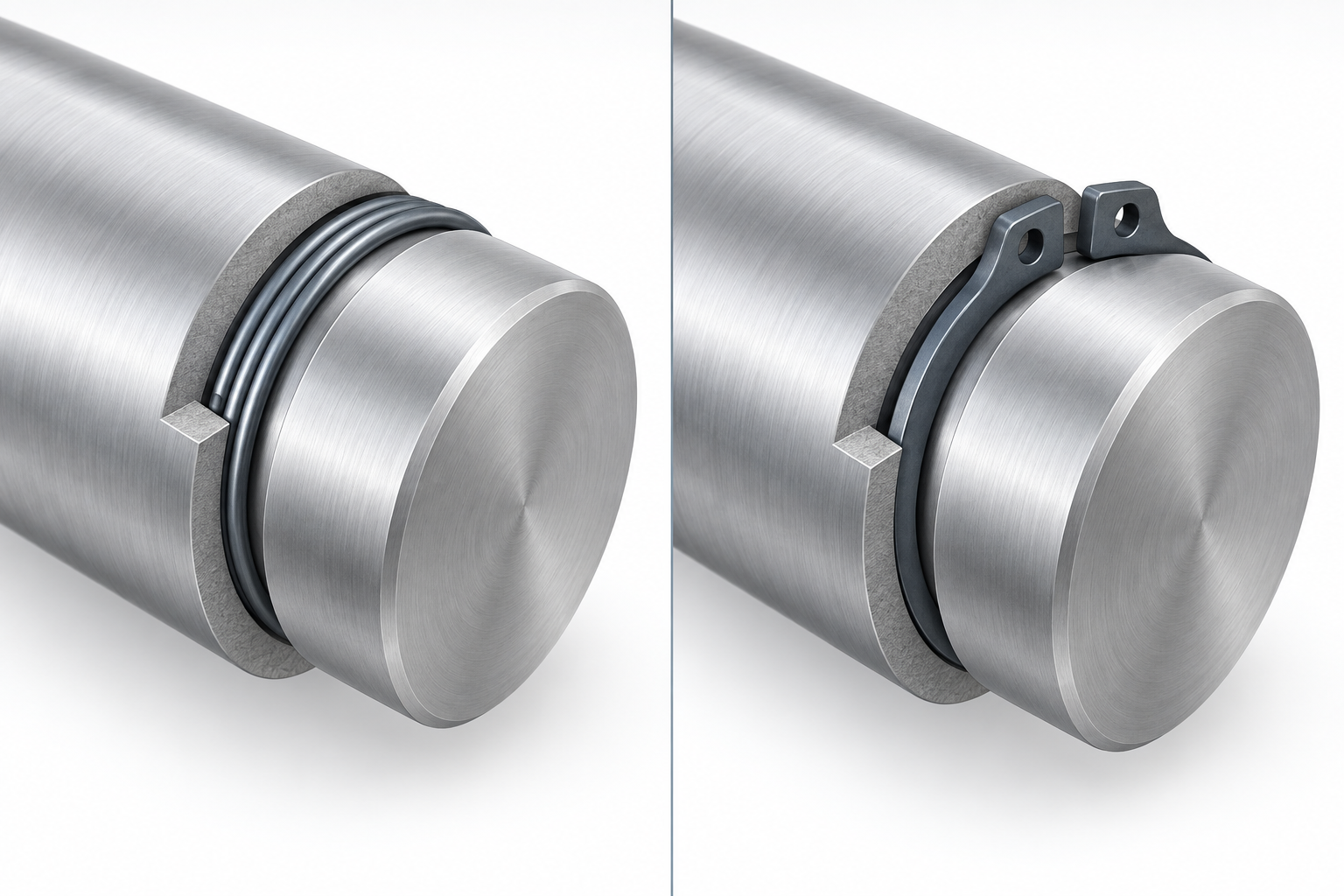
An external spiral retaining ring or external circlip sits in a shaft groove. An internal spiral retaining ring or internal circlip sits in a housing or bore groove. Mixing the two directions changes how the ring is stressed and how it is installed, so the drawing should identify the location before any catalog number is chosen.
Next, examine access. A spiral ring is useful when plier lugs would interfere with a nearby component or when a smooth, lug-free envelope is important. A circlip can be more familiar to assembly teams and gives a positive plier interface. For either style, the technician still needs room to start the ring, control it during installation and confirm full seating.
Production volume matters too. A ring that is easy to install by hand during prototyping may require a repeatable fixture or automated method in volume assembly. Review installation force, part orientation, containment and mistake-proofing before treating a manual sample as the production process.
The retained component pushes against the ring; the ring transfers that thrust into the load-bearing groove wall. The groove and the surrounding shaft or housing therefore form part of the fastening system. If the groove is too shallow, the ring may not seat deeply enough. If it is too deep, insufficient ring projection may remain to retain the component. Excessive groove corner radius can prevent full seating, while inadequate edge margin can weaken the material between the groove and the end face.
Also review whether the assembly rotates. Ring mass, free diameter, groove engagement and speed affect rotational behavior. Use the selected manufacturer’s rotational guidance rather than assuming that continuous contact alone makes every spiral ring suitable for high speed. For shock, reversing load or vibration, provide the actual duty cycle and validate the complete joint.
End play is a separate question. A flat retaining ring establishes a shoulder, but it does not automatically remove axial clearance created by the tolerance stack. If controlled preload or end-play take-up is required, the assembly may need a bowed or wave-style solution, a shim, or another spring element designed for that task.
If the design is currently based on a conventional ring, do not mark a spiral ring as interchangeable until the proposed series is checked against the existing groove and assembly envelope. Some catalog families are designed around common groove conventions, but that is a part-specific confirmation, not a blanket rule.
A circlip is often the direct route when the drawing already uses a verified DIN-style groove, plier access is available and the assembly process is established. TG Eugene’s verified DIN 471 external circlip and DIN 472 internal circlip pages show the two installation directions. They are useful product-family references; the final size still follows the controlled product data and drawing.
A spiral ring becomes a stronger candidate when lug clearance is the limiting constraint, winding installation suits the assembly, or the design needs a multi-turn, continuous-contact retaining surface. At that point, request the proposed ring drawing and recheck the groove, assembly access and duty rather than swapping only the part number.
A spiral retaining ring is coiled from flat wire and may use several turns without protruding plier lugs. A conventional axial circlip is a stamped open ring that is expanded or contracted with pliers. The construction difference affects radial clearance, installation, removal and groove contact; it does not by itself establish the final load rating.
Consider one when a lug-free envelope, winding installation or multi-turn continuous groove contact solves a real assembly constraint. Confirm the choice against thrust load, rotation, groove geometry, edge margin, material, finish and service access. Keep a conventional circlip when its verified groove and plier-based process already meet the application more simply.