The 1/8 NPT drill size is commonly listed as Q, 0.332 inch, but some matched tap-and-drill kits specify R, 0.339 inch. Choose from the instructions for the actual 1/8-27 NPT tap you will use. The two recommendations are documented alternatives; they are not a universal rule that Q requires a reamer and R does not.
The “1/8” identifies a nominal pipe-thread size. It does not tell you to drill a 0.125-inch hole. For a useful shop instruction, record the complete thread designation, tap identification and recommended preparation together.
| Documented recommendation | Drill diameter | What the source actually supports |
|---|---|---|
| Q drill | 0.332 in; approximately 8.43 mm | The technical pocket guide’s NPT/NPTF column [1], explicitly without a taper reamer |
| R drill | 0.339 in; approximately 8.61 mm | The drill supplied in the specific 1/8-27 NPT kit [2] |
The diameter difference is 0.007 inch. These are drill diameters, not finished-thread inspection limits. The metric values are rounded conversions, not permission to substitute the nearest available metric bit.
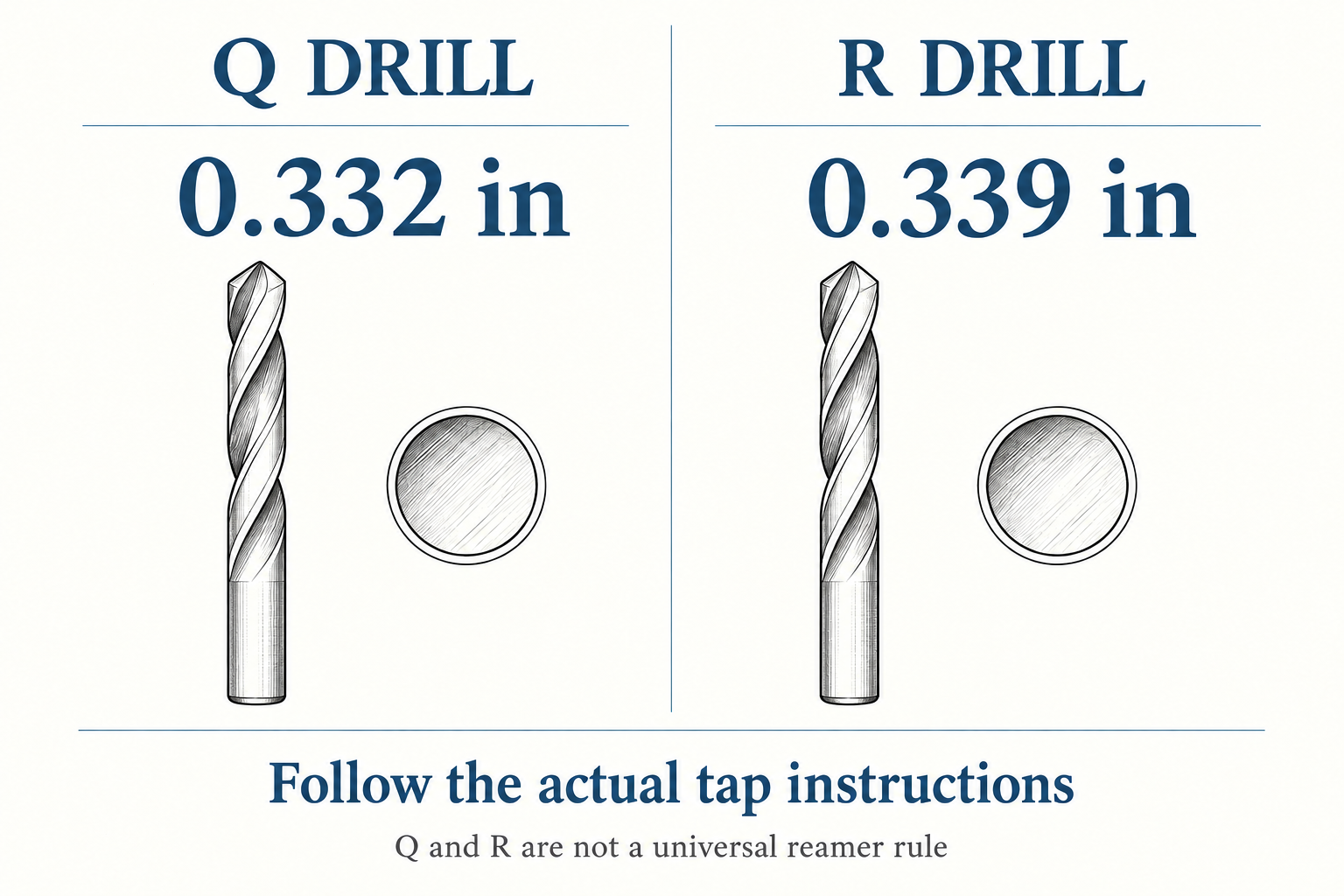
A short chart strips away much of the tooling context. A supplier’s matched kit identifies a particular drill and tap together; a general reference chart offers a starting recommendation within its stated scope. Treating either as the instruction for every tap creates a conflict that the source itself may never have claimed to resolve.
The individual NPT tap listings [3] also show Q and R recommendations for different tools. That supports checking the selected listing. It does not establish a dependable rule based only on the tap’s material or appearance.
Keep the thread family visible while comparing charts. NPT, NPTF and straight pipe-thread designations can appear in neighboring columns. A value copied from the adjacent column may look plausible while answering a different question. Likewise, a chart that places NPT and NPTF together does not by itself establish that the finished threads are interchangeable.
Reaming is a separate process decision. In particular, the pocket-guide chart [1] labels its Q recommendation “without taper reamer.” Using that chart to claim Q always requires taper reaming would reverse its meaning.
The following entries reproduce the pocket guide’s NPT/NPTF drill column [1], identified there as preparation without a taper reamer. Use them as that manufacturer’s reference baseline, then check the selected tap. For 1/4 NPT drill size, this column lists 7/16 inch; the other rows give the corresponding preparation for the stated pipe sizes.
| Nominal pipe size | Threads per inch | Listed drill |
|---|---|---|
| 1/8 | 27 | Q — 0.332 in |
| 1/4 | 18 | 7/16 in |
| 3/8 | 18 | 9/16 in |
| 1/2 | 14 | 45/64 in |
Do not infer the remaining sizes, drill depths or acceptance requirements from these four rows. The source’s thread and preparation labels belong with the dimensions whenever the table is transferred to a worksheet.
Read the drawing and tap marking before choosing a bit. Write down the complete thread designation rather than “small pipe tap.” Match the tap’s part number to its supplier instructions, including whether the listed preparation uses drilling alone or a taper-reaming step.
If the tap identification is missing, resolve it before making the hole. A generic internet chart cannot confirm what an unidentified tool needs. The same applies when a drawing calls for a different pipe-thread family.
Keep drill diameter, drilled depth and required threaded length as separate entries. A blind-hole plan also needs room for the tap’s cutting lead and chip clearance. Do not convert the desired thread length directly into a drilling-depth instruction without checking the tool geometry and part.
Use the selected tool’s guidance for entry preparation, lubrication, chip handling and cutting conditions. There is no supported single speed, feed or number of turns that this diameter comparison can supply for every material and setup.
A correct drill choice is only the preparation step. Record how the finished thread will be inspected under the drawing or purchase requirement, using the appropriate thread-inspection method and acceptance criteria. Keep that decision distinct from a connection’s sealing or pressure-test requirements.
Do not approve a pressure connection merely because a fitting can be screwed into it. This guide supplies neither a pressure rating nor a leak-test procedure.
Suppose a work instruction copied Q from a chart, but the identified tap-and-drill kit specifies R. Keep both source records, check that both refer to 1/8-27 NPT, and ask whether the work instruction was written for that particular tap and preparation route. Resolve the instruction before machining rather than averaging the two diameters.
If the kit and the approved drawing or process still conflict, obtain a clarified instruction from the responsible tooling or engineering contact. Choosing the larger drill simply because it seems easier does not resolve the acceptance question. Choosing the smaller one simply because it appears in more search results does not resolve it either.
For an already-drilled hole, record its actual measured condition and the tool used. Do not label it acceptable or scrap from the Q/R comparison alone. The next decision depends on the required finished thread and the applicable inspection, not just the starting bit’s letter.
A plain receiving hole for a roll pin is a different task; see drill size for roll pins for that fit question. An internally threaded DIN 7979D locating pin serves another purpose again: its internal thread supports extraction. That product designation does not specify an NPT port or an NPT tap-drill diameter.