Blue tempered steel usually describes a spring-steel strip condition and its blue or blue-black appearance after processing. This is useful terminology, but it is not a complete material specification. The color does not tell a buyer the exact grade, hardness, thickness tolerance or forming limit.
For a controlled order, specify the material grade and condition first. Then add the strip dimensions, tolerances, edge, flatness, surface requirement and the operation that will happen after delivery. TG Eugene’s heat-treated spring-steel strip page is a product-family route for this discussion, not a substitute for the final drawing or material certificate.
Blue-tempered strip is associated with hardened and tempered spring-steel processing and a visible blue oxide or temper appearance. Different suppliers may use slightly different commercial terms, and the final appearance can depend on the process and surface condition.
| Question | What the color may indicate | What it does not prove |
|---|---|---|
| Is it a spring-steel condition? | It can point to a processed spring-steel strip condition. | It does not identify one universal grade or standard. |
| Does it identify chemistry? | No. Color is a visual condition or finish clue. | Carbon, alloy content and certificate values. |
| Does it identify hardness? | No. Hardness must be specified and verified separately. | A guaranteed HRC, tensile range or elastic limit. |
| Can it be formed? | The answer depends on the delivered condition and geometry. | A universal bend radius or successful post-heat-treatment forming. |
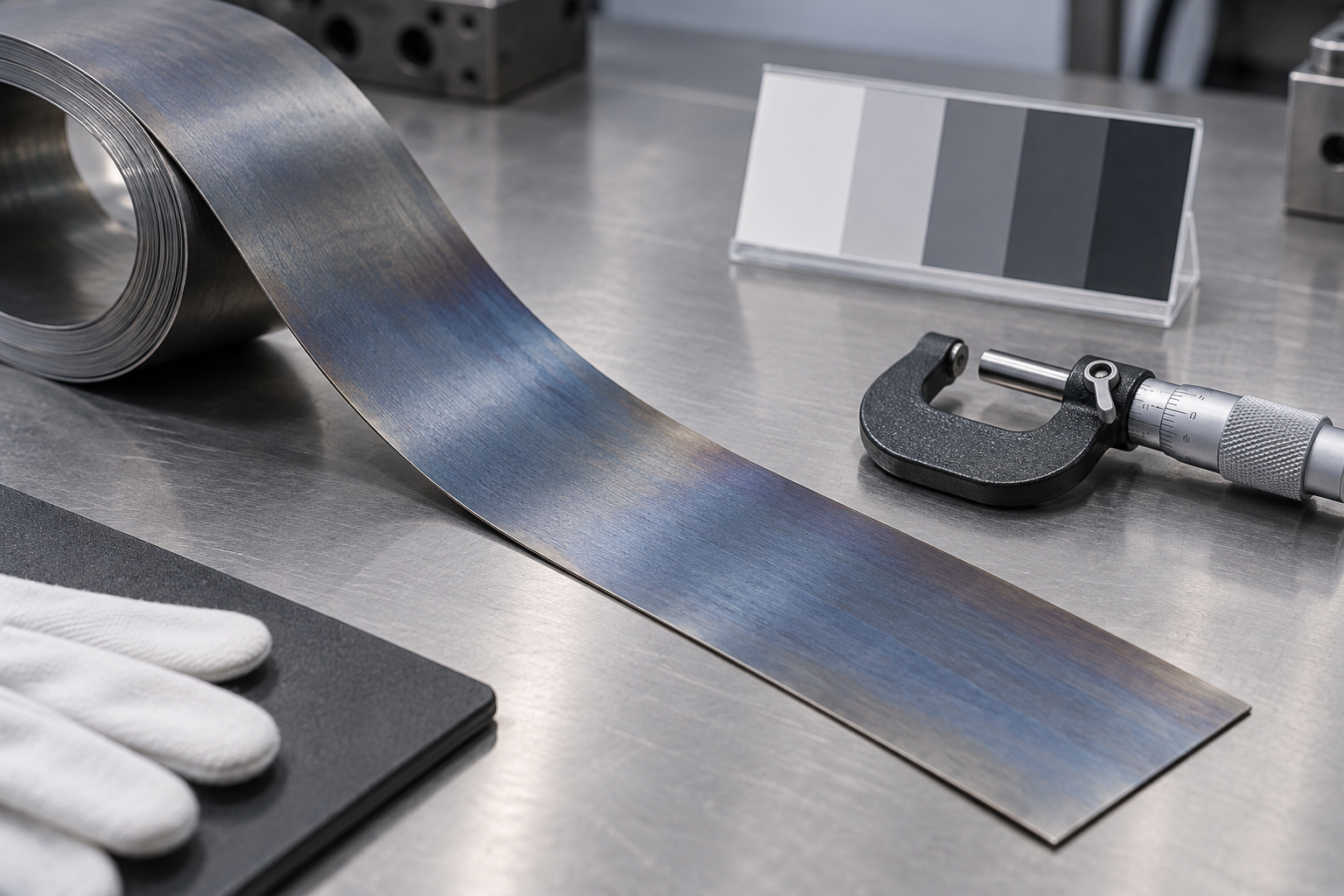
Use “blue tempered” as one part of the description, not as the only line on an RFQ. A supplier needs to know whether the strip will act as a spring, be stamped, be cut into a precision component or be formed after heat treatment. The required condition may be different for each route.
For example, a strip that must be formed into a tight shape may need a softer condition before a later heat-treatment step. A strip ordered already at spring temper may have limited plastic formability and more springback. The correct choice depends on the part geometry, tooling and required final properties.
“Blue temper steel” and “blue tempered spring steel” can appear as shorter purchasing phrases, but neither phrase removes the need for a grade and condition. Ask whether the blue appearance is an oxide finish, a temper indication or a customer-specific surface requirement. The answer affects how the supplier prepares the strip and what the receiving inspection should verify.
Use the color term to find the right product family, then move to the controlled details. If the part needs spring recovery, discuss the required condition and mechanical range. If it needs stamping or bending, discuss the forming route before the final heat treatment. If appearance matters, state whether the blue surface must remain visible after cutting or forming.
This sequence is more reliable than selecting a coil by appearance alone. It also prevents a finished strip from being ordered in a condition that the next process cannot handle. A supplier can then recommend a route, sample and inspection plan against the actual part rather than a color name.
Receiving inspection should compare the delivered strip with the order, not with a remembered shade of blue. Check the grade or certificate reference, thickness and width, edge condition, flatness or camber, surface defects and the stated delivery condition. If hardness or a mechanical range is part of the order, use the specified inspection method and acceptance range.
Keep a small sample with the lot record when the surface appearance matters. A photograph can document appearance, but it cannot replace dimensional or material verification. This separation keeps a visual condition useful without turning it into an unsupported performance claim.
Sometimes, but there is no safe universal answer. After hardening and tempering, the strip’s hardness, thickness, width, bend direction, inside radius, edge condition and tooling determine the risk of cracking, marking or excessive springback. A small bend in one grade and thickness cannot be used as proof for another.
Before production, provide the supplier with the finished profile, bend locations, required radius, grain or rolling direction if relevant, and the target final condition. A sample or tooling trial is the practical way to confirm the route when the bend is close, the strip is narrow or the condition is hard.
This separation prevents a familiar color term from carrying more meaning than it can support. It also gives the supplier a clear way to confirm whether the requested condition is available and whether the planned forming route is realistic.
No. Blue color can describe a visible temper or oxide condition, but it does not prove chemistry, grade, hardness, thickness tolerance or mill origin. Put the selected grade or standard, delivered condition and inspection requirement on the order. Treat the color as a finish or identification requirement only when that is what the project needs.
It may be possible for a particular grade, thickness, radius and tool, but the color alone cannot answer the question. Confirm the delivered hardness and geometry, then review springback and cracking risk with a sample or tooling trial. If the part needs substantial forming, compare a pre-forming heat-treatment route with buying fully tempered strip.