A retaining clip is a broad name for a component that limits axial movement on a shaft or inside a bore. The correct type depends first on where it sits, whether the assembly has a groove and how the clip reaches its final position. A snap ring, E-clip and push-on retainer may solve similar retention tasks, but they are not interchangeable parts.
| Clip family | Mounting location | Typical installation path | Groove decision |
|---|---|---|---|
| External snap ring or circlip | Outside a shaft | Axial, over the shaft end | Usually works in a defined shaft groove |
| Internal snap ring or circlip | Inside a bore | Axial, into the bore | Usually works in a defined bore groove |
| E-clip | Outside a shaft or pin | Radial, from the side | Works with the groove specified for the selected ring |
| Push-on retainer | Usually on a shaft, pin or stud | Axial press-on | Some designs are grooveless; confirm the exact retainer and shaft condition |
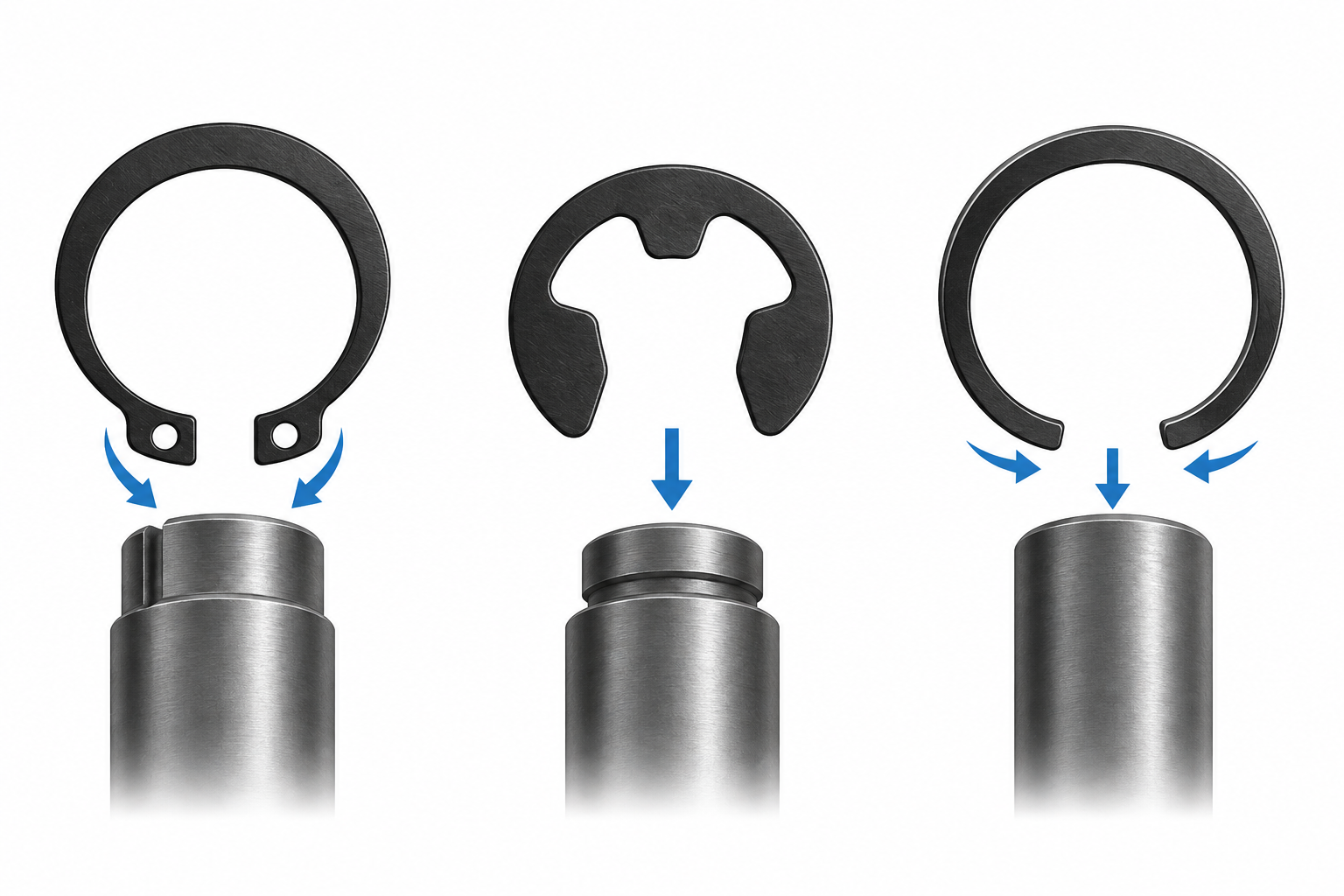
An external ring sits in a groove around a shaft and forms a shoulder for the retained component. Axially installed styles pass over the shaft end and expand only enough to reach the groove. The DIN 471 external circlip is one example of this family.
Use this route when the assembly has shaft-end access and the drawing can control the shaft groove. The ring size alone does not define the joint. The groove, retained-part geometry, axial clearance, installation tool and service load must be reviewed together.
An internal ring sits in a groove inside a housing or bore. During installation, the ring contracts so it can enter the bore, then returns into the groove. The DIN 472 internal circlip is a bore-retaining example.
Internal and external rings can look similar in a catalog image, but their geometry and installation action are different. Do not substitute one for the other based on nominal diameter. Start with the mounting location and selected standard.
A DIN 6799 E-type retaining ring enters its shaft groove from the side. This radial path can be useful when axial access over the shaft end is limited or when the assembly process is built around side installation. The DIN 6799 E-type retaining ring is a defined product route for this family.
For the basic terminology and geometry limits behind these families, see what a snap ring is before selecting the product standard.
The open profile and side-entry path do not make every E-clip equivalent. Confirm the shaft size, groove specification, ring standard, installation method and removal requirement. A tool selected for one ring size may damage another.
A push-on retainer is pressed along a shaft or stud. Some designs grip without a machined groove, which can simplify a low-cost assembly. That advantage is design-specific. Shaft material, diameter tolerance, surface condition, removal policy and the retainer’s tooth or edge geometry all affect whether the part is appropriate.
Use a push-on family only when the project can accept its service and removal behavior. If the assembly must be repeatedly removed and reinstalled, a grooved ring may offer a more controlled service path.
Search terms can hide this difference. A buyer may write “e clip” when the drawing actually needs an axial snap ring, or write “retaining clip” when the shaft has no groove. Resolve the mounting route before comparing price or material. The name is a starting point; the groove and installation path are the engineering decision.
Check access first. An external or internal ring needs the part to reach the shaft end or bore opening during installation. An E clip needs side access to the shaft groove. A push-on retainer needs a controlled press-on path and a shaft condition that the selected retainer can grip. If access, groove and removal requirements disagree, change the family before finalizing the size.
Check the retained part next. Confirm the shoulder diameter, axial clearance, chamfers and any rotation or vibration that can move the part against the retainer. These checks do not produce a universal load rating, but they prevent a nominal ring size from being treated as a complete assembly design.
Before requesting a quotation, write the answers in the same order that the assembly will be built. State whether the retained part sits on a shaft or inside a bore. Draw the groove or state that the selected retainer is a press-on design. Mark the direction from which the installer can approach. Then record the ring standard, nominal size, material, finish and quantity.
Add the service conditions that can change the decision: rotation, vibration, temperature, corrosion exposure, expected removal and whether the ring can be inspected after assembly. This worksheet does not replace a calculation or a groove drawing. It prevents a broad search term from becoming an incomplete purchase order.
Keep the selection record with the assembly revision. If the shaft diameter, bore, groove, coating or installation tool changes, review the retainer rather than carrying the old part number forward automatically. That small control helps purchasing, production and inspection work from the same fit requirement.
Ask for a sample or drawing review when the groove is close to an edge, the retained part has little shoulder width, or the assembly sees repeated impact. Those conditions can make a nominally correct diameter unsuitable in the real housing.
Installation matters because the ring can be stressed more during assembly than in normal service. Expand or contract the ring only as much as the selected installation method requires. If the assembly process forces the ring far beyond that path, review the tool and the ring family before changing material.
Not always. “Retaining clip” is often used as an umbrella term. A snap ring or circlip is one retaining-ring family, while E-clips and push-on retainers use different geometries and installation paths. Use the exact standard or drawing in a purchase order rather than relying on the broad name.
External shaft rings, internal bore rings and E-clips normally work with a groove defined for the selected ring. Some push-on or self-locking retainers can work without a machined groove. The exception is not universal: confirm the exact retainer, shaft material, diameter tolerance and service requirement.