 Wenzhou Eugene Technology Co., Ltd.
How steel dowel pins establish a stable industrial assembly
A locating pin transfers lateral shear and establishes a repeatable relationship between two parts. Fasteners provide clamping force, but their clearance holes normally do not control concentricity or edge position. In a pump cover, tooling plate, motor bracket, or sensor mount, steel dowel pins create the reference while screws maintain preload.
Start with the assembly datum. One pin can establish the primary position while a second pin prevents rotation; the drawing should avoid over-constraining the joint. If two perfectly fixed pins are placed across a wide span, thermal growth or hole-position error can make assembly impossible. A round pin and a relieved or diamond pin arrangement may be appropriate when the joint sees temperature change.
Hole quality matters as much as pin quality. Reamed holes provide a more predictable cylindrical surface than drilled holes, and the hole axis must be square to the mating face. The dowel pin sizes and fits guide is useful for the preliminary calculation, but the final fit should reflect material, temperature, service load, and the customer’s drawing conventions.
How steel dowel pins guide fit and installation choices
Fit is a functional decision, not a label to copy from a catalog. A slip-fit pin may let an operator align a removable guard by hand; a transition or press fit may keep a permanent bearing seat from shifting under cyclic load. Typical H7/m6 pairings are only a starting point—actual limits, surface finish, pin diameter, and hole measurement capability must be confirmed for the design.
For installation, clean both holes, break the entry edge with a small controlled chamfer, and remove raised material after machining or coating. Apply force along the pin axis with an arbor or suitable press fixture. Do not use a side load to “walk” a pin into position, and do not drive a hardened pin with an uncontrolled steel hammer; peening can damage the face and contaminate the joint. A light assembly lubricant can help when compatible with the process, but it must not disguise an incorrect interference allowance.
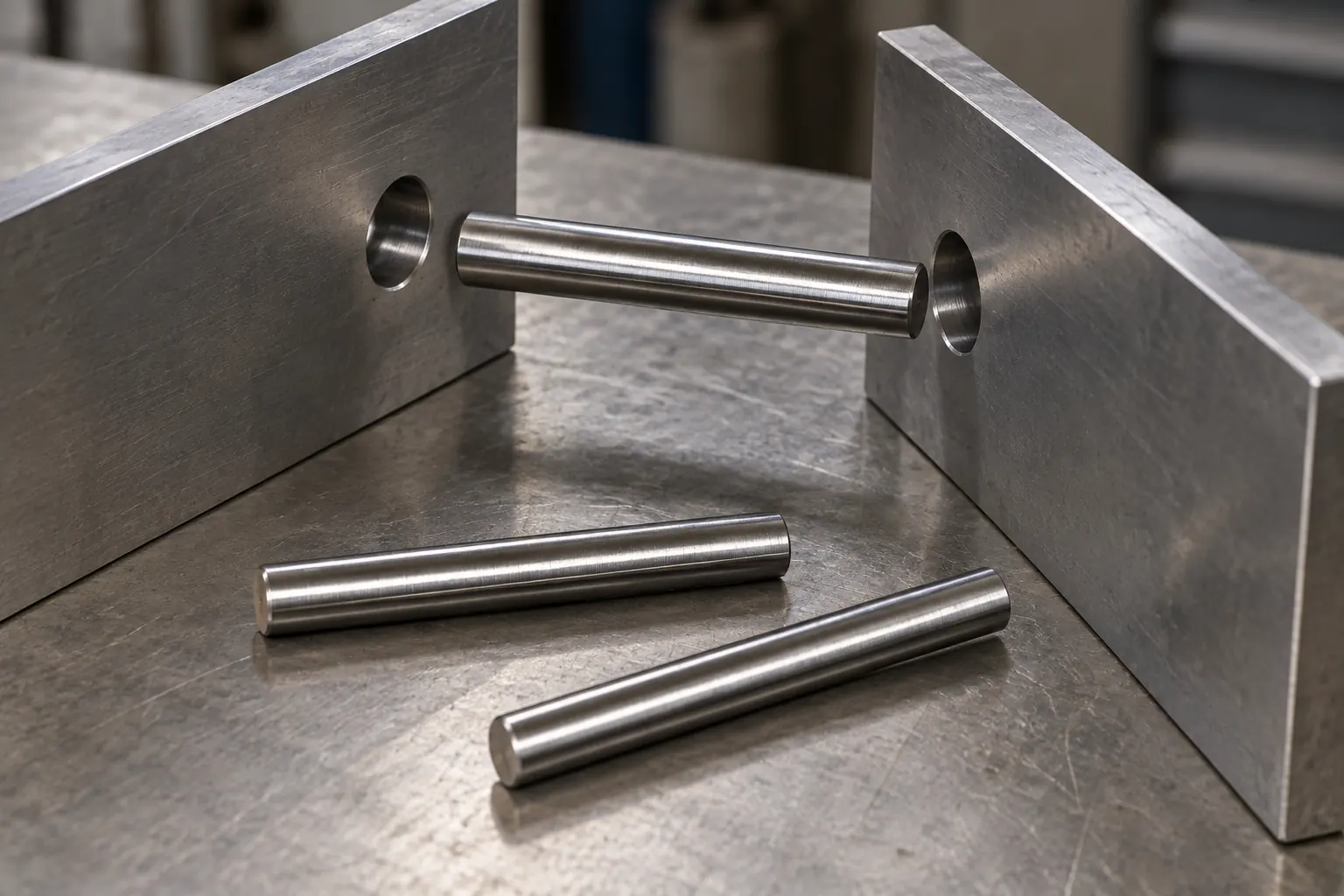
The right steel dowel pins also depend on the surrounding material. A hardened pin resists fretting and repeated service, but a soft aluminum housing may need a bushing, greater engagement length, or a design review to prevent hole expansion. In a corrosion-prone environment, specify compatible stainless or coated material and verify galvanic behavior rather than treating “stainless” as a universal solution.
| Option | Locating behavior | Installation | Durability and fit | Cost and TCO tendency |
|---|---|---|---|---|
| Unhardened cylindrical pin | Accurate location when paired with controlled holes | Slip, transition, or light press fit | Good for moderate loads; match hardness to the housing | Usually economical; hole and inspection quality drive TCO |
| Hardened and ground cylindrical pin | Stable reference for repeated assembly | Pressing requires aligned tooling and force control | High wear resistance; may mark a softer mating part | Higher unit cost can reduce replacement and downtime risk |
| Taper pin | Wedges into a matching tapered hole | Requires taper reaming and controlled seating | Useful for retention and serviceable joints | Tooling and removal labor can increase TCO |
| Spring or roll pin | Compliant location or retention, generally less precise | Can be driven into a prepared hole | Absorbs some variation; not a substitute for precision location | Low component cost; fatigue and hole wear must be assessed |
How steel dowel pins compare by material and service demand
Material selection should follow the failure mode. A steel dowel earns its value only when its material and fit match the interface. Through-hardened alloy steel is useful where the pin sees repeated contact or fretting. Low-carbon or unhardened steel can be appropriate for moderate-duty fixtures and where the mating component must remain protected. Stainless grades help with corrosion exposure, but their strength, galling behavior, and dimensional stability should be checked against the design rather than inferred from the grade name.
When purchasing steel dowel pins, ask for the material designation, nominal diameter, length, hardness condition where applicable, surface treatment, and lot traceability. If the assembly is welded, painted, plated, or exposed to washdown, define when the hole and pin are measured. A nominally correct pin can fail if coating thickness closes the hole or if post-treatment distortion changes the fit.
| Application | Recommended starting choice | Selection checks | Main risk to control |
|---|---|---|---|
| Removable machine guard | Slip-fit cylindrical pin | Hand assembly, corrosion, retention against vibration | Loose location or lost hardware |
| Gearbox or pump housing | Controlled transition or press fit | Datum scheme, gasket compression, thermal growth, service removal | Leakage or cover misalignment |
| High-cycle tooling fixture | Hardened, ground cylindrical pin | Wear, replaceable bushings, repeatability study | Progressive loss of positional accuracy |
| Outdoor or washdown equipment | Compatible stainless or protected steel | Corrosion pair, lubricant, cleaning chemistry, hardness | Seizure, pitting, or galling |
| Large temperature range | Relieved locating arrangement | Thermal expansion, pin spacing, slot or diamond feature | Assembly lock-up from over-constraint |
How a steel dowel inspection plan supports procurement
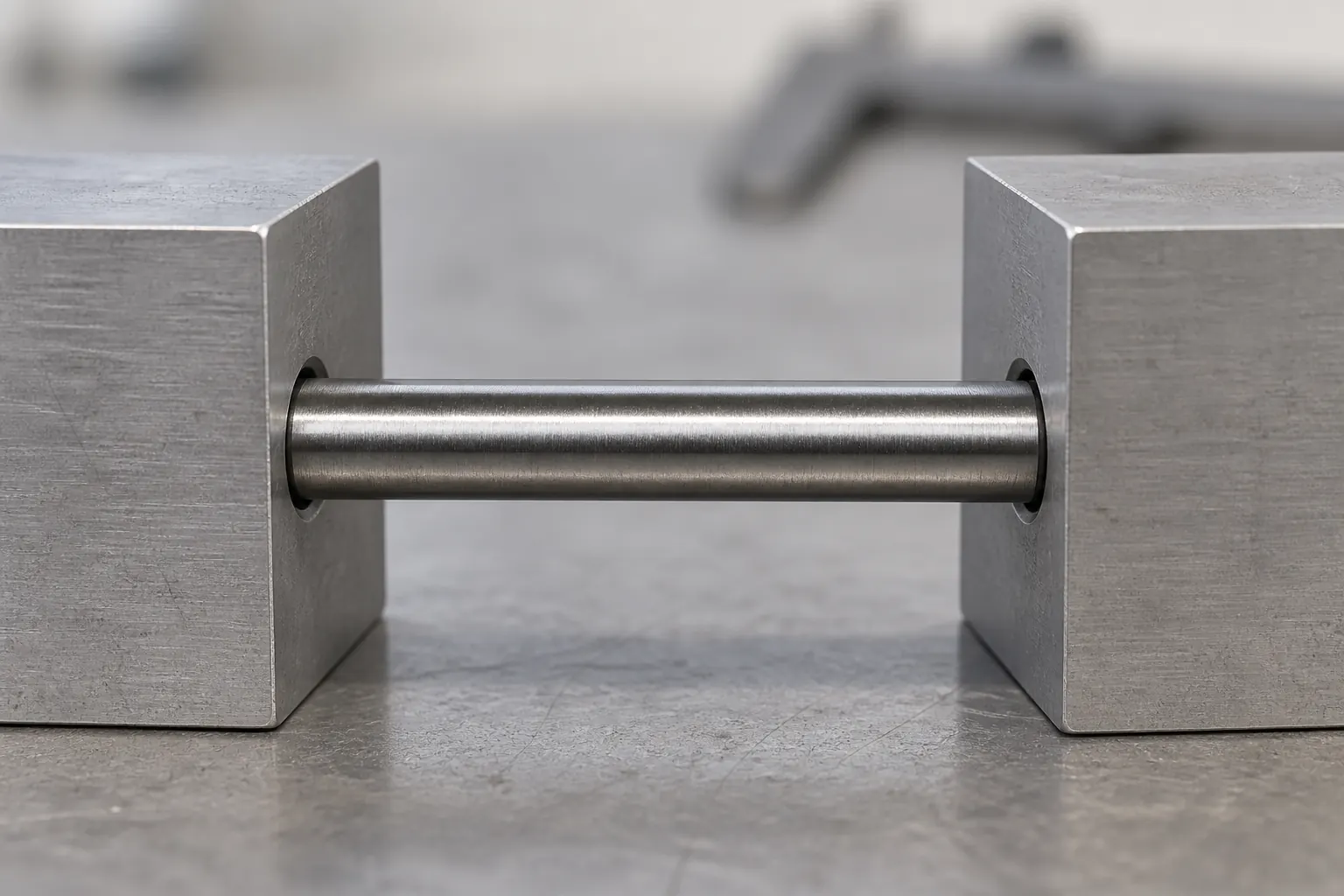
Inspection should prove the function that the joint needs. Verify diameter and length with calibrated equipment, check cylindricity and surface condition where they affect fit, and confirm the hole size at the actual assembly stage. For a press fit, record insertion force or use a defined sampling plan; for a slip fit, check assembled location and unintended play. Visual inspection alone cannot establish a locating fit.
Standards help make the purchase legible. ISO 2338 is for cylindrical pins that are generally unhardened; ISO 8734 addresses hardened and ground cylindrical pins. DIN 1 is a taper-pin standard, so it is relevant when the design intentionally uses a taper, not as a substitute for a cylindrical-pin callout. Read the standard edition and product scope, then state the applicable requirement on the drawing or purchase order. A standards reference is not, by itself, a claim that every supplied lot is certified.
For a practical review, compare the pin certificate or inspection report with the purchase order, verify sampling and gauge calibration, and retain the lot number with the assembly record. The dowel pin standards overview can help organize that request, while the pin reference provides a material-focused cross-check.
Procurement checklist for an assembly-ready pin
- Provide the datum scheme, nominal size, length, fit limits, and whether the pin is removable or permanent.
- State material, hardness, finish, corrosion exposure, and any compatibility limits from the mating parts.
- Define the inspection method, sampling level, calibration expectation, and required lot traceability.
- Confirm packaging that prevents mixed diameters, burrs, oil contamination, or damage to ground surfaces.
- Approve a first-article or trial assembly when the pin controls sealing, concentricity, safety, or expensive downstream machining.
Eugene (Wenzhou Eugene Technology Co., Ltd.) can be considered when a project needs configurable precision fasteners and a clear conversation about drawings, materials, inspection, and supply continuity. A steel dowel should still be judged by the requested specification and evidence; no supplier name removes that engineering responsibility.
Frequently Asked Questions
What is a steel dowel pin?
A locating pin is a precision cylindrical element used to align two or more components, usually alongside separate fasteners that provide clamping. Its performance comes from the pin, the hole, and the selected fit as a system. Specify the diameter limits and hole condition rather than relying only on a nominal catalog size.
Does Home Depot sell metal dowel pins?
Retail hardware stores may list metal locating pins or related hardware, but availability, diameter tolerance, hardness, and traceability vary by seller and pack. For a production assembly, confirm the drawing requirement and inspection evidence before substituting a retail item. A prototype can use an accessible part, but the production bill of materials should be approved against the functional fit.
What is the Killer dowel pin?
“Killer dowel pin” is not a general ISO product classification; it is commonly used as a brand, trade, or application phrase in particular tooling and repair contexts. Ask for the maker’s drawing, material, hardness, and dimensional definition before treating the phrase as a specification. If the pin is intended to replace a standard part, compare the actual interface requirements.
Do they make metal dowels?
Yes, manufacturers produce metal locating dowels in carbon steel, alloy steel, stainless steel, and other specified conditions. The useful choice depends on load, wear, corrosion, temperature, and the mating material—not simply on whether the dowel is metal. Request the applicable standard, finish, and inspection records for the intended service.
References
- ISO 2338, Cylindrical pins—unhardened, International Organization for Standardization.
- ISO 8734, Cylindrical pins—hardened and ground, International Organization for Standardization.
The dependable assembly is rarely created by the pin alone: it is created when the datum, fit, process, and inspection record agree. If your next design needs a documented locating solution, review the specification with Eugene and explore the precision fastening range for related retention components.