The right dowel pin manufacturer is evaluated by the evidence behind the part, not by a generic catalog label. When buyers compare dowel pin manufacturers, they should prepare the drawing, fit, material, inspection, traceability and delivery requirements that define an acceptable purchase. This turns a broad supplier search into a controlled RFQ.
A capable supplier may offer standard parts, drawing-based support or both. The buyer still needs to separate product identity from proof of conformity. Ask for the information required by the application, and avoid treating a website claim as a substitute for an order-specific specification or inspection record.
A precision dowel pin manufacturer should be able to explain how the quoted part, inspection evidence and repeat-order controls connect to the buyer’s drawing.
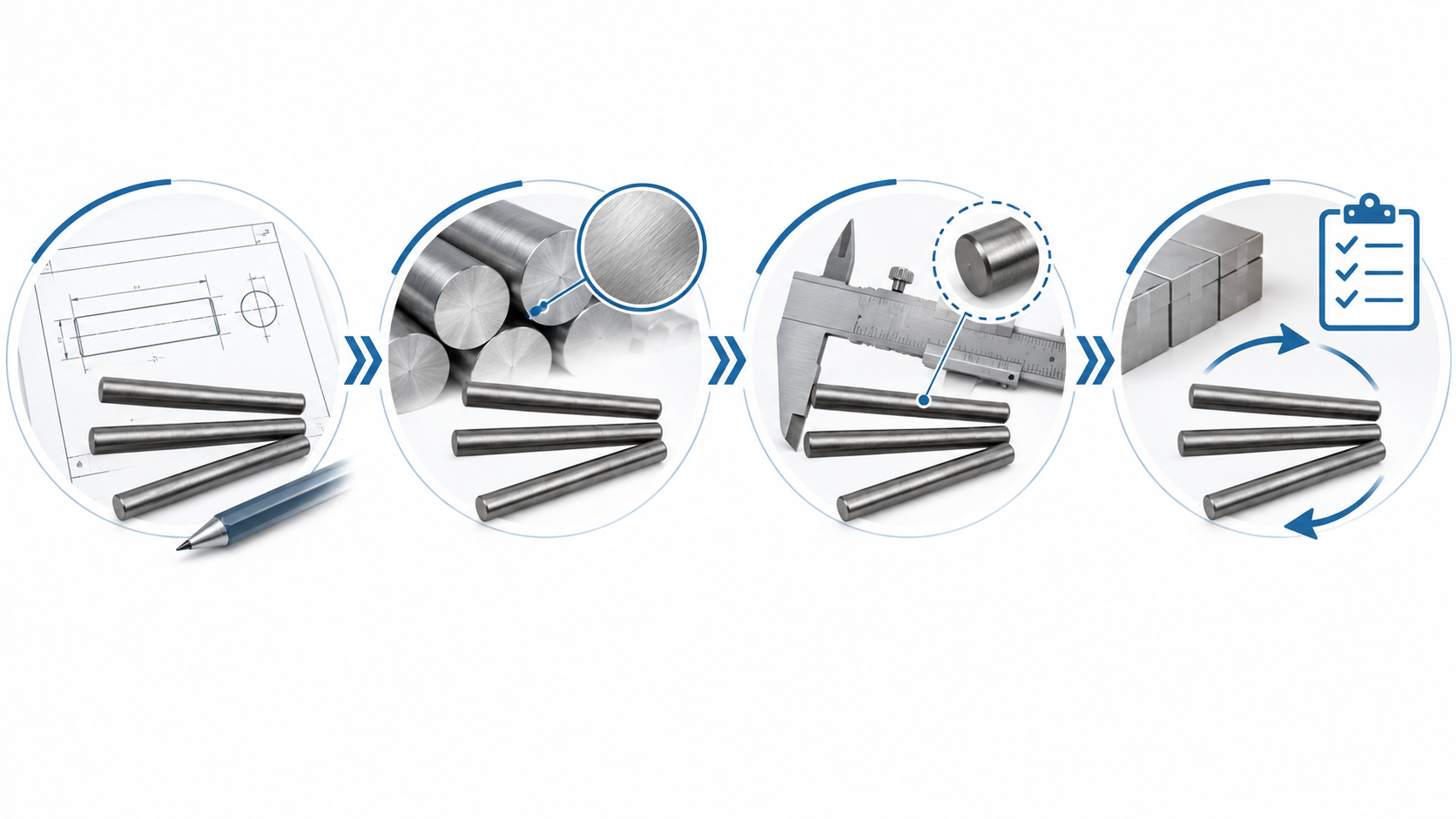
Send the supplier the part identity, drawing or standard reference, nominal dimensions, fit, material condition, finish, quantity and required delivery window. Include the application duty when it affects selection, such as locating, alignment, service removal or repeated assembly.
If the request says only “industrial dowel pins,” suppliers may quote parts with different geometries or conditions. A clear RFQ reduces substitutions that look acceptable in a photograph but do not match the drawing.
| Evaluation area | Buyer question | Evidence to request |
|---|---|---|
| Part identity | Can the supplier identify the exact geometry and revision? | Drawing review, standard reference and controlled quotation |
| Material | What material and condition will be supplied? | Specification, certificate or lot record as required |
| Fit | How are pin and hole requirements understood? | Fit callout, inspection method and deviation process |
| Quality | What is checked before release? | Inspection report, sampling basis and nonconformance route |
| Continuity | How are repeat orders and changes controlled? | Revision, lot traceability and change communication |
A dowel pin supplier should be able to discuss the relationship between part geometry and the receiving assembly. Ask whether the supplier can review cylindrical versus taper geometry, fit at each member, hole preparation, surface condition and inspection requirements. The goal is not to make the supplier design the whole joint; it is to expose missing information before production.
A useful supplier response should make its assumptions visible. It should identify the quoted geometry, the document or standard used, the material and condition, and any inspection or deviation assumptions. If the response cannot be tied back to the drawing, the buyer should clarify the basis before comparing price or delivery.
For repeat orders, ask how the supplier protects the approved configuration. A change in raw material, process, finish, tooling or inspection can affect a locating pin even when the catalog title remains unchanged. The buyer does not need a long marketing statement; the buyer needs a clear change-notification and nonconformance path.
Ask for the documents that match the risk of the purchase. Depending on the application, that may include a controlled quotation, material certificate, dimensional inspection report, lot traceability record, deviation approval and packaging identification. The required set should be agreed before production, not improvised after a problem appears.
Review the documents against the same part identity used in the quote. Check the revision, lot, quantity, units, inspection method and acceptance boundary. If a supplier uses a different internal code, require a clear cross-reference so the buyer can connect the shipped part to the approved drawing and future repeat orders.
A small sample approval can reduce risk, but it does not replace the production controls that will be used for the order. Define what the sample proves, what remains open and how the supplier will preserve the approved configuration. This keeps a one-time sample from becoming an unsupported promise about every future lot.
For standard parts, confirm the applicable standard and the exact product family. For drawing-based parts, confirm which drawing revision controls the quotation. If the supplier cannot state what document the quote is based on, the buyer has no stable reference for a later repeat order.
Ask how the supplier connects a sample approval to production release. The useful answer identifies the approved part identity, the inspection points that remain in production, the lot or batch traceability method and the process for notifying a change. This does not require a large document package for every purchase; it requires the right evidence to remain attached to the same revision. That connection is often more valuable than a broad claim about precision or manufacturing capability.
Ask for the material specification rather than a broad word such as “steel.” If hardness, finish, heat treatment or corrosion behavior matters, state the method and acceptance boundary. A hardness number without a test method, location and material condition may not be comparable between suppliers.
Inspection evidence should match the risk of the part. A simple locating pin may need dimensional and visual checks, while a critical assembly may require lot traceability, material documentation or a defined sampling plan. Do not request a report after production if the supplier was never told what the report must contain.
Compare quotations on the same basis: part identity, revision, material, finish, inspection, quantity, packaging, delivery assumption and deviation terms. A lower price may reflect a different inspection scope or an unapproved substitution. A higher price may include documentation the project actually requires.
Ask how the supplier handles a material change, process change, nonconforming lot or delayed delivery. A clear response is part of the sourcing decision because it affects repeat orders and production risk. Avoid publishing or relying on an unsupported “best manufacturer” ranking when the evidence is not comparable.
TG Eugene’s DIN 1 cylindrical dowel pin and DIN 7 taper pin pages help a buyer identify relevant product families. The final RFQ still needs the controlled size, material, fit, finish, inspection and order requirements.
For a drawing or application review, the Service process provides a direct route to organize those inputs. This is more reliable than selecting a supplier solely from a short product title.
Send the current drawing or standard reference, geometry, dimensions, fit, material, finish, quantity, inspection requirement and delivery assumptions. Add the application duty when it affects selection.
Compare the evidence each supplier can provide for part identity, fit, material, inspection, traceability, change control and repeat-order consistency. Do not compare marketing labels alone.
No. A product page can identify a product family or listed configuration. Certification, conformity and order-specific inspection must be supported by the applicable controlled documents.