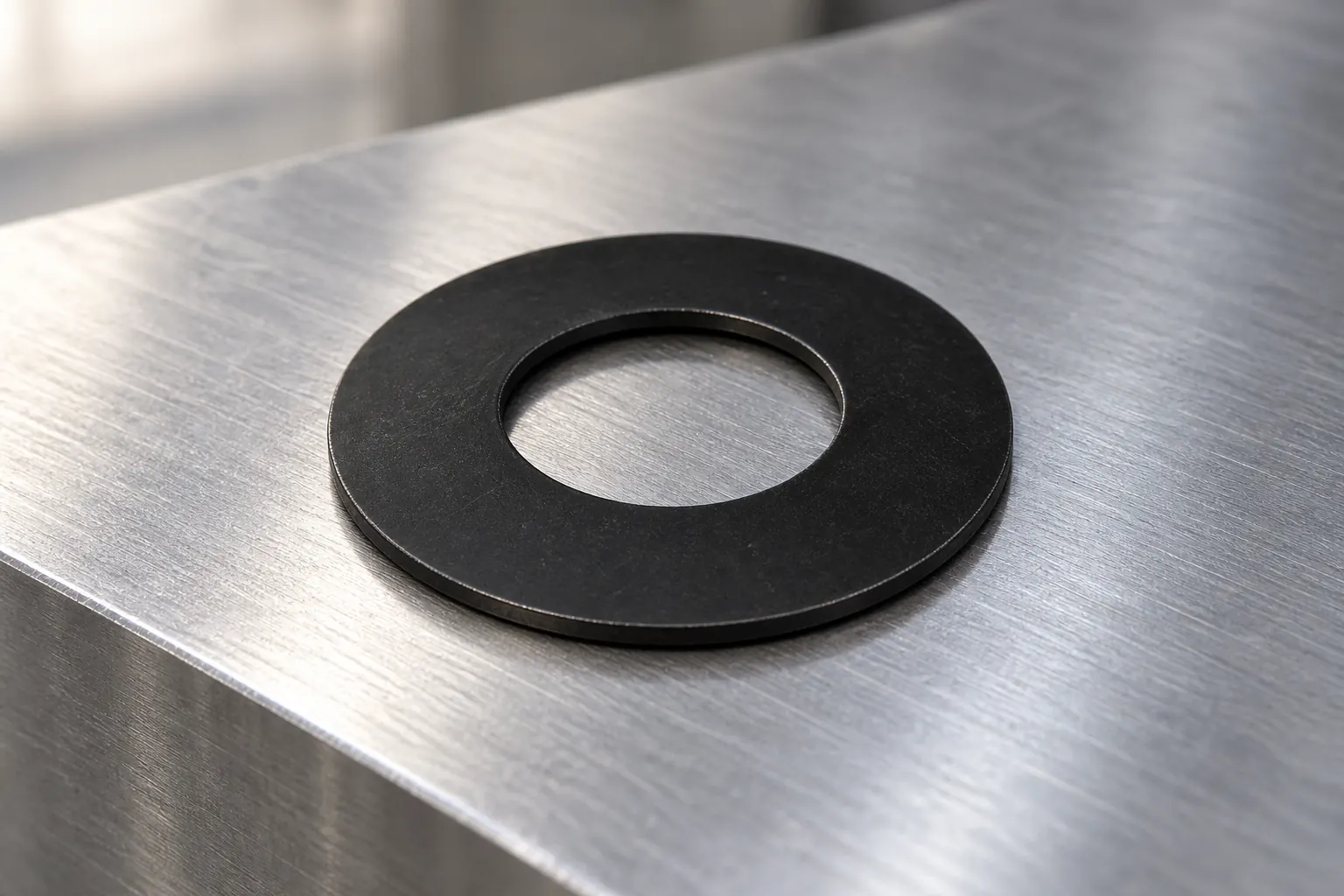
Belleville washer dimensions describe a conical disc spring, but a useful specification needs more than outside diameter, inside diameter, and thickness. It should also identify the free height, operating deflection or load, material condition, support surfaces, and any stack arrangement.
This distinction matters because two disc springs can look similar and still behave differently in an assembly. A dimension line identifies geometry. It does not automatically confirm the force at a chosen deflection, the fatigue requirement, or whether the surrounding parts support the spring correctly.
A Belleville washer is commonly called a disc spring. Its conical shape deflects under axial load. Catalogues and drawings often use a small group of symbols to describe that shape. The exact notation can vary, so always follow the legend in the selected standard or supplier document.
| Common symbol | What it describes | Drawing check |
|---|---|---|
| De | Outside diameter | Confirm clearance to the housing and adjacent parts. |
| Di | Inside diameter | Confirm clearance and guidance around the shaft or pilot. |
| t | Material thickness | Do not substitute measured thickness for a complete part designation. |
| h0 | Cone height above the material thickness | Check how the source defines and measures the cone. |
| l0 | Free height | Measure the unloaded spring on suitable equipment and supports. |
| s | Deflection from the free position | State the operating point when load matters. |
Some documents also show a force value at one or more deflection points. Treat that force and its stated deflection as a pair. Copying the force without its test condition can create a misleading requirement.
Searches for Belleville washer sizes often lead to catalogue rows that look complete. They are useful for narrowing a family, but the row may omit tolerance class, material variant, edge treatment, force tolerance, or test method. Keep the catalogue identifier with its source and revision so purchasing can trace the selection.
Useful Belleville washer specifications also define how the spring interfaces with the assembly. Record the pilot or guide diameter, contact-face geometry, installed orientation, available travel, and any hard stop. These controls help prevent a correct spring from being installed in an unsuitable envelope.
Many drawings, catalogues, and search queries still use “DIN 2093.” That name remains useful when identifying legacy specifications and familiar product families. DIN 2092 and DIN 2093 were withdrawn in 2017. Their content was incorporated into DIN EN 16984 for calculation and DIN EN 16983 for quality requirements and dimensions.
For a new controlled drawing, identify the exact standard and edition your engineering team has approved. Do not change a legacy callout only because a newer designation exists. First confirm whether the change affects dimensions, tolerances, testing, documentation, or supplier qualification for the assembly.
The main dimensions define the spring’s form. The assembly still needs an operating requirement. That requirement may be a target force at a stated deflection, a permitted working range, or a stack response approved by the designer.
A practical drawing review separates three questions:
This separation prevents a catalogue size from being treated as a complete engineering approval. It also gives the supplier a clear path to identify which values come from a standard and which are specific to the project.
Measure parts in an unloaded and clean condition. Burrs, coating buildup, damaged edges, and a tilted setup can distort the result. Use calibrated equipment that suits the tolerance and avoid compressing the spring while checking free height.
A caliper may be adequate for a receiving check with broad tolerances. It does not replace the inspection method required by a controlled drawing. When force is a purchase requirement, define the test fixture, loading direction, deflection point, and acceptance rule.
Disc springs may be used singly or combined in stacks. Springs placed in the same direction and springs placed in alternating directions do not produce the same load-deflection response. Friction, guidance, contact surfaces, and stack height also matter.
Do not select one spring from a size chart and assume a stack will behave as a simple multiple in every condition. Specify the arrangement and review it as an assembly. The separate guide to Belleville washer stack arrangements explains the main series and parallel configurations.
| Input | Why it matters |
|---|---|
| Standard and edition | Controls the referenced dimensions, quality requirements, and calculation basis. |
| Part or size designation | Connects the drawing to the intended spring family. |
| Material and delivery condition | Prevents a generic “spring steel” substitution. |
| Surface treatment and edge condition | Defines corrosion and contact-surface expectations without relying on appearance. |
| Operating load or deflection | States what the spring must do in the assembly. |
| Stack arrangement and quantity | Controls orientation, installed height, and assembly count. |
| Inspection and documentation | Defines how conformity will be checked and recorded. |
Where force or deflection is an acceptance characteristic, state the nominal value, tolerance, test position, loading direction, fixture condition, and sampling plan. Ask the supplier to identify which results will appear on the inspection report. This turns a general performance request into a result that both parties can verify.
The quotation, drawing, purchase order, and inspection record should reference the same revision. If an approved catalogue number is used, retain the catalogue source and revision with the project file.
TG Eugene’s DIN 2093 Belleville disc spring page is a starting point for product-family discussion. Send the approved drawing, quantity, operating condition, inspection needs, and destination when requesting a review. The product page does not replace application approval.
The terms often describe the same conical spring form. Confirm the selected standard and drawing because symbol definitions, tolerances, and product scope may differ between sources.
No. Outside diameter is only one identification value. Inside diameter, thickness, free height, material, operating point, support conditions, and stack arrangement may all affect selection.
Use the standard and edition approved for the project. DIN 2093 remains common in legacy documentation, while current European references include DIN EN 16983 for quality requirements and dimensions and DIN EN 16984 for calculation.