A Belleville disc spring is a conical type of disc spring. The terms overlap, but a purchase specification still needs geometry, load-deflection data, stack orientation, material, finish, and inspection requirements. Use the distinction to choose the right engineering controls—not just a familiar product name.
Summary: A disk spring is a compact spring element made from a washer-like disc that deflects axially; a Belleville disk spring is the conical disc-spring form most engineers mean when discussing Belleville washers. DIN 2093 provides a reference for disc-spring dimensions, tolerances, and testing, while ISO 9001 concerns a quality-management system rather than a product grade. Before approving a substitute, compare geometry, force-versus-deflection behavior, stack arrangement, operating temperature, and supplier documentation.
“Disk spring” and “disc spring” are spelling variants used in different markets. In practical procurement language, the term usually describes a spring cut or formed as a disc with a central opening; under axial compression, the disc moves toward a flatter shape. “Belleville” identifies the characteristic conical washer geometry associated with this action. Therefore, every Belleville disk spring is a type of disk spring, but a drawing that says only “disk spring” may still leave cone height, thickness, material, and load class unspecified.
The distinction is important because a flat washer, a wave washer, and a conical washer can share a similar outside diameter while delivering very different travel and force. The specification should identify at least the free height, thickness, inside and outside diameters, material or material family, required deflection, and any stacking direction. For global supply, also state whether dimensions follow a standard or a controlled customer drawing.
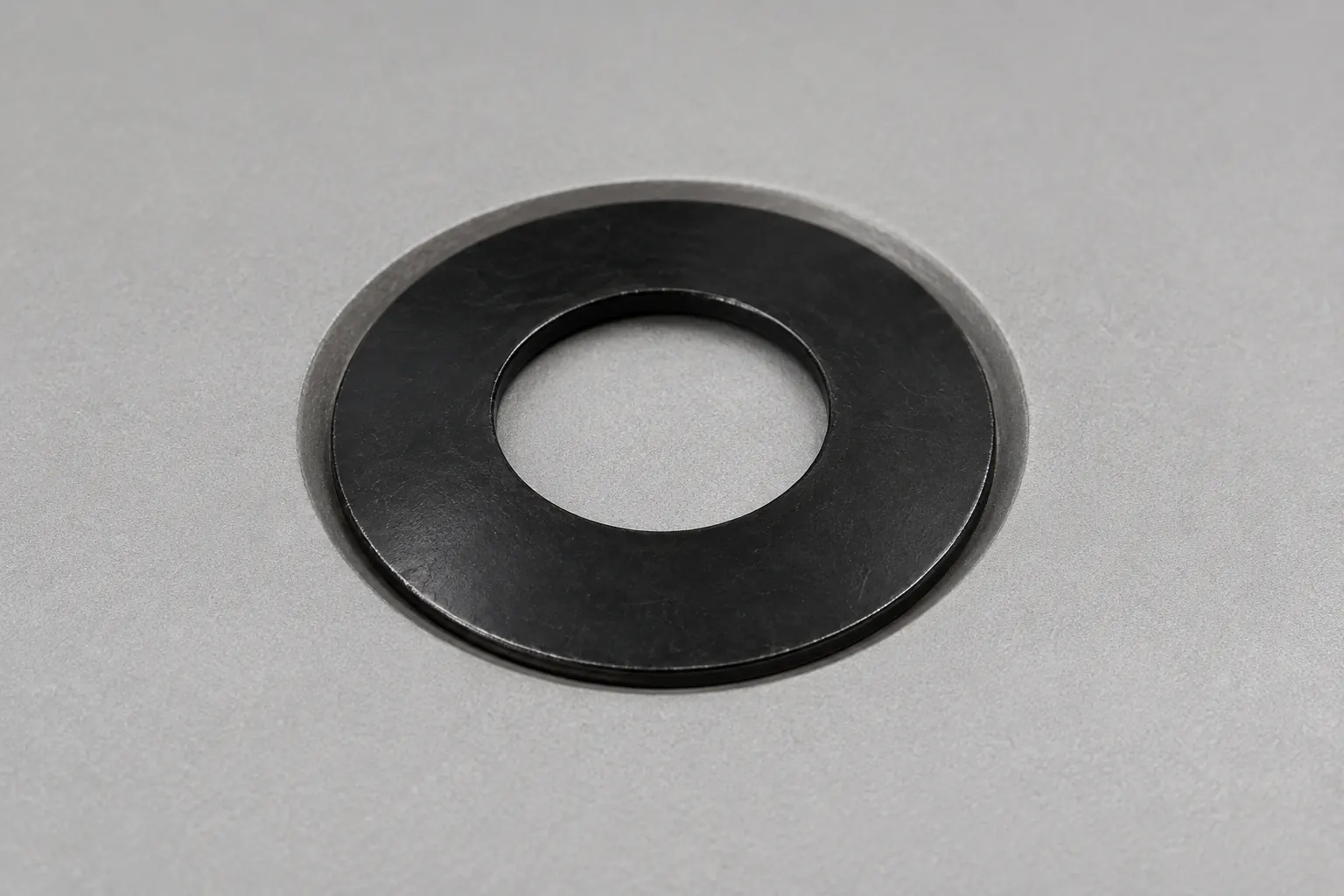
A conical washer does not behave like a simple cylindrical coil. Its force changes with deflection, and the useful operating point depends on the ratio of diameter, thickness, and free height. Near a selected working position, the spring can provide high force in a short axial package; past that position, flattening, friction, or local stress can alter the expected response. That is why a Belleville disk spring should be evaluated from a force-deflection curve rather than from outside diameter alone.
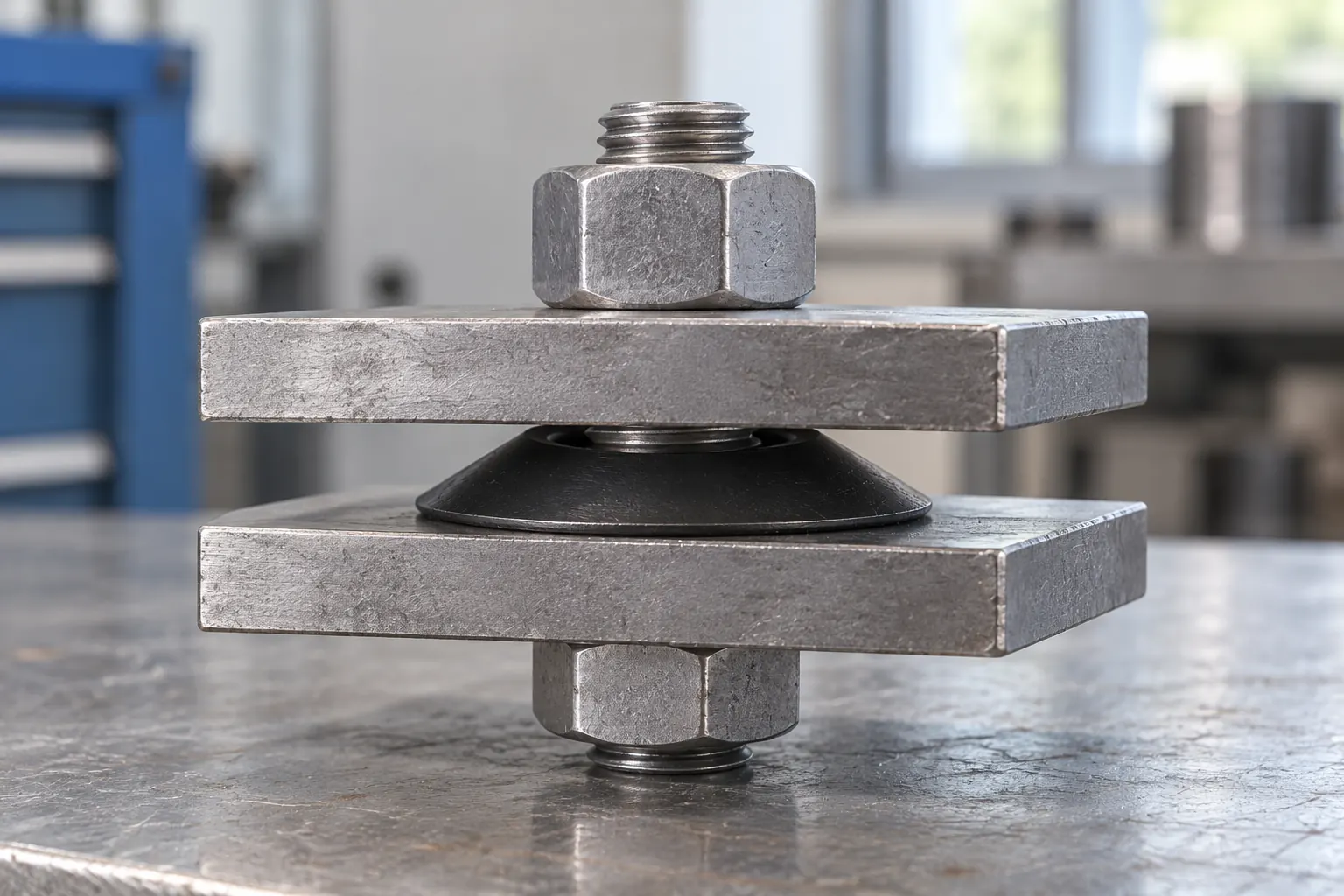
Stacking changes the result. Springs nested in the same direction increase force at a given travel, while alternating orientation increases available travel; combinations can do both. The exact result depends on friction, guidance, parallelism, and the number of active elements. A design review should therefore record the stack sequence, target deflection, load tolerance, and stop condition, then confirm the assembly with a compression test using a defined test method.
In a controlled comparison, measure free height and load at specified deflections, not just unloaded dimensions. DIN 2093 is useful as a common reference for this style of dimensional and performance control. A supplier’s curve remains relevant because material condition, surface treatment, lot variation, and test setup can affect the result. For a high-consequence joint, treat an illustrative curve as a planning aid until production samples are tested.
The strongest case for a Belleville disk spring is a high-load, limited-travel joint where preload must be maintained in a compact axial space. Examples include bolt tensioning, bearing preload, valve and actuator mechanisms, clutch systems, and thermal compensation. The choice is not automatic: if the assembly needs long travel, low force, or a nearly linear rate, another spring architecture may be easier to control.
Environmental details matter as much as nominal load. Corrosion exposure, temperature, relaxation, lubrication, mating-surface hardness, and guidance can change the working life. In bolted joints, the spring must be integrated with the bolt, nut, washers, and joint stiffness; a spring cannot compensate for poor alignment or an unsuitable tightening process. The related guide on Belleville spring washers for high-load bolting is a useful application cross-check.
Use the generic term on drawings only when the rest of the callout removes ambiguity. If the intended part is specifically conical, include the Belleville geometry, dimensions, material, heat treatment or finish where applicable, and acceptance tests. If the part is a custom retaining or loading component, a supplier should receive the actual force, deflection, space, life, and environment rather than a product name alone.
| Dimension | Broad term | Belleville disk spring (specific form) |
|---|---|---|
| Geometry | Washer-like spring element; geometry must be specified. | Typically a conical disc with a defined free height and cone angle. |
| Load behavior | Depends on the selected disc profile and dimensions. | High axial force over short travel is common, with a nonlinear curve. |
| Stacking | Requires a stated orientation and count. | Parallel and series arrangements tune force and travel, subject to friction. |
| Compatibility | Must be checked against seats, guides, stops, and mating parts. | Needs controlled seating so the cone does not tilt or bind. |
| Documentation | Drawing, test points, material, and finish define the part. | Standard reference plus supplier curve and lot records help control variation. |
| Cost and maintenance | Unit cost is only one factor; inspection and replacement access affect TCO. | Compactness may reduce package cost, but preload verification remains essential. |
Use the following sequence before releasing a purchase order:
| Application need | What to examine | Procurement evidence |
|---|---|---|
| High preload in a short package | Force at target deflection, seat guidance, stress and temperature margin | Load curve, dimensions, material and sample test records |
| Thermal or joint relaxation compensation | Expected movement, relaxation, cycle profile and stop position | Application calculation and repeatability data under stated conditions |
| Long travel or low force | Whether a conical disc is the right architecture at all | Alternatives comparison and prototype test plan |
| Corrosive or outdoor service | Material compatibility, coating, hydrogen or embrittlement risks where relevant | Finish specification, inspection method and lot traceability |
| Global repeat supply | Standard versus custom geometry, interchangeable drawing controls | Approved drawing, change notification and packaging requirements |
DIN 2093 is a product-oriented reference for disc springs: it helps parties align on dimensions, tolerances, and testing expectations for a Belleville disk spring. It is not a blanket statement that every spring on the market has been independently certified to every requirement. The purchase order should identify the applicable edition or customer drawing and state which characteristics are subject to inspection.
ISO 9001:2015 specifies requirements for a quality management system. It can support controlled purchasing, records, corrective action, and change management when a supplier’s certification scope covers the relevant operation. It does not establish the force of a Belleville disk spring, replace a material certificate, or prove that a part meets DIN 2093. Always verify the supplier’s current certificate scope and the actual product evidence for the destination market and intended use.
For distributors and equipment integrators, unsupported compliance language creates a commercial risk: a catalog claim can be treated as a contractual promise. Keep standards references, certificates, test reports, and approved deviations linked to the part number. This evidence is more useful than a generic claim that a part is “industrial grade.”
A disk spring is an axially loaded spring element formed as a disc or washer-like component. Its force and travel depend on its profile, dimensions, material, and whether it is used alone or in a stack. A disk spring callout should therefore include working dimensions and test requirements, not just a nominal diameter.
A Belleville disk spring is the conical disc-spring form commonly used to generate high axial force in a short package. Its free height, cone geometry, and stacking direction determine the working curve. Confirm the intended geometry and seating details before treating a catalog Belleville washer as a direct substitute.
Usually, yes: “disk” is common in American English and “disc” is common in British and international technical usage. The spelling does not define the dimensions or performance. The drawing, standard reference, and force-at-deflection requirements are the controlling information.
Axial compression pushes its conical disc toward a flatter position, creating a reaction force. Several elements can be nested to increase force or arranged in alternating directions to increase travel, but friction and alignment affect the actual result. Validate the assembled stack rather than multiplying a single-part value without testing.
Not generally. A disc spring’s force-deflection relationship is commonly nonlinear, and its local rate changes with geometry, deflection, friction, and stacking. If the mechanism requires a controlled near-linear region, specify that region explicitly and verify it with a measured curve.
For a practical introduction, compare Eugene’s guides to what a disc spring is and Belleville disc spring applications before finalizing the drawing.
Eugene helps global buyers translate a spring or washer requirement into a controlled drawing, inspection plan, and repeatable supply arrangement. Contact the team with your load, travel, dimensions, material, finish, and application conditions.