DIN 6799 retaining ring weight is not one fixed value. The mass of an E-type retaining ring is tied to its nominal size, ring section, material, and the drawing or catalog basis used for the calculation. Finish and measurement basis should also be recorded so the result refers to the same configuration and reporting method. If a buyer needs a verified number for an RFQ, replacement, packaging estimate, or incoming inspection, the standard name alone is not enough.
This guide explains what to confirm before comparing an E-type retaining ring and how to request a weight that can be traced back to the correct part. Eugene’s DIN 6799 E-type circlip family can be reviewed once the size, material, finish, and inspection requirements are known.
DIN 6799 identifies a family of radial-entry retaining rings, commonly called E-clips. It does not turn every ring in the family into one interchangeable mass. A small ring and a larger ring occupy different volumes; a thicker or wider section contains more material; and two parts with similar geometry may still weigh differently when their material or surface treatment differs.
That is why a search for DIN 6799 dimensions should lead to the correct size and drawing, not to a generic weight copied from another part. The same caution applies to an “E-clip weight” request: the result needs a defined part number or dimensional basis.
| Input | Why it matters | What to provide | What to avoid |
|---|---|---|---|
| DIN 6799 size | Nominal shaft and groove dimensions identify the intended ring family and geometry. | Nominal size, groove condition, and drawing revision. | Using a nearby size as a substitute. |
| Section and geometry | Width, thickness, open profile, and edge details affect material volume. | Drawing, controlled dimension sheet, or approved sample. | Estimating from a photograph or screen image. |
| Material | Material designation is part of the part identity and determines which material record should be checked. | Material designation and any required certificate. | Assuming every E-type retaining ring uses one grade. |
| Finish and measurement basis | These inputs keep the comparison tied to the same configuration and reporting method. | Finish, unit basis, sample condition, and rounding rule. | Mixing piece weight with packed or coated lot weight. |
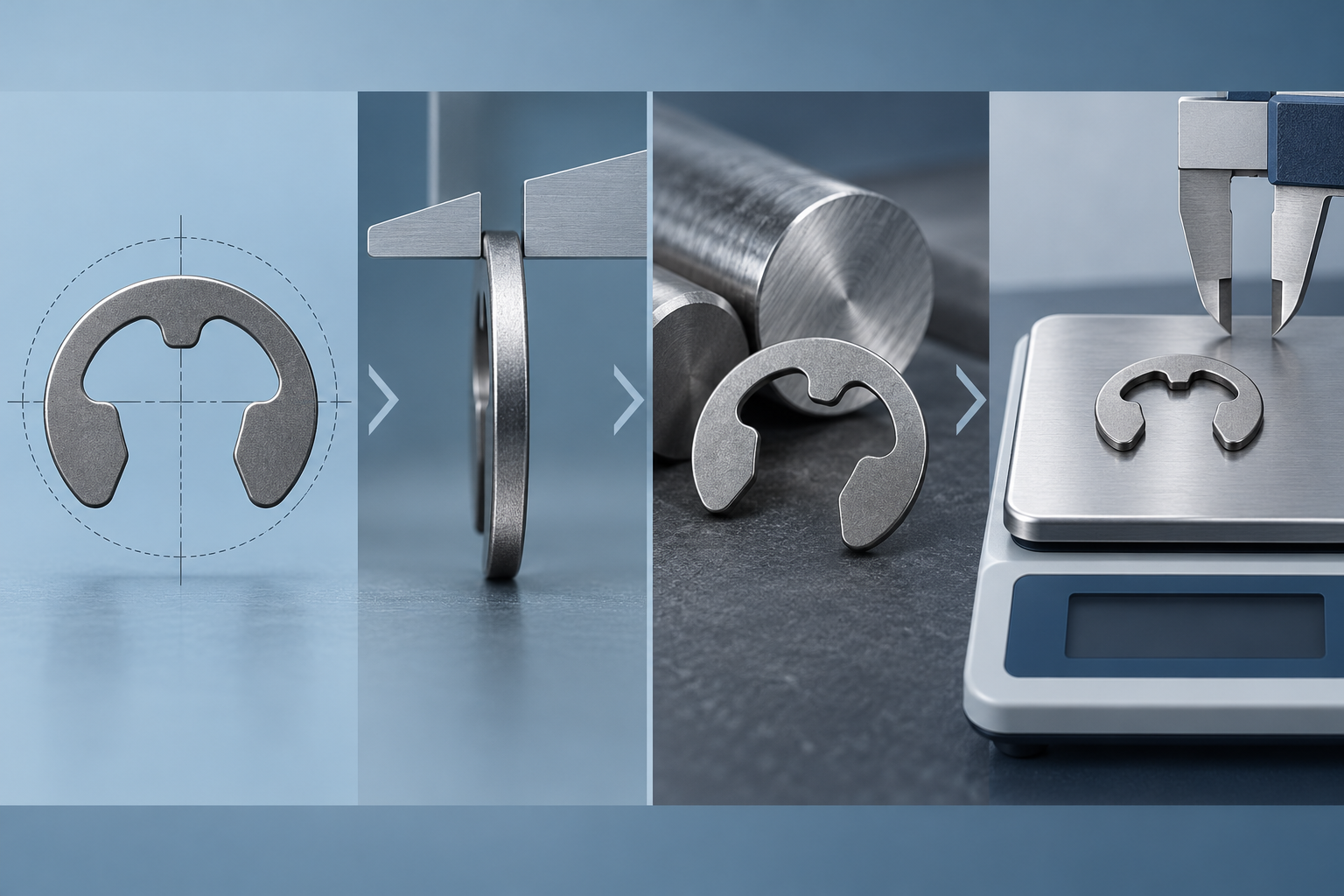
A calculated value and a measured value answer different purchasing questions. A drawing-based calculation can support packaging estimates or early design work when the geometry and material are controlled. A sample measurement can support incoming inspection or a lot review, but it should identify the sample condition, instrument, unit, sample count, and rounding rule. Neither result should be copied to another DIN 6799 size without checking the part identity.
When the buyer needs both, ask the supplier to keep them separate in the quotation or inspection file. The calculated basis should point to the drawing revision and material designation. The measured basis should point to the lot and record how the sample was selected. This separation makes an E-clip weight result easier to audit and prevents a packing estimate from being mistaken for an acceptance limit.
A quote request should include the standard and DIN 6799 size, shaft and groove information, material, hardness or heat-treatment requirement when applicable, surface finish, quantity, packaging basis, destination market, and inspection documents. If the requirement is based on a replacement, attach the drawing or a clear sample specification rather than only a product photo.
For a high-volume order, also state whether the weight is needed for part-level control, carton planning, shipping documentation, or a customer approval file. Those uses can require different sampling and rounding rules. Separating them at the start prevents a supplier from returning a technically correct number that does not match the buyer’s intended use.
Eugene’s DIN 6799 E-type retaining ring page is the right starting point for a standard product review. For terminology and installation context, see What Is an E-Clip? Before a weight is accepted for purchasing or inspection, send the exact size, material, finish, quantity, and drawing or data-sheet requirement so the result is tied to the requested configuration.
Identify the exact size and drawing, confirm section and material, define the measurement basis, and keep the result tied to the relevant sample or lot record. Do not reuse a value from a different size or configuration.
Send the DIN 6799 size, shaft and groove information, material, finish, quantity, packaging or measurement basis, drawing revision, destination market, and any inspection-document requirement.