What are snap ring pliers used for? They install and remove retaining rings under controlled expansion or compression. Internal-ring work expands the ring inside a bore; external-ring work compresses the ring around a shaft. The tool makes the movement repeatable, but it does not replace the final groove and seating inspection.
This article focuses on the tool’s purpose and workflow. For the basic definition and broad types of retaining rings, see the existing snap-ring guide rather than repeating that topic here.
| Use case | Action | What must be confirmed |
|---|---|---|
| Install an external ring | Compress the ring at its lugs and guide it over the shaft | The ring returns into the shaft groove without twisting |
| Install an internal ring | Expand the ring and guide it into the bore groove | The ring is supported around the bore and not caught on a chamfer |
| Remove a ring | Reverse the controlled movement and lift the ring out | The ring, groove and retained part are not damaged |
| Inspect an assembly | Use the tool only when movement or repositioning is required | Final seating and axial retention are checked separately |
The tips engage holes or lugs that are designed to receive them. The handles then convert hand movement into a small, controlled change in ring diameter. This is different from prying against the shaft, bore or housing, which can create marks and unpredictable ring deformation.
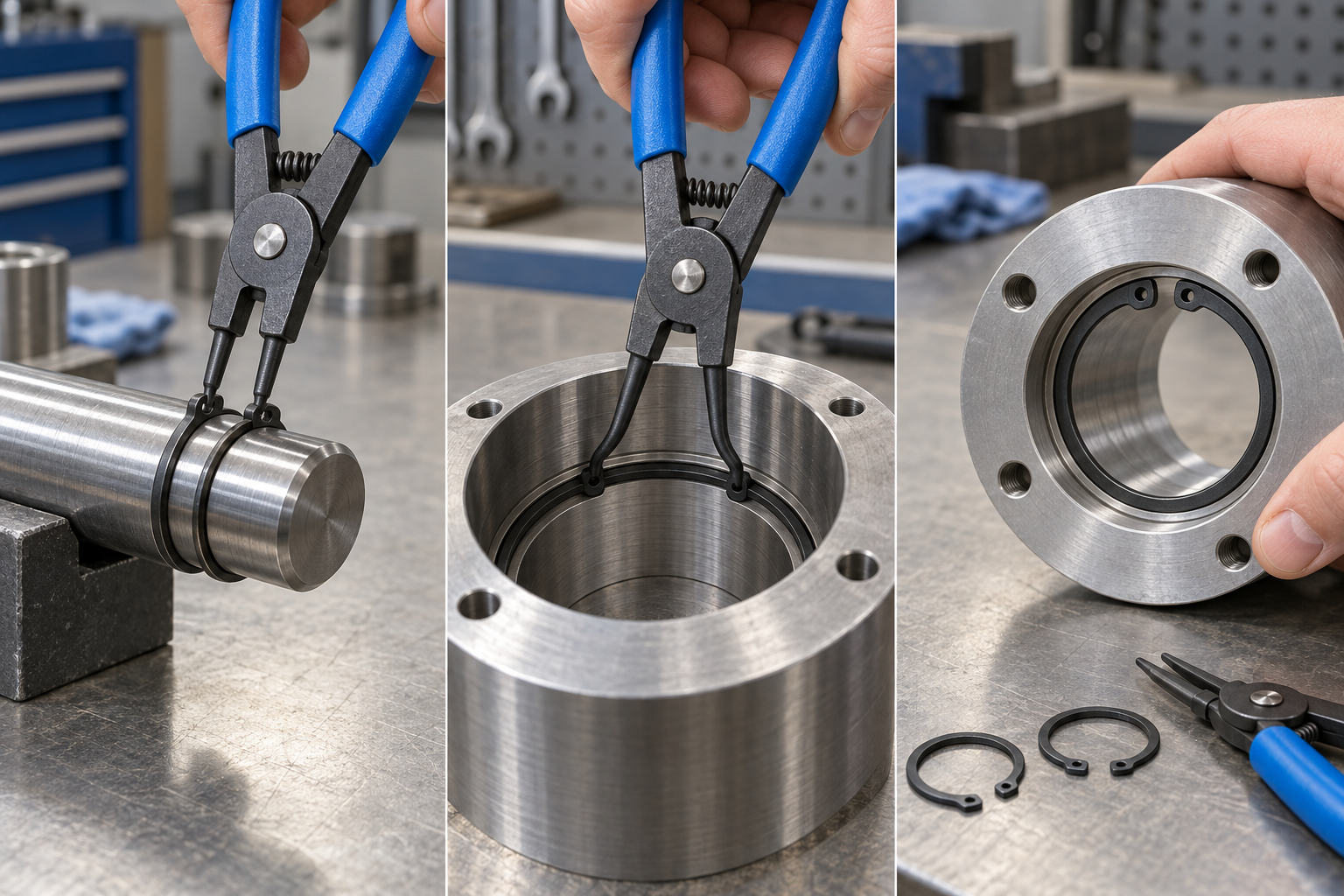
For an external ring, the tool compresses the ring so it can pass over the shaft. The shaft groove should be clean and free of burrs before the ring is released. Releasing the handles is not the same as confirming installation: the ring must return into the groove and make full contact with the groove walls.
For an internal ring, the tool expands the ring so it can pass into the bore. The operator should confirm that the tips remain engaged and that the tool body does not interfere with the housing. Expand only enough to clear the bore entrance and seat the ring.
In both cases, the ring should be guided rather than thrown into position. Excessive expansion or compression can permanently alter the ring. If the ring does not move with controlled force, stop and check the ring design, access, corrosion, burrs and tool fit.
During removal, keep the ring controlled as it leaves the groove. Shield the work area from an uncontrolled release and keep the ring away from people and finished surfaces. The exact handling method depends on the assembly and the ring design.
After removal, inspect the ring for cracks, permanent opening, bent lugs and damage at the contact area. Inspect the shaft or bore groove for burrs, galling, corrosion and contamination. If the ring is deformed or the groove is damaged, replacement or engineering review is preferable to simply reinstalling the same parts.
Standard snap ring pliers depend on positive engagement with compatible holes or lugs. They are not a universal solution for E-clips, wire rings, seized rings, rings without usable holes or rings that have been damaged in service. Forcing a tip into an unsuitable edge can create a slip hazard and damage the assembly.
Limited access can also make a nominally correct tool impractical. A bent tip, a different handle reach or a fixture change may be needed. The decision should be based on the ring’s standard, size, installation direction and the space available around the assembly.
TG Eugene’s retaining-ring product families provide a starting point for a standard and size review. For a fit-specific request, include the groove location, dimensions, material, finish and quantity in the technical inquiry.
No. They are used for both installation and removal. During installation they control the ring as it enters the shaft or bore groove; during removal they keep the ring movement controlled as it leaves.
Check that the ring is fully seated, not twisted or riding on a chamfer, and that the shaft or bore groove is undamaged. For a service part, also check the ring for permanent deformation.
Not by default. The two ring locations require opposite movements. Use a tool designed for the required action and verify tip engagement before applying force.