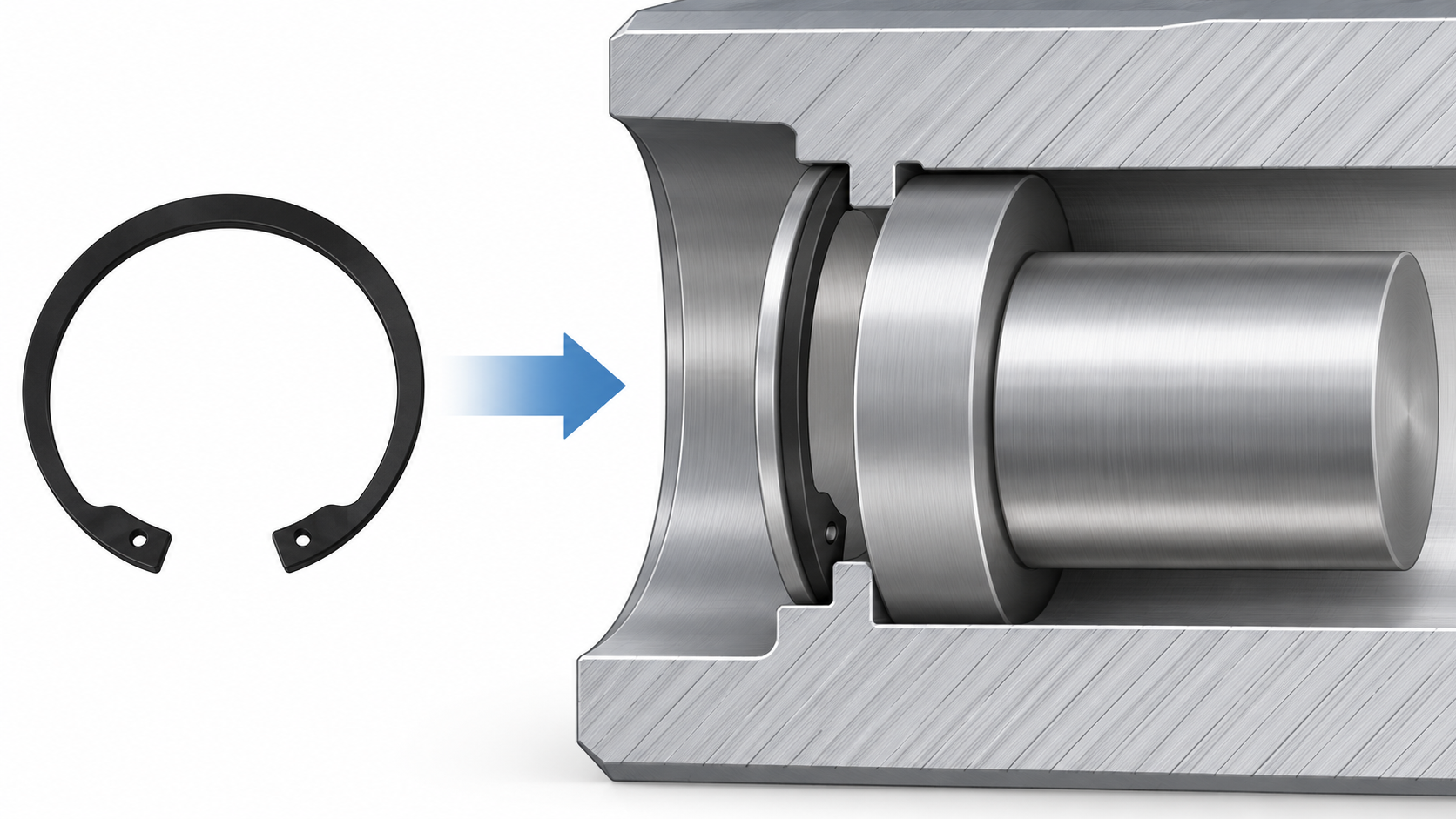
An internal retaining ring holds a component inside a machined bore by seating in an internal groove. The ring is only one part of the fit: the bore, groove, retained component, axial load, and installation access must all agree.
An internal retaining ring, also called an internal circlip or bore retaining ring, is installed in a groove cut into the inside wall of a housing or bore. Once seated, it creates a shoulder that limits axial movement of a bearing, sleeve, gear, or other retained part.
The practical distinction is installation direction. An internal ring works in a bore; an external ring works in a groove around a shaft. Those families may look similar in a catalog, but they are not interchangeable because their free diameter, groove position, and working direction are different.
Do not select the ring from the bore diameter alone. Confirm the nominal bore, groove diameter, groove width, available wall thickness, and the axial space needed by the retained component. The drawing should also identify the applicable standard and size designation.
DIN 472 is a common reference for retaining rings used in bores. Independent catalog references place it in the retaining-ring-for-bores family, while the TG Eugene DIN 472 product route is the relevant product starting point for a sourcing discussion.
A standard number does not replace the size and drawing information. When the application is safety-critical or the groove is already machined, compare the drawing dimensions with the applicable standard edition and confirm the ring material and finish before release.
For a related terminology and size-navigation reference, see the internal snap ring size chart guide; use it as a navigation aid, not as a substitute for the current drawing.
Spring steel is commonly used for retaining rings because the ring must flex during installation and recover its shape in the groove. The right material and finish still depend on corrosion exposure, temperature, installation cycles, and the customer specification.
TG Eugene lists material and finish routes on its DIN 472 product page. Treat those as product options to confirm for the order, not as a universal statement that every DIN 472 ring has the same material or coating. If the application is exposed to moisture, chemicals, or frequent service, request the material, surface-treatment, and inspection details with the quotation.
For a sourcing review, send the drawing or the measured bore and groove dimensions with the quantity. This avoids treating a generic ring size as an approved fit.
When the design is still being finalized, the TG Eugene product range can help identify the relevant ring family before the engineering drawing is frozen. The final order should still reference the approved geometry and finish.
They are often used as near-synonyms in product searches. The important engineering distinction is whether the ring is intended for a bore or a shaft and whether the groove and installation method match.
Do not assume that. DIN 471 is associated with shaft grooves, while DIN 472 is associated with bore grooves. Confirm the application family and drawing before ordering.
For a production fit, yes. The bore, groove, retained part, and assembly access together determine whether the selected ring is suitable.