Coiled pins, also called coiled spring pins or coiled roll pins, and slotted spring pins are spring-type fasteners with different cross-sections. Choose between them by load type, hole variation, installation method and the standard named on the drawing. “Roll pin” alone is not a complete specification.
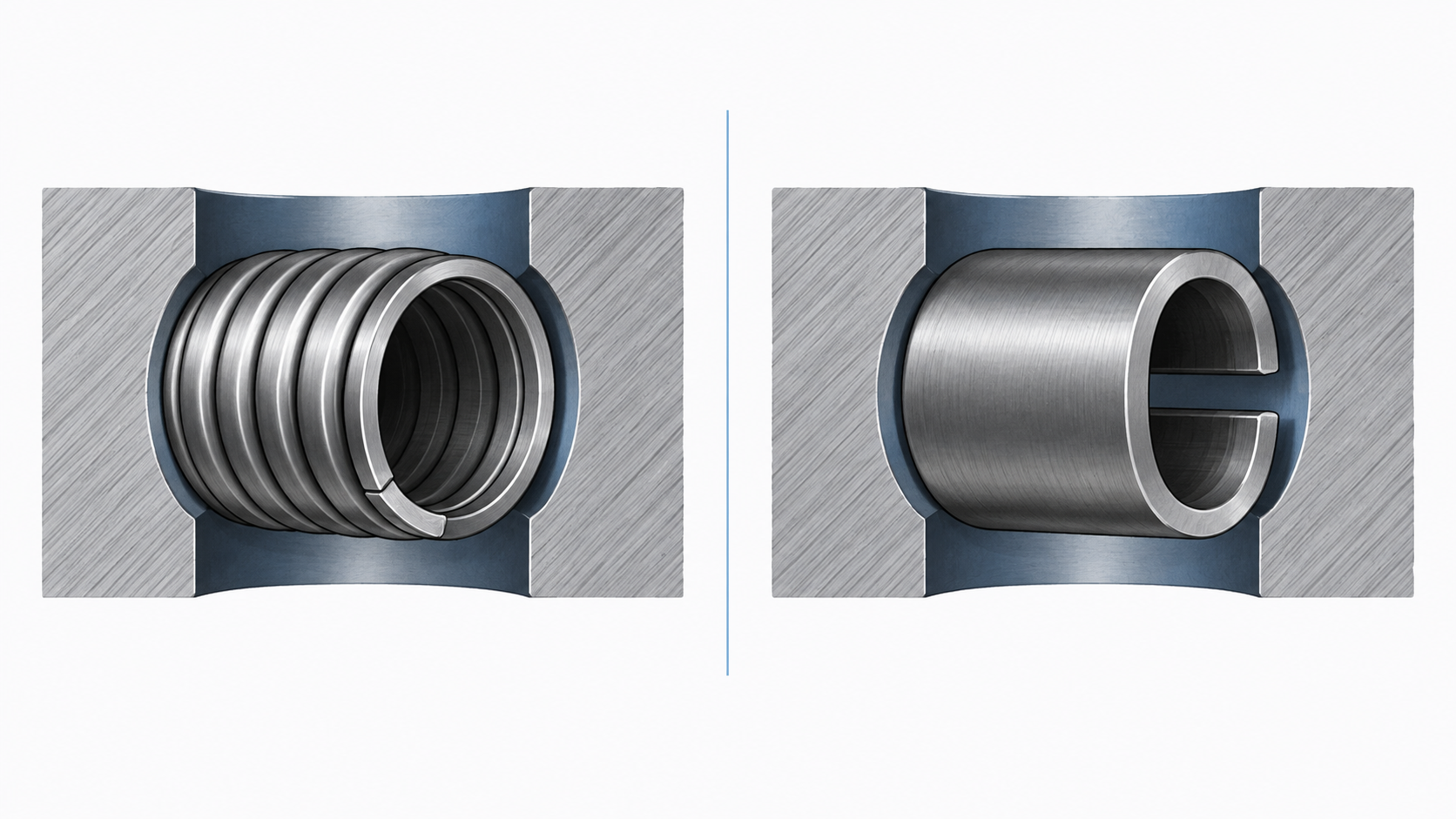
A slotted spring pin is a hollow pin with one longitudinal slot. A coiled spring pin is formed from multiple wraps of spring material. That difference changes how the pin compresses into the hole and how much flexibility remains after installation. The comparison is about construction, not simply about two names for the same component.
| Check | Coiled spring pin | Slotted spring pin |
|---|---|---|
| Cross-section | Multiple wraps with a seam | Hollow C-shaped section with a slot |
| Installation question | Can the selected duty and hole support the required spring recovery? | Will the slot, chamfer and hole condition allow controlled insertion? |
| Changing load | Retained flexibility is a key reason to consider this family | Flexibility and slot position must be checked against the load direction |
| Best next document | Application-specific selection data | Exact standard, size and hole preparation |
Consider coiled spring pins when the joint experiences repeated vibration, shock or movement and needs retained flexibility after insertion. SPIROL’s engineering comparison reports fatigue differences under its stated test conditions. Use that evidence for routing, not as a universal life guarantee.
Coiled pins can also be a strong candidate when the hole is made by a process that does not deliver a perfectly uniform condition every time. SPIROL’s hole-preparation guidance describes coiled pins as accommodating a wider recommended hole tolerance than other press-fit pin families. The decision still belongs to the actual assembly: inspect the host material, hole edge, engagement length and insertion method before releasing the drawing.
A slotted spring pin is often the straightforward choice when the design already specifies a slotted standard, the application is relatively static, or purchasing and production are organized around that established part family. The selected standard controls more than the nominal diameter. It also sets the product family and the dimensions that the drawing or supplier specification must follow.
ISO 8752:2009 is the current ISO reference for heavy-duty slotted spring-type straight pins. TG Eugene’s listed route is an ISO 8752 heavy-duty slotted spring pin described as 65Mn with black oxide treatment. The site’s ISO 8752 slotted spring-pin guide explains that route. It is not evidence that the product is a coiled pin or substitutes for a coiled design.
Hole fit is not a separate afterthought. A pin that is easy to insert may still be wrong if the hole allows excessive movement, damages the host material, or leaves the spring section with no useful recovery. Review the hole-making process, edge break, burr direction, host material and access for the installation tool.
For a slotted pin, also check slot orientation when the joint has a defined load direction. The referenced engineering literature discusses orientation and slot closure as factors in dynamic behavior. Do not convert those observations into a fixed percentage or service-life claim unless the actual pin, hole, load and test method match.
For a coiled pin, identify the required duty and confirm that the selected diameter and hole provide the intended retention. The word “coiled” alone does not replace a selection calculation. Both families remain application parts, not generic plugs for any hole.
For a slotted-pin quotation, the TG Eugene ISO 8752 slotted spring pin page is the relevant product route. For dimensions and hole-fit notation, use the roll pin sizes and hole fit guide. The roll pin vs spring pin guide provides the terminology check.
Start with a coiled pin when the joint has repeated vibration, shock or movement and retained flexibility is important. Confirm the choice against the host material, hole condition, duty, load direction and installation method. A slotted pin can remain the better route for a defined static application or an existing ISO 8752 specification.
The slot and the multiple-wrap section distribute deformation differently during installation and service. The coiled form is designed to retain more flexibility, while a slotted pin’s remaining gap and orientation can change its behavior under load. Use these as selection questions, not as a substitute for the actual standard, drawing or application validation.