 Wenzhou Eugene Technology Co., Ltd.
 A belleville disc spring stores load through conical geometry
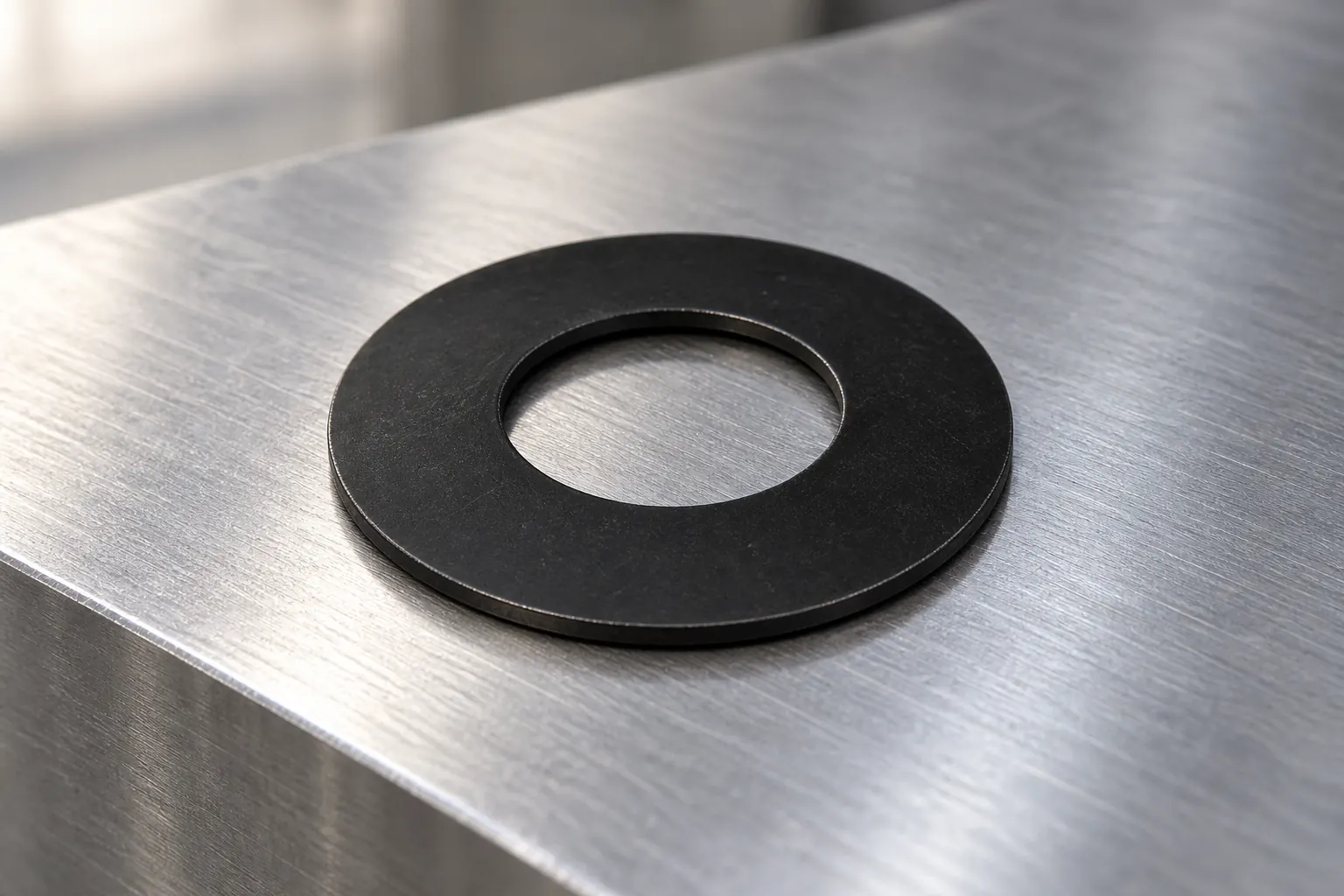
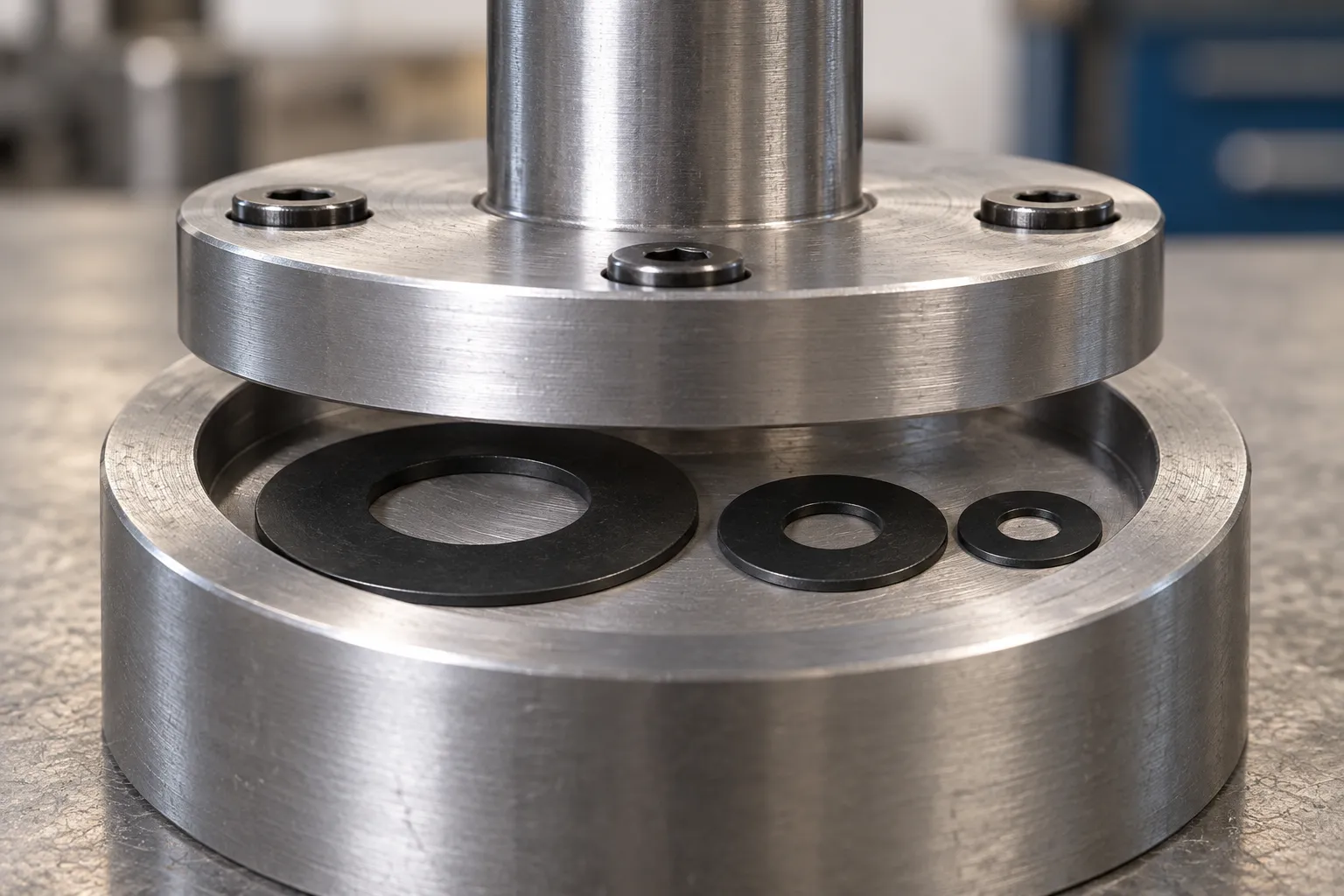
A conical spring is an annular element that deflects axially when loaded. Its behavior comes from the shallow cone, not from a long coil length. As the cone flattens, it develops force and returns toward its original height when unloaded within the intended elastic range.
Designers use the term disc spring for the component family and “Belleville spring” or “Belleville washer” for the same basic conical form. A belleville disc spring still needs a drawing that states outside diameter, inside diameter, free height, thickness, material, finish, and required load-deflection point. Geometry controls the curve: a thicker or steeper section generally produces more force and less travel.
For an illustrative calculation, assume one spring must provide 1,000 N at a defined working deflection. Compare that target with supplier data at the same deflection, friction condition, and orientation; the 1,000 N figure is a design input, not a universal rating. A compression test that records force and displacement together is more informative than a nominal catalog label.
A belleville disc spring changes force and travel through stacking
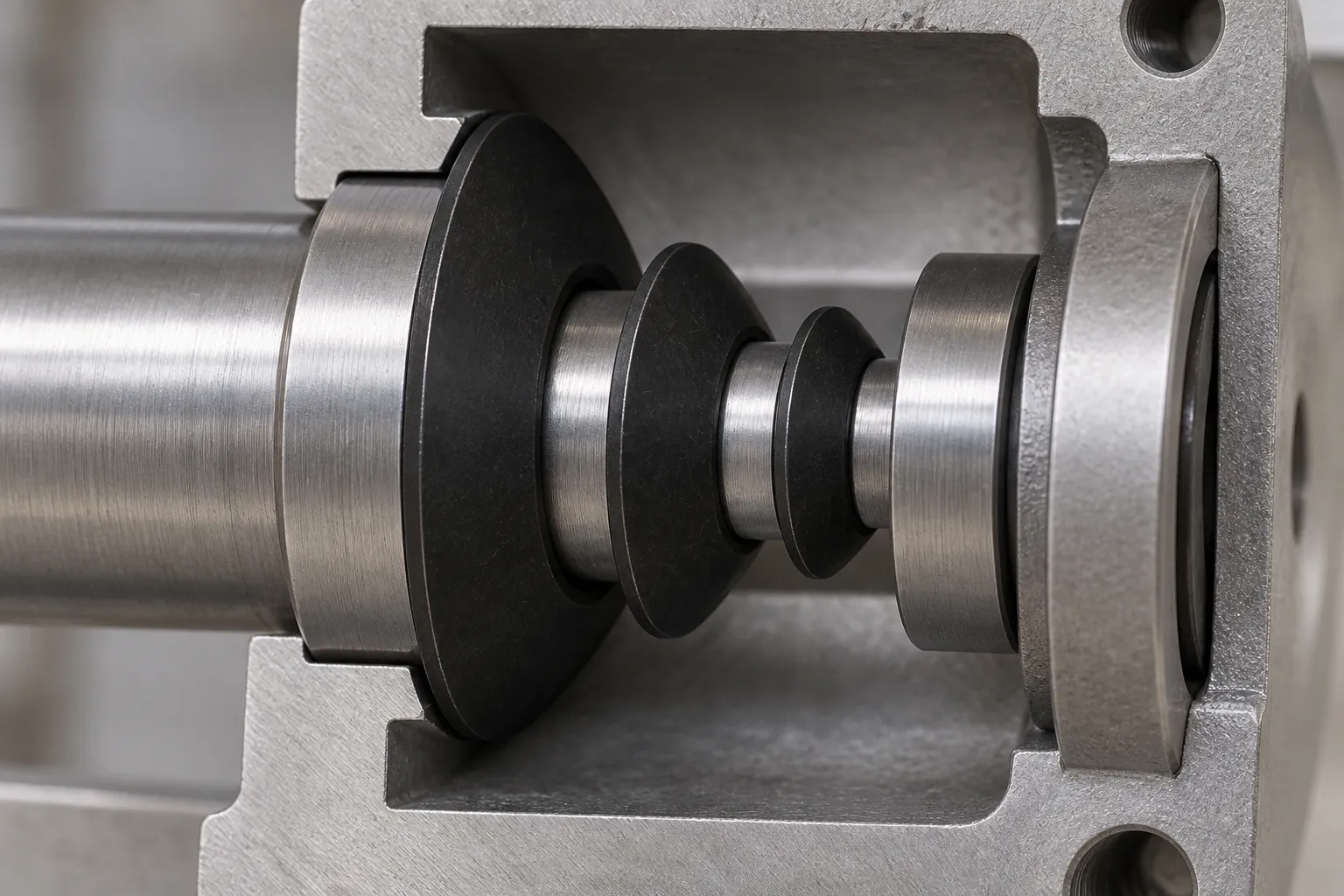
A single belleville disc spring can be arranged with other discs to change system force and travel. Discs nested in the same direction act in parallel: forces add while deflection remains approximately that of one disc. Discs facing alternately act in series: travel adds while force remains approximately that of one disc. Friction, guide clearance, and variation modify the ideal result.
Series, parallel, and mixed stacks
In an illustrative model, three identical discs in parallel target roughly three times the force of one disc at the same deflection. Three groups of two discs in parallel, arranged in series, target roughly twice the travel of one group. These relationships are not product guarantees; validate the actual stack against force-deflection curves and assembly friction.
Stack direction should be unmistakable on the drawing and at the workstation. Show a section view, discs per group, groups in series, the guide or locating feature, and the permitted installed height. Marking the outer face or using a controlled fixture can prevent the reversal that caused the Stuttgart failure. Eugene’s Belleville washer stack arrangements guide gives useful terminology for documenting these layouts, and a belleville disc spring stack should carry the same notation into assembly instructions.
| Term | What it usually describes | What the drawing still needs to define |
|---|---|---|
| Disc spring | Conical annular spring designed for axial loading. | Dimensions, material, load-deflection point, cycle duty, and finish. |
| Belleville disc spring | Common industry name for a conical spring. | Exact geometry and inspection; the name alone is not a specification. |
| Disc spring washer | Washer-shaped spring element used for preload or compensation. | Whether it is a spring element, plain washer, or defined stack component. |
A disc spring washer needs fatigue, relaxation, and tolerance control
Compact force density does not remove the need for fatigue analysis. A disc spring washer may be loaded once, cycled repeatedly, or held near a high working deflection; each duty creates a different risk profile. State cycle count, load range, dwell time, temperature, corrosion exposure, and whether permanent set is acceptable.
Fatigue is influenced by stress concentration, edge condition, surface finish, material quality, and operating stroke. Relaxation can reduce preload during a long dwell, especially at elevated temperature and stress. The supplier should explain material condition and inspection approach; the application owner validates the complete stack under representative conditions.
Tolerances matter because free height and thickness affect installed force and travel. Stack-height variation can consume margin intended for thermal expansion or joint settlement. Specify critical dimensions and measuring references, then agree on sampling, traceability, and acceptance criteria. A force-versus-deflection test at the defined installed height is a practical release check; it does not replace a life test when cyclic duty is critical.
For bolted joints, the disc spring washer should be evaluated as part of the joint, including bolt stiffness, surface settlement, torque scatter, and temperature. A disc spring washer stack can compensate for selected settlement, but only after the joint’s actual preload window is measured. Eugene’s overview of Belleville spring washers for high-load bolting is relevant when preload retention, rather than simple compression, is the design objective.
Belleville disc spring selection should connect dimensions, application, and total cost
Selection starts with the mechanism, not nominal outside diameter. Record load, working deflection, installed-height limits, guide condition, temperature, corrosion environment, and inspection access. Then compare candidate geometries and stack arrangements. A low-cost component can become expensive if it causes adjustment, assembly errors, or preload loss. A belleville disc spring may be the right form only if its working point fits the joint.
| Application need | Dimension or behavior to prioritize | Validation focus |
|---|---|---|
| High force in a short package | Conical height, thickness, and working deflection. | Force-deflection test and installed-height tolerance. |
| Longer axial travel | Series groups and available stroke before flattening. | Stack orientation, guide clearance, and travel limit. |
| Stable bolted-joint preload | Working point below the intended stress limit. | Relaxation, joint settlement, and torque/preload correlation. |
| Repeated cycling | Stress range, edge quality, and material condition. | Documented fatigue or endurance test using representative duty. |
| Corrosive or hot environment | Material, coating, and dimensional effect of the finish. | Environmental exposure and post-test dimensional inspection. |
For procurement, total cost of ownership includes inspection time, rejected assemblies, rework, orientation controls, replacement access, and unexpected preload loss. Compare drawing review, sample data, packaging, identification, change notification, and technical response time alongside unit-cost tendency. For a disc spring washer, these controls can matter more than a small unit-cost difference.
Eugene’s DIN 2093 Belleville disc spring product information can start a drawing-based discussion. The final fit remains application-specific. A prototype disc spring review can catch stack errors before tooling.
A disc spring washer specification should separate standards from certification
DIN EN 16983 is a reference for quality requirements for disc spring products. It establishes a basis for dimensions, materials, manufacturing quality, and inspection, but citing it does not prove certification, lot acceptance, or suitability for a particular machine. The purchase order should identify the edition, drawing revision, material condition, finish, test records, and nonconformance process. The disc spring washer description should match that controlled specification.
Standards and certificates answer different questions. A standard describes requirements or a technical framework; a certificate is evidence under a defined certification scheme. Ask what was inspected, by which method, and for which lot. Public references from DIN Media’s DIN EN 16983 listing and SPIROL’s DIN EN 16983 overview are useful starting points, but they do not replace project-specific validation.
Frequently Asked Questions
What is a disc spring?
A disc spring is a conical, annular spring element that produces axial force as it deflects toward a flatter shape. It is selected by geometry, material, load-deflection behavior, and service duty, not by the word “washer” alone.
What is a Belleville disc spring?
A Belleville disc spring is the common engineering name for a conical spring. The terms generally describe the same family of components, but the drawing must define exact dimensions, working point, and inspection.
Is a Belleville washer the same as a disc spring?
Often, “Belleville washer” refers to a conical spring, but “washer” can also mean a plain spacing or load-distribution washer with no intended spring function. Confirm the conical geometry and spring requirements; Eugene’s explanation of what a Belleville washer is provides useful terminology context.
How does a disc spring work?
Axial force flattens the cone, and elastic deformation creates a restoring force. Stacking discs in parallel increases force, while arranging groups in series increases travel in an idealized model; friction and tolerances modify the real result.
Why are disc springs used in tight spaces?
They can deliver substantial axial force with a short free height and small radial envelope compared with many coil-spring arrangements. They suit preload compensation and compact clamps when the guide, seat, stress range, and inspection method are properly designed.
References
- DIN Media: DIN EN 16983
- SPIROL: technical disc-spring overview
- SPIROL: DIN EN 16983 and former DIN 2093 overview
Eugene, Wenzhou Eugene Technology Co., Ltd., supports DIN-standard and custom fastener programs with drawing-based review and stack advice. For adjacent retaining-ring and fastening requirements, visit the circlips product category and contact Eugene with the assembly drawing, target load, travel, cycle duty, and inspection requirements.