A snap ring bearing is not selected from the word “bearing” alone. Confirm whether the retaining ring is integrated with the bearing or installed in the housing, then check the bearing designation, groove location, shoulder, fit and axial-retention direction as one assembly.
The phrase is used for more than one arrangement in supplier catalogs. The reliable purchasing question is therefore: which component carries the groove, which surface retains the bearing, and what exact ring or bearing designation is being replaced?
| Assembly condition | What the ring does | What to confirm |
|---|---|---|
| Bearing with an external retaining feature | Positions the bearing axially in a housing | Bearing designation, ring position and housing counterbore or groove |
| Separate housing retaining ring | Creates an axial shoulder against the bearing outer ring | Housing groove, ring section, orientation and seating depth |
| Internal bearing-side feature | Retains an adjacent component or locates the bearing in a specific assembly | Which surface is retained and whether the feature is part of the bearing or housing |
| Replacement ring only | Restores retention without changing the bearing | Original standard, nominal size, material, finish and groove condition |
The visible ring may look like a simple circlip, but the groove and shoulder geometry determine whether it can retain the bearing. A ring that fits the shaft or bore diameter may still be wrong if its section, axial position or material condition does not match the released assembly.
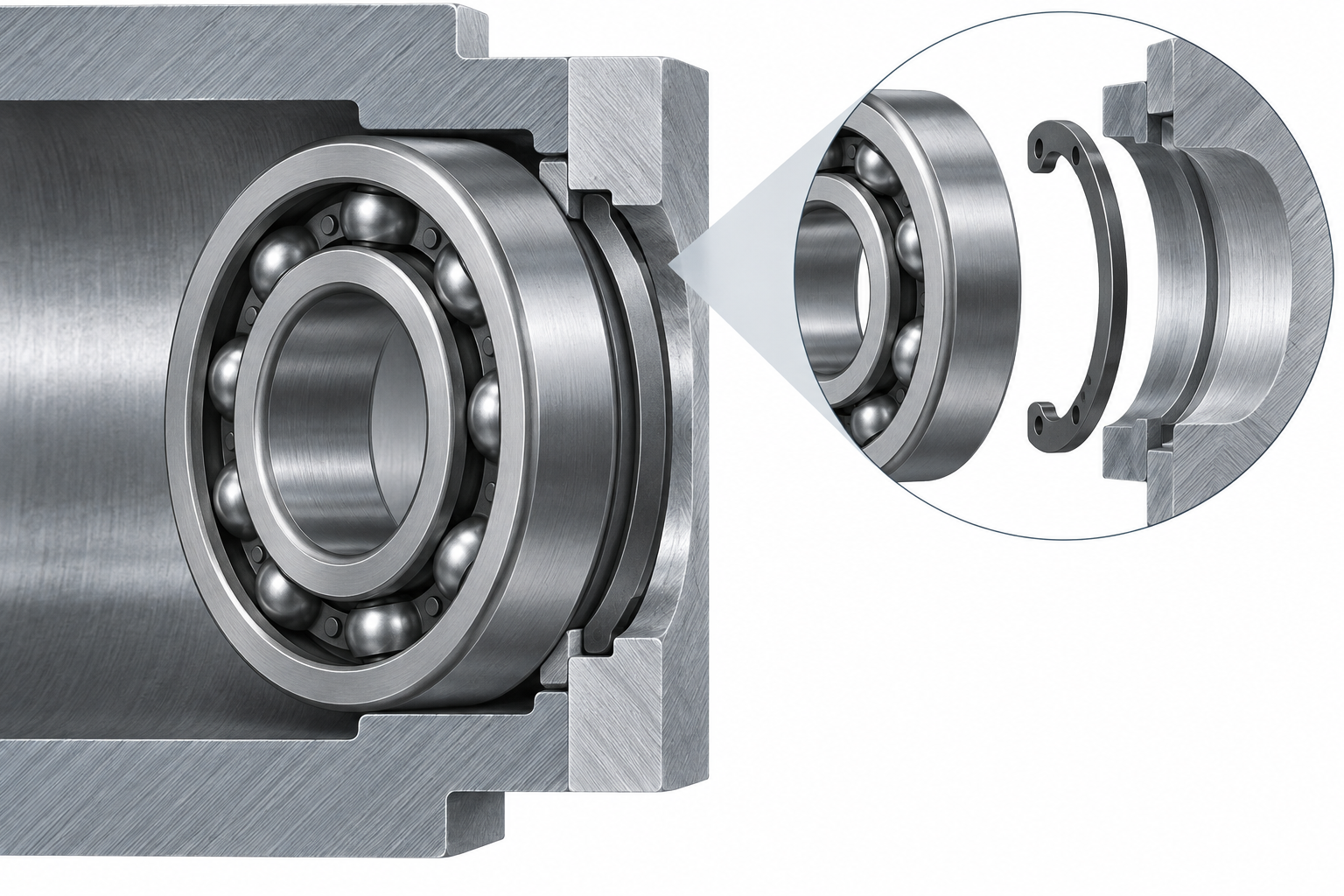
The bearing designation identifies the bearing’s own geometry and internal construction. The retaining ring has its own standard, nominal diameter, section, material and finish. Do not use the bearing designation as a substitute for the ring specification.
For a replacement bearing, confirm bore, outside diameter, width, sealing or shielding requirement and the housing condition from the bearing manufacturer or released drawing. For a replacement ring, confirm the groove diameter or bore, groove width and depth, ring section, axial load direction, material and surface condition.
When the bearing and ring are supplied as an assembly, preserve the relationship between those two records. A new bearing may have the same nominal envelope but a different retaining feature. A new ring may have the same nominal diameter but a different section or finish.
Inspect the housing groove for burrs, galling, contamination, corrosion and deformation. Check the shoulder that receives the bearing outer ring for damage and confirm that the bearing can seat without rocking. The ring should be fully supported by the groove and should not ride on a chamfer.
Also check access for installation and removal. A ring may be correct on paper but impractical if the lugs cannot be reached or the tool cannot approach without contacting the bearing or housing. If the design requires repeated service, include the removal method in the assembly review.
TG Eugene’s retaining-ring product families are a sourcing route for the ring component. For a standard or drawing-based review, identify the bearing/housing relationship rather than sending only the phrase “snap ring bearing.”
Not necessarily. The ring may be an integrated bearing feature or a separate housing component. Confirm which part carries the groove and how axial retention is created.
No. The groove diameter, width, depth, ring section, material and retention direction also matter. Match the released assembly condition.
This article routes the retaining-ring requirement to TG Eugene’s listed product families. Bearing supply and bearing-specific performance must be confirmed separately from the bearing maker or approved assembly source.