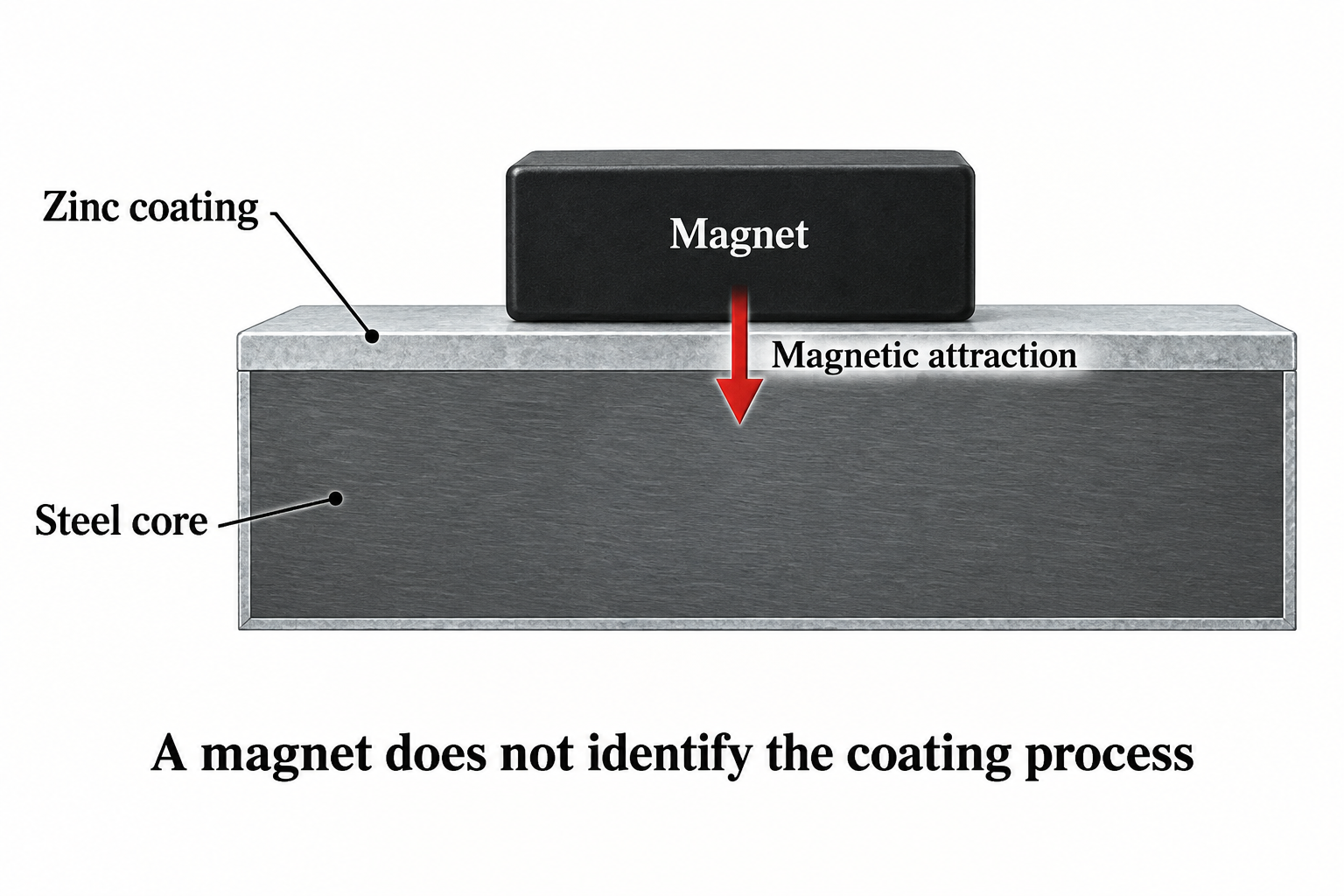
The answer to “is galvanised steel magnetic?” is usually yes when the underlying material is carbon steel. The magnet responds to the steel core through the zinc coating. Zinc itself is not the layer responsible for the familiar strong attraction.
This also explains the limit of the test: a magnet sticking to a gray steel part does not prove that the coating is zinc, that it was hot-dip galvanized, or that it meets the specified thickness. Material identity, coating identity and coating acceptance are separate questions.
No. Ordinary galvanized carbon steel combines a magnetic steel substrate with a nonmagnetic zinc coating. The coating does not turn the substrate into a nonmagnetic material. In a simple magnet check, you are mainly observing the response of the material underneath it.
The American Galvanizers Association describes this distinction when explaining why magnetic instruments can assess nonmagnetic coatings over steel. It also warns that a coating measurement alone cannot distinguish hot-dip galvanizing from other nonferrous coatings. Do not treat the visible surface and the base metal as the same material.
| Observation | What it supports | What still needs evidence |
|---|---|---|
| A magnet sticks to the part | A magnetic material is present within the magnet’s reach | Steel grade, zinc identity, coating process and coating thickness |
| The surface looks silver or gray | A description of appearance | Whether the finish is galvanizing, another coating or paint |
| A suitable coating gauge gives a reading | A layer measurement under that instrument’s operating conditions | Layer identity, individual-layer thickness in a multilayer system and compliance with the order |
No obvious attraction is also a reason to check the declared substrate and the test arrangement. It is not a reliable instruction to label the part “ungalvanized.” A coating description cannot establish how every possible underlying alloy should behave.
A coating gauge uses a defined measurement principle and manufacturer instructions. DeFelsko’s magnetic gauge range, for example, is intended for nonmagnetic coatings on steel and includes applications involving galvanizing and paint. A loose workshop magnet supplies no corresponding calibrated thickness result.
Identify what the instrument is measuring before interpreting its display. If paint covers zinc on steel, the nonmagnetic layers can contribute together to a magnetic coating reading. Valspar’s galvanized-substrate technical sheet explicitly notes this combined-layer issue.
Consequently, a reading taken over paint cannot automatically be reported as zinc thickness alone. Use the appropriate instrument and agreed method for the actual layer system. This distinction matters before comparing a result with a purchase requirement, even when the displayed number appears plausible.
Record the specified steel or component designation and the supplier’s description of the supplied material. Keep the substrate identity separate from words such as galvanized, painted, blued or polished. Those descriptions answer different questions.
For instance, Eugene’s heat-treated spring-steel strip page describes blued and polished surface options. That is a separate material-and-finish offering; those finish names are not evidence of a zinc coating.
Match the coating callout to the quotation and delivery documentation. “Zinc-coated” and “hot-dip galvanized” should not be silently treated as identical process instructions. If the order requires a particular coating process, obtain evidence for that process rather than relying on color or attraction.
A useful inspection record identifies the part or batch, the layer system, the measurement method and the applicable acceptance requirement. This is an information checklist, not a substitute for the specified inspection procedure. It prevents an unidentified sample result from being used to approve unrelated material.
If the surface treatment is uncertain, resolve that uncertainty with the supplier or an appropriate material/coating examination. Scratching, heating or applying chemicals to a part is not necessary to follow this document-based decision path.
Suppose a supplied bracket attracts a magnet and looks gray, while the order calls for hot-dip galvanized carbon steel. The attraction is consistent with the declared steel substrate. It does not resolve the coating requirement.
The next useful request is the coating-process and inspection evidence linked to that delivery. If a gauge result is supplied, check whether it was taken over bare zinc or another layer as well. Keep the material description, coating evidence and measurement record together before deciding whether the delivery meets the order.
For a different base material, use its own response explanation. The guide to titanium and magnetic identification addresses a separate material question. A magnet observation can help frame a follow-up; it cannot replace a grade or coating record.