In an 18-8 stainless steel vs 304 comparison, the main difference is the precision of the material description. “18-8” is a common composition-family shorthand. Type 304 is a specific grade, identified as UNS S30400. A part sold as 18-8 may be made from 304, but the broad label alone does not prove that it meets a 304 requirement.
For purchasing, the useful question is whether the supplied part and its records satisfy the order. Comparing these names as if they were always two different alloys can produce a false strength, corrosion or price ranking.
| Item | 18-8 description | Type 304 designation |
|---|---|---|
| What the name tells you | A broad chromium-nickel stainless description | A particular stainless steel grade |
| Meaning of the numbers | Nominal shorthand for roughly 18% chromium and 8% nickel | Grade number; 304 does not mean a composition percentage |
| Does the name certify a delivered part? | No; it does not establish every grade requirement | No; the delivered material still needs evidence matching the specified requirement |
| Useful purchasing follow-up | Ask which exact grade and product specification are supplied | Connect that grade and specification to the delivered batch |
SSINA explains that 18/8 and 18/10 can describe Type 304 or similar austenitic stainless steels, while the chemistry requirements for the specific grades vary. Treat the shorthand as a starting description, rather than a substitute for the required grade.
The numbers refer approximately to chromium and nickel content, not to two exact acceptance values that every product must match. That nominal description helps explain the name, but it leaves other composition and delivery requirements unanswered.
The comparison therefore is not “18-8 contains one recipe, while 304 always contains another.” A 304 material can fit the familiar 18-8 description. The problem is assuming that every item carrying the broader description has also been verified as 304.
Outokumpu’s Core range datasheet identifies its Type 304 product with UNS S30400 and describes it as a classic chromium-nickel austenitic stainless steel. Its published typical composition illustrates a particular product range. Typical values should not be copied into a purchase order as though they were the complete specified acceptance limits for every product form.
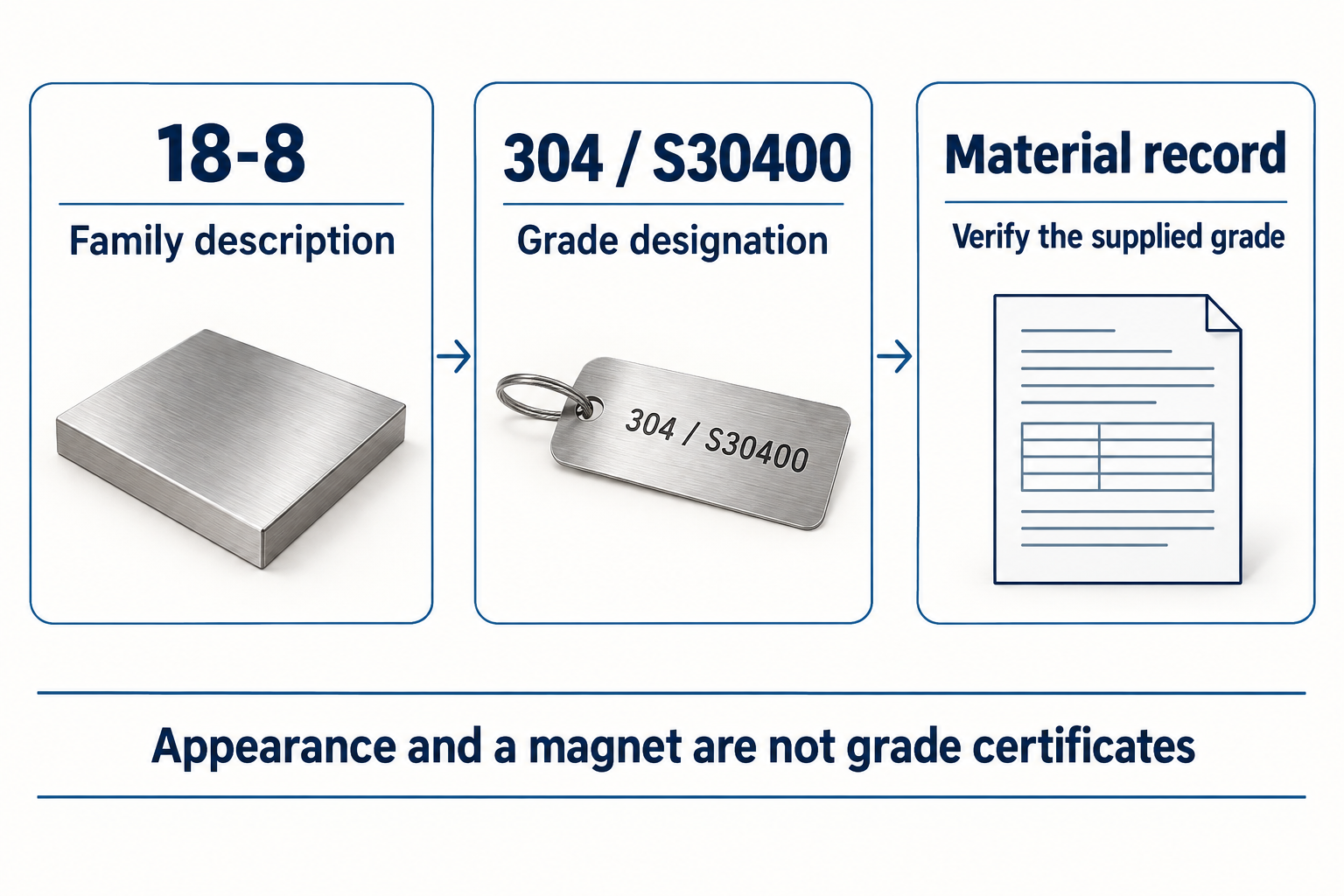
Austenitic 304 is generally not significantly attracted to a magnet in the annealed condition. Cold working can change its structure and magnetic response. ASSDA explains that deformation can transform some austenite into martensite, producing attraction.
Consequently, attraction does not by itself prove that a delivered 304 part is wrongly labeled. Lack of attraction does not certify it as 304 either. The observation and the grade-identification task need separate treatment.
Surface appearance has a similar limit. A bright nut, a brushed strip and a polished pin may look convincingly stainless without the appearance establishing an exact grade. Use observations to investigate a discrepancy; use the specified material evidence to resolve it.
Find the actual material callout. If the order requires 304, do not silently reduce that requirement to “stainless” or “18-8.” If the order itself only says 18-8, clarify whether a particular grade was intended before making a grade-specific acceptance decision.
Keep the applicable product specification visible as well. A material designation and a finished-fastener requirement do different jobs. Naming the alloy does not automatically establish the required condition or properties of a completed component.
Compare the supplier’s exact wording with the requirement. A quote saying only 18-8 has not answered an order that explicitly calls for 304 material evidence. Request the missing identification before treating the difference as a routine naming variation.
If the supplier confirms 304, have that confirmation connected to the supplied product and order. A general catalog statement about available stainless materials is not the same as a delivery-specific statement.
Review the material or inspection documentation required by the order. Check the grade designation, product identification and batch or lot connection where applicable. The purpose is to establish which record belongs to which supplied material.
This is not an instruction to require one certificate format for every purchase. The required document and verification method should follow the drawing, agreement and application. A generic, unrelated material report does not resolve a mismatch merely because it contains the word 304.
Keep dimensions, fit, condition, finish and any specified mechanical requirements in the review. Approval of a material name does not approve a different pin fit or spring behavior. Equally, a dimensionally correct part has not demonstrated the required alloy simply by fitting the assembly.
Suppose an order requests a 304 component, while the quotation and bag label say only 18-8. The label is incomplete evidence for the order; it is not proof that the material is inferior or unsuitable. Ask the supplier to identify the supplied grade and provide the agreed supporting record.
If the documentation establishes the ordered grade and the other requirements are met, the naming discrepancy may be resolved. If the supplier can confirm only the broad 18-8 description, a substitution decision remains necessary. Do not approve it by assuming that all stainless descriptions mean the same thing.
Price and strength comparisons also need defined products and conditions. Neither the 18-8 label nor the 304 number alone justifies a universal claim that one item is cheaper, stronger or more corrosion-resistant than the other.
For locating components, stainless steel dowel pin selection addresses the related fit and material decision. For elastic retaining components, stainless steel spring pin requirements need a separate review. Those component questions remain after the material name is clarified.
Specify the required grade together with the product function. A naming comparison cannot authorize substituting an unspecified stainless material for a particular spring-steel component.