The everyday answer to “is copper a magnetic material?” is no: an ordinary magnet usually will not stick to pure copper. More precisely, copper is weakly diamagnetic, meaning it develops a weak response that opposes an applied magnetic field. That differs from the strong attraction associated with ferromagnetic materials such as iron.
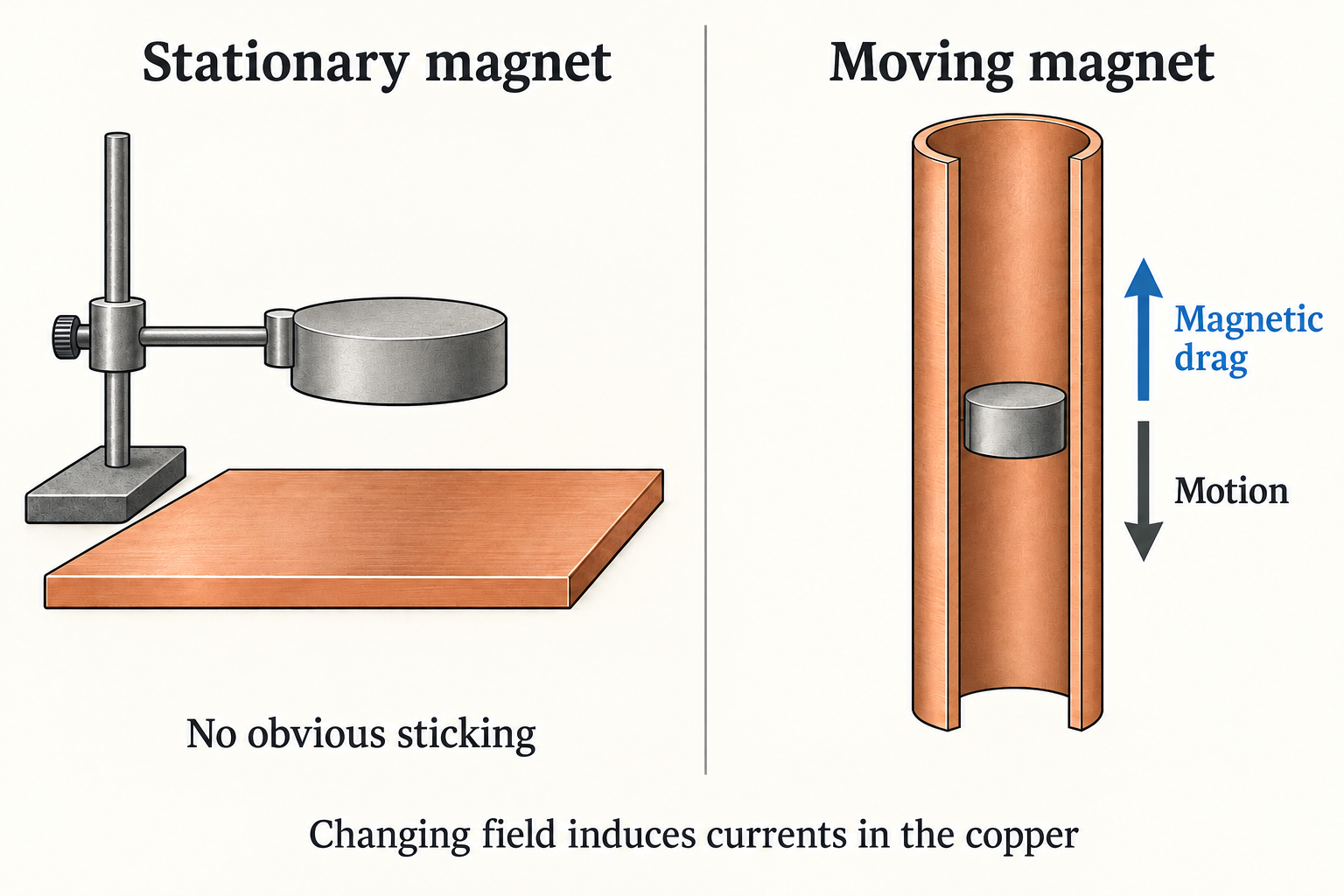
A moving magnet can still interact noticeably with copper. In a copper-tube demonstration, a falling magnet can slow because its changing field induces circulating electrical currents in the metal. Those currents produce a magnetic response that opposes the motion. The slowing does not mean the copper has become an ordinary permanent magnet.
The answer depends on what “magnetic” means in the question. If it means “will a refrigerator magnet stick to a clean piece of pure copper?”, the practical answer is usually no. If it means “can copper respond to a magnetic field?”, the answer is yes, although its static diamagnetic response is weak.
Calling copper nonmagnetic is convenient in ordinary conversation, but “no magnetic interaction at all” goes too far. Copper diamagnetism describes the weak static response. Eddy-current effects explain a different observation: resistance to relative motion between a magnet and conductive copper.
Keep those explanations separate when interpreting a video or a material check. A magnet that fails to cling to a copper sheet and a magnet that falls slowly through a copper tube are not contradictory results.
As a magnet moves through the tube, the magnetic field at a given part of the copper changes. That change induces circulating currents, called eddy currents. Their magnetic effect opposes the change that produced them. For a downward-moving magnet in the illustrated arrangement, the resulting drag acts upward.
This is a motion-dependent effect. It does not require the copper to attract a stationary magnet like an iron surface. The museum’s copper-tube explanation [3] makes this distinction between electrical conductivity and ordinary magnetic attraction.
The amount of slowing is not a fixed property that can be read from the word “copper.” Magnet strength and position, copper thickness and the shape of the conductive path influence the response. The magnet supplier’s demonstrations [2] illustrate these dependencies with copper sheets and tubes. A result from one arrangement cannot supply the fall time or braking force for another.
Use the observation to choose the next question, rather than jumping directly to a material name. This comparison keeps a simple magnet check in its proper scope.
| Observation | Reasonable interpretation | What it does not establish |
|---|---|---|
| No obvious sticking to a stationary sample | Consistent with pure copper’s ordinary static behavior | Copper purity, alloy grade or the absence of every magnetic interaction |
| Resistance appears while the magnet moves | Eddy-current drag may explain the motion-dependent effect | Ferromagnetism or a universal braking value |
| Strong attraction remains when movement stops | Check the complete part, backing, nearby hardware and material identification | That the copper-colored surface is solid pure copper |
The distinction is especially useful for finished components. A loose material sample and an assembled part are different objects to identify. Record what the magnet approached, whether anything was moving and whether attraction persisted at rest. Those details make a follow-up investigation more useful than a photograph labeled simply “magnetic copper.”
Copper is widely associated with electrical conductors and coils. A field associated with current in a conductor is different from a material strongly attracting a stationary magnet. Do not use a working coil as proof that the copper itself behaves like iron.
Likewise, the circulating currents in a tube demonstration do not establish that the tube will retain useful permanent magnetization. They explain an induced response under the demonstrated changing-field conditions.
A claim about pure copper should remain a claim about pure copper. Do not extend it automatically to every copper-based alloy, coated fastener or mixed-metal assembly. For an alloy or finished component, identify the material designation and consult the applicable supplier data rather than using color as the specification.
If the purchasing requirement includes magnetic behavior, state that requirement explicitly and obtain relevant material or test documentation. A casual magnet check does not identify composition, verify the ordered grade or replace the agreed acceptance method.
If a copper-colored component strongly attracts a magnet at rest, inspect what is actually present. A backing, underlying material, insert or nearby part may affect the observation. Surface appearance alone does not tell you which material the magnet is interacting with.
This is a reason to investigate the construction, not a diagnosis that every attracted part is plated steel. Avoid naming the substrate until the part records or an appropriate examination establish it.
Consider two reported observations: a magnet will not cling to a reddish metal sheet, but a similar magnet falls slowly through a tube described as copper. The sheet observation is consistent with ordinary pure-copper behavior. The tube observation is consistent with changing-field eddy currents. Neither observation alone identifies the material’s purity.
A useful material record separates the declared grade from the observed behavior. Include the supplier’s material identification, whether the item is a loose sample or an assembly, and the static or moving conditions of the observation. If those records disagree, resolve the identity before assigning an explanation to the whole component.
Other metals need their own interpretation. The guide to whether titanium is magnetic covers a related question without implying an identical response. For finished fasteners, brass versus steel material properties puts material selection in a component context. A magnet observation is one clue; the specified material and application requirements still govern the choice.