Snap ring pliers should be chosen by the ring location first: internal rings are expanded inside a bore, while external rings are compressed on a shaft. Straight or bent tips then depend on access, lug alignment and how clearly the ring can be inspected after it is seated.
This is a tool-selection decision, not a ranking of one plier shape as universally better. When comparing snap ring pliers types, match the tool to the retaining ring, the groove and the available working angle before applying force.
| Ring condition | Tool action | First check |
|---|---|---|
| External ring on a shaft | Compress the lugs so the ring can move over the shaft | Confirm the ring can close without twisting or leaving the groove |
| Internal ring in a bore | Expand the lugs so the ring can enter or leave the bore groove | Confirm the tips engage both holes and the bore is accessible |
| Limited radial access | Use the tip angle that reaches the lugs without side loading | Check the tool body clears the housing and adjacent parts |
| Ring without suitable lugs or holes | Do not force standard snap-ring pliers | Identify the ring design and use its intended removal method |
The plier handles may look similar, but the direction of the jaw movement matters. A tool intended to expand an internal ring is not automatically suitable for compressing an external ring. Reversing the action can deform the ring, damage the groove or make the ring difficult to control.
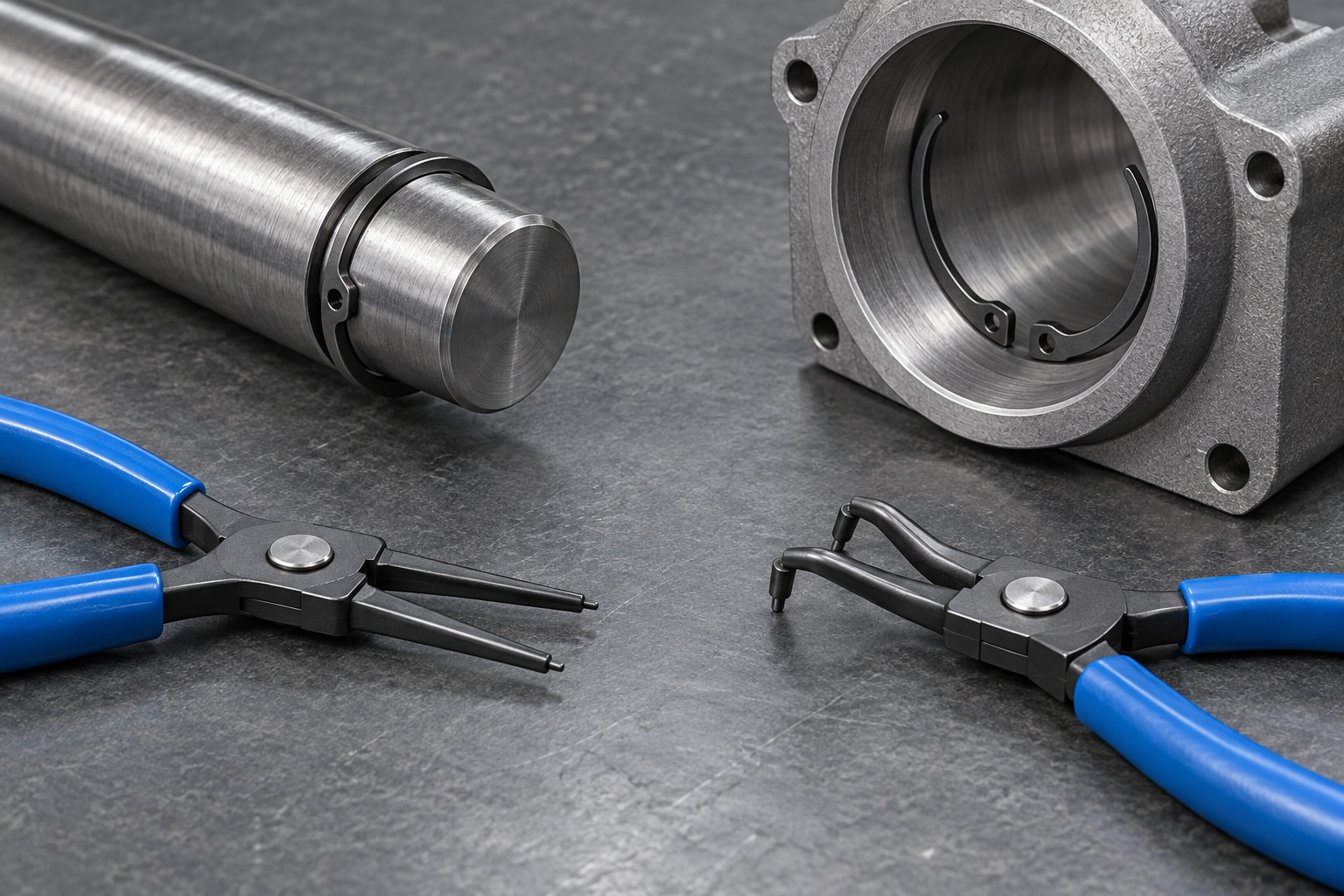
Internal snap ring pliers are used when the retaining ring sits in a bore or housing groove. The tips enter the ring holes or lugs, and the handles expand the ring enough to position it in the groove or remove it from the bore. The required movement is controlled: expand only as far as needed to clear the groove.
Before choosing the tool, check the bore opening, the depth of the groove, the ring-hole position and the space around the housing. If the tool body contacts the housing before the ring is fully seated, the operator may apply an offset force that distorts the ring or marks the surrounding surface.
External snap ring pliers are used when the ring is fitted around a shaft. The tips engage the lugs and compress the ring so it can pass over the shaft or move into its groove. The ring should remain controlled during the movement; do not use the handle force as a substitute for checking the groove and shaft condition.
Inspect the shaft groove for burrs, contamination, corrosion and damage before installation. A ring that stops short of the groove is not installed just because the handles have released. Check that the ring has returned to its intended shape and that its full circumference is supported by the groove.
Straight tips are often the simplest choice when the lugs face the operator and the tool can approach in line with the ring. Bent tips can improve access when a shoulder, housing wall or adjacent component blocks a straight approach. When buyers compare straight snap ring pliers with bent snap ring pliers, the correct choice is the one that keeps the tips seated in the lugs while the tool remains aligned with the ring.
Use access as the selection sequence:
A bent tip is not a replacement for the wrong action direction. If the plier tips slip, stop and reassess the ring design, hole size, access and tool fit rather than increasing force.
After installation, verify that the ring is fully seated in the groove, not riding on a chamfer or burr. Check the ring circumference, lug position and the retained component’s axial movement. For an internal ring, inspect the full bore perimeter where access allows; for an external ring, inspect the shaft groove and the side facing the retained part.
Replace a ring that is visibly bent, cracked, permanently opened or otherwise damaged. A plier is a handling tool, not evidence that a deformed ring remains fit for service. Production applications should define their own inspection and replacement rules.
For retaining-ring sourcing, TG Eugene’s product families can be reviewed with the required standard and size. If the fit or finish is application-specific, include the standard, dimensions, material, finish and quantity in the technical inquiry.
Internal pliers expand a ring inside a bore. External pliers compress a ring around a shaft. The ring location and lug movement determine the basic tool action.
Neither is universally better. Straight tips suit a direct approach; bent tips can reach lugs around a shoulder or housing wall. Choose the angle that maintains tip engagement and inspection access.
No. Rings without compatible holes or lugs, heavily corroded rings and damaged rings may need a different method or replacement. Do not force a tool that does not positively engage the ring.