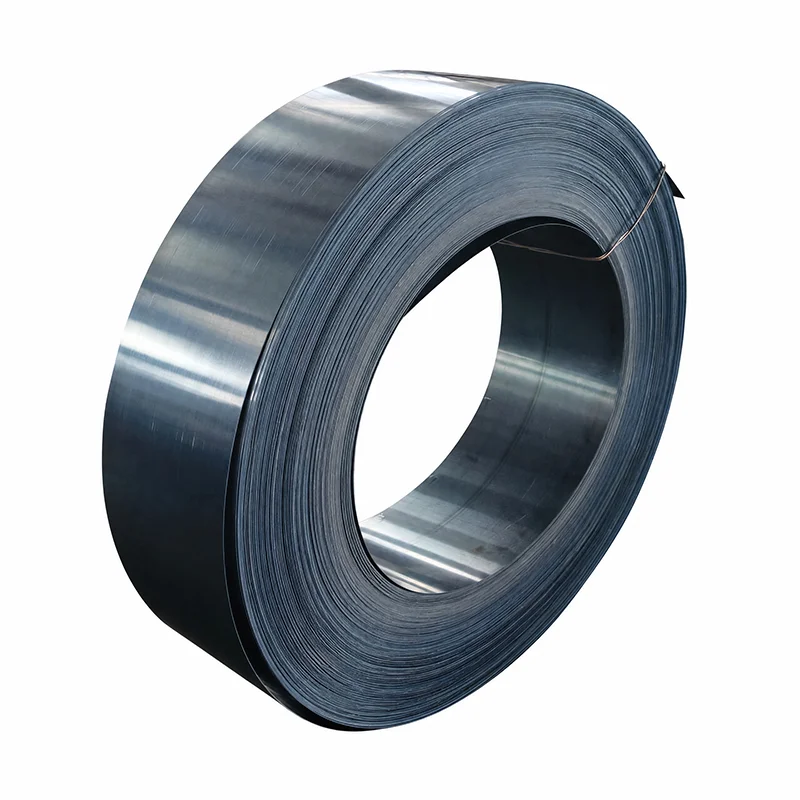
Spring steel is a family of steels designed to recover after bending or deflection when the applied stress stays within the usable elastic range. The name describes a performance role, not one grade, hardness, or product form. A controlled material specification must also define the standard, grade, delivery condition, dimensions, surface, edges, and later manufacturing steps.
This distinction matters when buyers compare strip for clips, retaining parts, flat springs, washers, and formed components. Two coils may both be called spring steel material, yet behave differently during stamping, forming, heat treatment, and service. The correct choice starts with the finished part and its production route.
The most important spring steel properties are elastic recovery, strength, hardness, and resistance to permanent deformation. Steel composition helps establish the possible property range. Processing determines how much of that range the finished material or component reaches.
Carbon content and alloying elements affect hardenability and the response to heat treatment. Thickness, prior cold work, quenching, tempering, and final part geometry also influence the result. For that reason, a grade name alone cannot predict how a finished spring will perform.
Elastic recovery also has a practical limit. If a part is loaded beyond its usable elastic range, it may take a permanent set or fail. Designers therefore evaluate the applied load, deflection, stress concentration, section thickness, forming direction, and expected cycle conditions together.
Hardness is not a complete substitute for this evaluation. A harder strip may offer higher strength, but it can also require different forming radii, tooling, and edge control. Buyers should connect the requested condition to the downstream operation instead of asking for the highest available hardness.
Spring steel grades identify defined chemical-composition families within a standard or supplier specification. Standards may also control dimensions, tolerances, delivery conditions, testing, or other requirements. A familiar grade label should never be treated as a complete purchase description.
| Reference | What it identifies | What the buyer still needs to define |
|---|---|---|
| DIN EN 10132-4 grade examples | Carbon and alloy spring-steel designations such as C55S, C60S, C67S, C75S, C100S, 51CrV4, and 80CrV2 | Delivery condition, dimensions, tolerances, edge, surface, and applicable test documents |
| ASTM A684/A684M-25a | Cold-rolled high-carbon steel strip within the standard’s stated scope | Selected composition, ordered type or condition, size, finish, edge, and order-specific requirements |
| Supplier-listed designations | Materials available within a supplier’s stated product range | The exact standard, condition, certification, and approved substitution rules for the order |
These systems should not be merged into an informal equivalence chart. Similar carbon levels or common market usage do not prove that two designations have identical chemistry, tolerances, heat-treatment response, or documentation. If a drawing permits alternatives, engineering should name the acceptable standards and substitution limits.
The latest edition also matters. ASTM currently lists A684/A684M-25a as active and describes several conditions for cold-rolled high-carbon strip, including spheroidized annealed, annealed, intermediate hardness, and full hard. That scope applies to the products covered by the standard; it does not define every spring steel form.
For an international order, place the standard and complete grade designation on the drawing or purchase order. Avoid requests that contain only a trade name such as “blue spring steel” or “high carbon spring steel.” Those terms may describe appearance or a broad material family, but they do not control the delivered material.
Delivery condition changes where forming and heat treatment occur in the manufacturing sequence. The better route depends on the component geometry, production process, tooling, final property requirements, and available heat-treatment controls.
| Strip route | Typical manufacturing logic | Points to confirm |
|---|---|---|
| Annealed strip | Form or stamp the softer material, then apply the specified hardening and tempering process | Forming severity, heat-treatment allowance, distortion control, scale or decarburization control, and final testing |
| Heat-treated strip | Use strip supplied in a hardened and tempered condition, then perform operations compatible with that condition | Required hardness range, bend limits, flatness, edge condition, tooling wear, and whether later heating could alter properties |
Annealed material can support demanding forming before the final heat-treatment step, but the finished component then depends on that later process. Heat-treated strip can remove part-level hardening from the sequence, yet it may be less forgiving during tight bending or severe forming. Neither route is automatically superior.
TG Eugene lists both annealed spring steel strip and heat-treated spring steel strip. These pages show the available supply routes and listed grade options. The project drawing and approved material specification should still control the final selection.
Spring steel appears as strip, sheet, wire, bar, and finished spring components. Product form affects how the material is rolled, cut, formed, heat treated, inspected, and packed. A strip supplier’s capabilities should not be assumed to cover wire or bar products under the same controls.
Cold-rolled strip is widely associated with flat springs, clips, retaining features, washers, blades, and stamped elastic parts. The application alone does not determine the grade. A small retaining clip, a power spring, and a loaded washer can require different sections, edges, hardness ranges, and fatigue validation.
Edge quality can become especially important after slitting. Burr direction, edge shape, surface defects, and local decarburization may affect forming or create a stress concentration. Surface finish, flatness, camber, thickness tolerance, and hardness uniformity can also influence feeding, stamping, and final part consistency.
Buyers should verify that the ordered material matches the production route and the finished component’s controlled requirements. This check gives engineering and purchasing a common basis for supplier review.
A good inquiry allows the supplier to check material availability and manufacturing compatibility without guessing. Start with the applicable drawing revision and identify the material using a recognized standard and complete grade designation.
For a new part, include the critical function without replacing measurable requirements with an application name. A statement such as “used for a retaining clip” gives context, but it does not define the load, deflection, hardness, or geometry. The drawing should carry the requirements that determine acceptance.
Prototype results should also remain tied to the tested material and process. Record the grade, heat, delivery condition, thickness, forming direction, tooling, heat treatment, and inspection method. This prevents a successful sample from becoming an unsupported approval for every material sold under a similar name.
Spring steel selection becomes clearer when the team separates four decisions: material family, grade and standard, delivery condition, and finished-part validation. That structure avoids false equivalence and makes supplier feedback more useful. It also gives purchasing a specification that can be checked at quotation, production, and incoming inspection.