Single sourcing places a component’s purchases with one chosen supplier; dual sourcing uses two supply sources. The choice should turn on the cost of qualifying and maintaining the routes, their ability to meet the same requirement and the disruption each route can absorb. Two quotations do not establish that two usable production routes exist.
For retaining rings, washers, pins and other drawing-controlled parts, compare approved configurations and actual dependencies before dividing orders. The framework below separates a sourcing decision from a supplier-count target.
Define the decision at the component or purchasing-family level. A company can use one supplier for a particular pin while using several suppliers across its wider fastener spend. Calling the entire business single-sourced can hide the specific dependency being assessed.
IBM distinguishes single sourcing, where a business chooses one source while alternatives exist, from sole sourcing, where only one source is available. That distinction changes the next question: is the buyer choosing concentration, or does a usable alternative still need to be developed?
For this purchasing framework, dual sourcing means maintaining two evaluated routes for the same defined requirement. They may both receive regular orders, or one may serve as an agreed contingency. State which arrangement is proposed; a name on a supplier list does not describe readiness.
Single sourcing may be a deliberate choice when the buyer can justify concentration and manage its consequences. Dual sourcing may be worth developing when an alternative addresses an important interruption scenario. Neither label establishes product quality, available capacity or an appropriate split of orders.
Compare each arrangement against the same drawing, demand pattern and acceptance requirements. Separate the initial cost of creating a usable route from the ongoing effort needed to keep it current.
| Decision area | One chosen route | Two evaluated routes |
|---|---|---|
| Qualification effort | Evaluate and maintain one approved configuration. | Evaluate each configuration and retain source-specific records. |
| Commercial comparison | Check the effect of concentrated volume and dependency. | Check tooling, order size and maintenance costs for both routes. |
| Quality control | Control the selected source and its changes. | Control both sources and distinguish their deliveries. |
| Interruption response | Identify inventory, recovery or alternative-development actions. | Verify which interruption the second route can actually address. |
| Ongoing readiness | Review changes affecting the active source. | Review technical currency and availability of the second route too. |
This is an original comparison aid, not a claim that either arrangement always costs less. Ask suppliers to identify the assumptions behind their offers. Compare the same sample stage, production quantity, inspection scope and delivery basis before interpreting a unit-price difference.
Capacity also needs a scope and a time. A supplier’s general willingness to quote does not answer whether it can supply the required configuration during a disruption. Ask what must happen before an additional order can be accepted: material availability, tooling access, technical approval and the proposed production slot may all need confirmation.
Map the important operations behind each supplier before treating the routes as independent. Different sales offices or manufacturing sites can still rely on a common material source, outside operation or transport connection.
Consider a hypothetical washer requiring a specified heat-treatment operation. Supplier A forms the part and sends it to an outside processor. Supplier B quotes the same drawing but proposes the same outside processor. If that shared operation is unavailable, moving the purchase order from A to B may leave the original constraint unresolved.
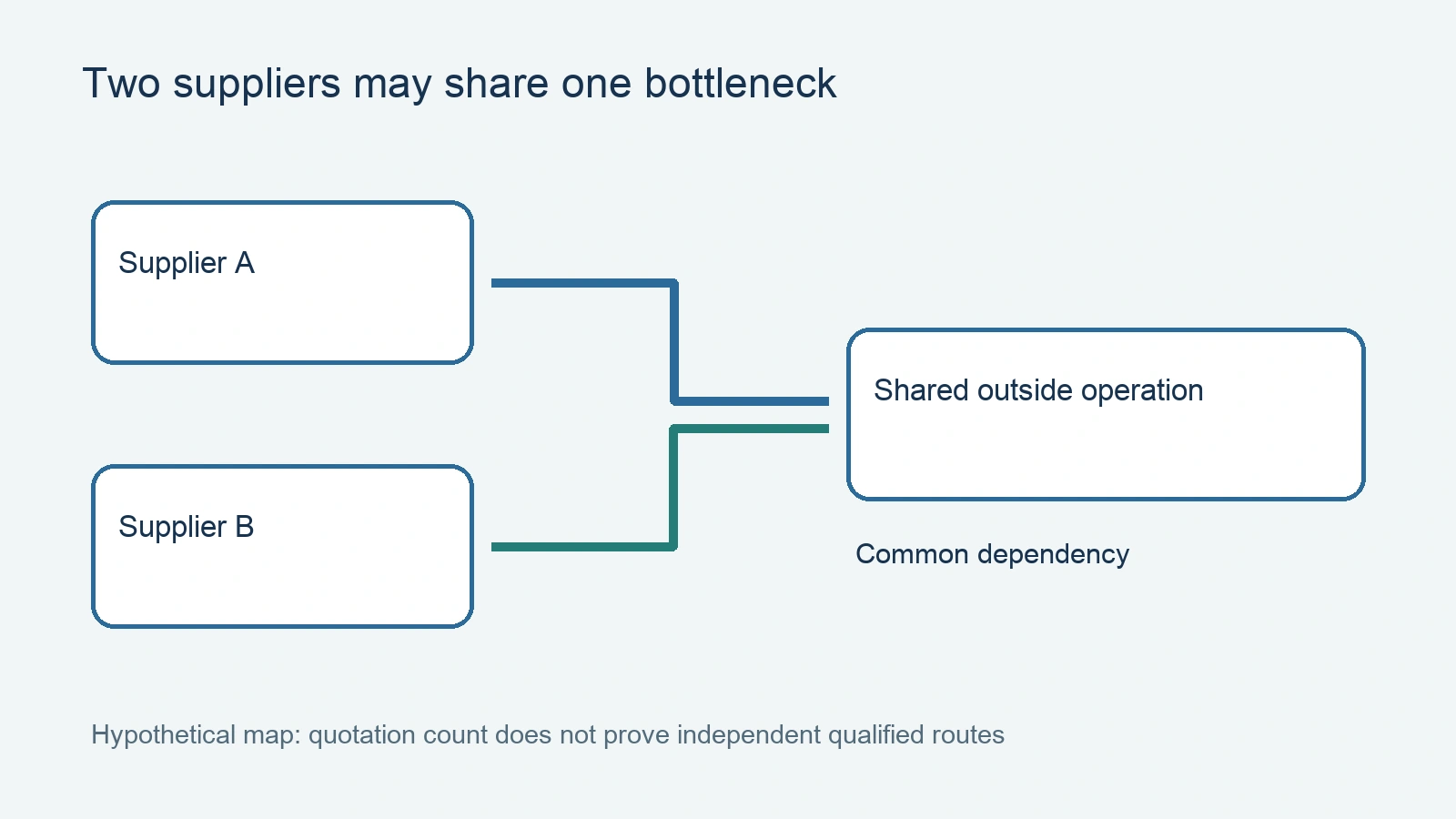
The shared processor is not automatically a reason to reject either supplier. It is a reason to describe the limitation honestly and decide whether another approved route is needed. An alternative processor would itself require the relevant technical review; a purchasing substitution cannot supply that approval.
NIST’s supply-chain risk discussion recommends looking beyond the first tier to supplier locations, activities, alternative sites and the time required to begin shipping from them. Use that mapping principle to ask focused questions about the interruption you want the second route to cover. Avoid asking suppliers for unrelated confidential customer information.
Give the second source the current controlled requirement and define the evidence needed for release. A backup evaluated against an old revision is not automatically ready for a new order.
Start with the drawing and its referenced material and finish requirements. Request a written response identifying exceptions or unclear notes. Keep an alternative material or process proposal separate from the baseline until the responsible technical person approves it.
Then agree the purpose of the sample submission. The buyer may need dimensional records, material evidence or an assembly evaluation, depending on the part and its specification. Select the evidence from the actual requirement; there is no universal test package that qualifies every fastener.
Retain the decision against the source, configuration and evidence reviewed. If the supplier changes a relevant outside operation, material route or drawing interpretation, make the review path clear. The same need applies to the first source; dual sourcing should not leave one route under weaker change control.
Keep deliveries distinguishable while evaluating the routes. For example, the buyer can agree source and lot identification sufficient for its own receiving and traceability needs. That makes an observed issue easier to connect to the affected delivery rather than to an undifferentiated stock of parts.
The practical qualification result can be approved, approved with stated limits or awaiting a specific answer. Record the remaining limitation directly. Do not turn “sample requested” or “quotation received” into “qualified” in the supply-risk register.
State whether the second route is active or held for contingency, and document what would trigger a change. An allocation percentage without an availability agreement can create a false sense of security.
For an active arrangement, discuss the expected demand pattern with each supplier. Identify which orders are firm, which figures are forecasts and what notice is needed for a proposed increase. Do not assume that either source reserves unused capacity merely because it supplied a previous order.
For a contingency arrangement, identify the steps between a disruption and the first acceptable delivery. These can include confirming the current drawing, checking tooling condition, securing material and releasing a production order. Obtain current information from the parties responsible for those steps rather than inventing a recovery time.
A short decision record might read: “The second source is technically evaluated for the stated revision; available capacity and material must be reconfirmed before release.” That is a hypothetical wording example, not evidence that any supplier is ready. It makes the boundary between technical acceptance and commercial availability visible.
Review the record when a material change occurs: a drawing update, a major demand change or a different outside process can affect its usefulness. Assign an owner for this review so that the backup remains a managed option.
Keep one source when the evaluated route meets the requirement and the buyer accepts a documented concentration risk with a practical response. Develop a second route when it addresses a defined interruption and the buyer can maintain its technical and commercial readiness.
If the current evidence supports neither decision, make qualification the next action. Identify the unanswered question, its owner and the evidence needed. That may be more useful than changing an allocation before the proposed route can supply acceptable parts.
For a fastener enquiry within Eugene’s retaining-ring, washer, pin and spring-steel-strip scope, use the service and enquiry process to provide the drawing revision, material, finish, quantity and evaluation objective. Explain whether the enquiry concerns a primary source, a second source or feasibility only. Request confirmation of the proposed route and its open points before treating it as available supply.
IBM: Sourcing types and the single-source/sole-source distinction