FCA Incoterms means Free Carrier: the seller delivers to the carrier or another person nominated by the buyer at the agreed place. Under Incoterms® 2020, delivery differs between the seller’s premises and another named place. A usable FCA quotation therefore needs a precise handover point, a defined collection arrangement and a clear boundary for the included transport work.
For a fastener buyer, the key task is to connect that boundary with the component quotation and the forwarder’s instructions. A town name followed by “FCA” leaves important operational questions unanswered.
Identify the delivery place before comparing an FCA offer with another delivery basis. FCA can be used with different transport modes; the location and agreed handover are more useful than assuming that the term refers to a port.
The seller handles applicable export clearance under FCA. That does not mean the seller handles every later customs task or arranges the whole journey. Ask what the quoted route includes and keep onward-carriage instructions consistent with it.
This article explains a general purchasing framework under the 2020 edition. It does not determine clearance eligibility, tax treatment or the appropriate terms for a specific transaction. Those questions require the actual route and parties.
A useful review separates the component requirement, the sales delivery boundary and the carrier’s assignment. Each needs a named owner. The quotation can then be checked against a defined movement rather than an assumed meaning of “delivery included.”
At the seller’s premises, FCA delivery occurs with the goods loaded on the buyer-arranged vehicle. At another named place, delivery occurs on the seller’s vehicle, ready for unloading and available to the buyer-nominated carrier or person. The ICC’s rule explanation distinguishes these cases; use the actual proposed place to identify which applies. Risk of loss or damage transfers from seller to buyer at the delivery event described for the applicable case.
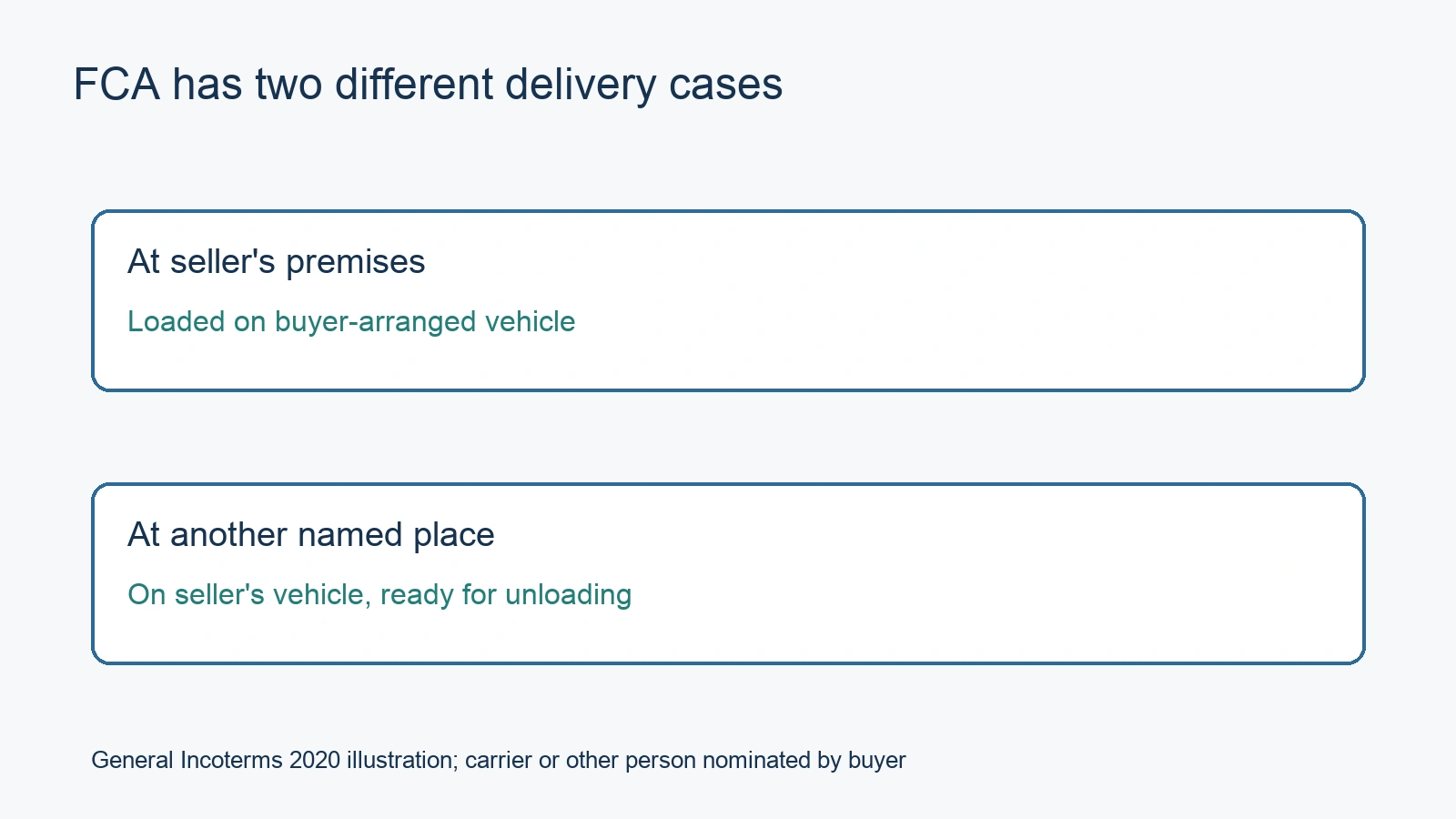
The following comparison translates that distinction into questions for the quotation review. It is an original coordination aid, not a reproduction of the full FCA rule.
| Proposed arrangement | Quotation question | Forwarder question |
|---|---|---|
| Collection at seller’s premises | Which exact address and collection point are included? | What vehicle, arrival window and loading coordination are needed? |
| Handover at another named place | Which pre-carriage movement and exact receiving point are included? | Who receives the goods and how is unloading coordinated? |
Do not combine details from the two cases into an informal description. For example, seller loading at its premises and handover at a distant terminal describe different stages. If an offer refers to both, ask where the agreed delivery boundary is intended to sit.
Keep risk transfer and operational handling visible as separate review questions. A collecting party still needs clear instructions about access, timing and the consignment, even when the sales delivery point has been identified.
Name a point that the people moving the goods can identify. An address, terminal name or warehouse description may need an entrance, receiving contact or booking reference to become operationally usable.
Consider a hypothetical order for cartons of retaining rings. The supplier quotes FCA at a terminal, while the buyer’s forwarder assumes collection at the supplier’s warehouse. Both parties may believe the other will arrange the movement between those locations. The problem is an inconsistent route description, not a component-price difference.
Resolve the example by obtaining one agreed handover description. Identify the named terminal and precise point, the proposed arrival arrangement and the person receiving the consignment. Then ask the forwarder to confirm its assignment against that same description.
Collect the operational inputs together: the order reference, confirmed packing information, expected readiness, nominated carrier contact and any receiving instructions. If the packing dimensions or collection window remain provisional, keep that status visible when transport is quoted.
Ask who will notify the other parties when the goods are ready and who will communicate a changed collection plan. A driver arriving at the wrong premises can create a practical problem even though every document contains the letters FCA.
Before release, compare the supplier’s final quotation, the buyer’s order and the forwarder’s instructions. Any difference in the named point should be an explicit question rather than something the warehouse is expected to interpret.
Compare the same goods first, then compare the route. For drawing-based pins or washers, align the drawing revision, material, finish, quantity and required inspection records before interpreting a delivery-price difference.
Next identify the movement included up to the named handover. If one offer assumes collection at the seller’s premises and another assumes delivery to a terminal, show that difference in the comparison. Request the missing transport scope instead of treating both prices as equivalent FCA offers.
List separately quoted items and exclusions in plain language. These might include packing assumptions, terminal handling items or a buyer-arranged onward movement. Confirm the actual quotation treatment; do not infer a universal charge allocation from an incomplete cost line.
A practical comparison sheet can contain the component price, exact delivery point, included movement, separately quoted handling and unresolved questions. Keep any forecast packing data separate from confirmed shipment data. This preserves the assumptions behind the freight comparison.
The outcome should allow the buyer to explain why two totals differ. A cheaper component price paired with a different route may still be useful, but it needs an explicit route comparison before becoming an order decision.
Coordinate the document requirements with the people responsible for the sale and carriage. The ICC Academy highlights that the sales contract and the carriage contract involve different parties and obligations. A delivery term does not, by itself, arrange the carrier’s paperwork.
Ask which evidence will record the agreed handover and which transport document the carrier proposes to issue. Match the consignment identifiers across the relevant documents so the buyer can connect the movement with the goods ordered.
If the commercial arrangement requires a particular document, raise that requirement before the shipment is booked. Do not assume that every FCA movement produces an identical bill of lading or that a document available for one transport mode will suit another.
For a technical purchasing team, keep product records in the same handoff plan without confusing them with transport documents. A dimensional report addresses specified component characteristics; a carrier receipt addresses a different event. Identify which records are required and when the buyer needs them.
Keep the final collection instructions accessible to the supplier and the nominated carrier. A document request buried in an earlier email may not reach the people handling the shipment.
Request a quotation against one defined component requirement and one proposed handover. State the rules edition, named place and exact point as far as these are known. Mark the remaining route questions explicitly.
The enquiry should identify whether collection is proposed at the seller’s premises or at another location. Provide the carrier or forwarder contact when available, and request confirmation of packing details needed for transport planning. Keep the sample and production stages separate if their packing or delivery arrangements differ.
Within Eugene’s retaining-ring, washer, pin and related fastener scope, use the service enquiry process to provide the drawing revision, material, finish, quantity and intended handover point. Ask the supplier to identify the quoted route and exclusions. A specific FCA arrangement remains subject to confirmation in the actual offer.
ICC Digital Library: FCA explanatory notes in Incoterms 2020