CPT Incoterms means Carriage Paid To: the seller arranges and pays the agreed carriage to a named destination, while risk of loss or damage passes at the earlier carrier-delivery point. Under Incoterms® 2020, paying freight to a destination does not mean retaining transport risk until arrival. A buyer should understand both locations before comparing a CPT quotation.
For cartons of pins, retaining rings or washers, that distinction affects the questions to ask about transport, insurance and the movement beyond the quoted destination. Start with two points on the route rather than one price labelled “freight included.”
Read the named destination as the place to which the seller undertakes to arrange carriage. Separately identify where the goods will be delivered to the carrier. The ICC Academy’s CPT explanation stresses that these locations have different functions.
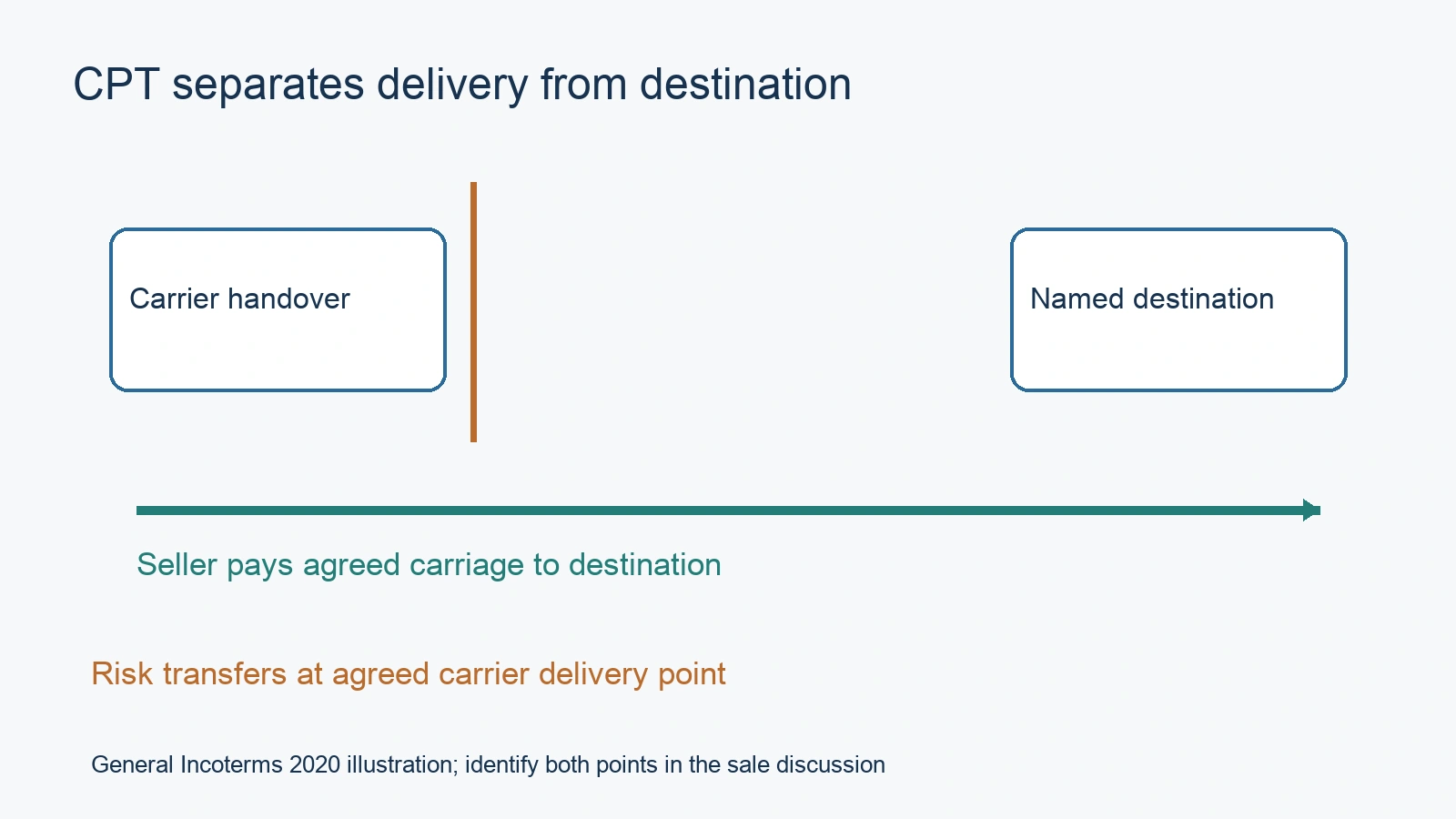
If several carriers are involved and no specific delivery point has been agreed, the first-carrier handover is particularly important. Do not assume that the main vessel, final truck or destination terminal automatically marks the risk boundary.
The term also does not describe every commercial condition of the component order. Keep the part specification, quality evidence and payment arrangements separately identifiable. A delivery abbreviation cannot resolve a drawing deviation or establish which inspection report the buyer will receive.
This is a general purchasing explanation of the 2020 framework. It does not determine a party’s legal liability in a disputed shipment or select insurance cover for a particular transaction.
Use one route description that the supplier and forwarder can both understand. Record the location associated with each responsibility and identify which details still need confirmation.
| Quotation item | Question to resolve |
|---|---|
| Carrier delivery | At which agreed place and point will the goods be handed to the carrier? |
| Named destination | To which exact place does the quoted carriage extend? |
| Route after destination | Is another movement needed to reach the buyer’s actual receiving site? |
| Handling scope | Which terminal or unloading items are included in the quoted transport arrangement? |
| Transport evidence | What handover and transport information will be available to the buyer? |
| Open assumptions | Are packing details, readiness or the receiving arrangement still provisional? |
This original worksheet is a quotation-review aid. It does not replace the agreed rules or the carrier’s terms. Its purpose is to prevent a destination name from hiding an earlier handover or a remaining delivery leg.
For example, a quotation naming a destination terminal differs from one naming the buyer’s receiving site. Before comparing their totals, ask the responsible party to price the remaining movement on the same packing and readiness assumptions. Record that amount separately if it is outside the supplier’s offer.
Keep the exact destination description consistent across the quotation, order and transport discussion. If a supplier changes the proposed terminal, review the effect on onward movement rather than assuming that all destinations in the same city are interchangeable.
Consider a hypothetical order for cartons of drawing-controlled pins. The seller proposes handing them to a carrier at an inland collection point and paying carriage to a terminal in the destination country. The buyer’s warehouse is beyond that terminal.
The buyer should identify the carrier handover and the named destination separately. The freight offer reaches the terminal; the buyer still needs a clear plan for any movement from there to its receiving site. The earlier risk boundary also needs to be understood when discussing insurance.
Now suppose another supplier quotes carriage through to the warehouse. That offer covers a different destination scope. It cannot be compared with the first terminal-based offer solely by subtracting the component prices.
Before evaluating either proposal, confirm that the pin drawing revision, material, finish, quantity and inspection scope match. Then compare the transport descriptions and any separately quoted items. A freight difference should not obscure a technical difference in the components being offered.
No cost saving or transit duration is assumed in this example. The useful result is a visible list of included movements and unanswered questions. If the packing dimensions remain estimated, mark the transport comparison as provisional until the final shipment information is available.
Ask directly whether insurance is included and what arrangement is proposed. CPT does not impose the seller insurance obligation associated with CIP. An offer saying “carriage paid” is therefore insufficient evidence that the buyer’s transit exposure is insured.
If cover is proposed, obtain the relevant policy information and ask the responsible insurance adviser to assess its scope for the shipment. Identify the route, goods and handover assumptions used. Avoid inferring coverage from a freight line or assuming that a carrier’s liability arrangement is the same as cargo insurance.
Review handling charges with similar care. Ask what the transport contract includes at the named destination and what is left for the receiving arrangement. A general summary of CPT cannot price an unidentified terminal service.
Import formalities remain a separate question for the buyer under the general CPT allocation. Confirm the actual requirements with the responsible parties for the intended movement; do not turn the delivery term into a country-specific clearance or tax calculation.
The comparison should expose exclusions before the order is released. Where a cost is unknown, record who will obtain it. An empty cell in a cost sheet should not be read as confirmation that the service is included.
Agree which component records are needed before shipment and which transport records will document the handover. These records answer different questions and should remain connected to the same order.
For a custom washer, for example, the buyer might request agreed inspection evidence against the controlled drawing. The precise record set follows the specification and purchasing agreement. A transport receipt does not replace that technical evaluation.
Use the required order, part and package identifiers consistently enough for the receiving team to connect the cartons with their records. Ask how the supplier will communicate the final packing information and who will receive notice when the shipment enters the proposed transport route.
If the buyer needs to review records before release, identify the approval contact and the action that follows approval. Keep goods readiness separate from a provisional freight booking. That gives both the supplier and forwarder a clearer basis for planning the handover.
Send a stable component requirement and a clearly described destination. Ask the supplier to identify the proposed carrier-delivery point, the included carriage and any route assumptions that remain open.
Include the drawing revision, material, finish, quantity and inspection requirements. State whether the enquiry concerns samples or repeat production, since the packing arrangement may differ. Provide the receiving location and any known forwarder requirements rather than asking only for a generic delivered price.
For Eugene’s retaining rings, washers, pins and related fastener scope, use the service enquiry process to request the component and delivery details together. Ask for a defined quotation boundary; a particular CPT, freight or insurance arrangement must be confirmed in the actual offer.
ICC Academy: CPT, carrier delivery and the insurance distinction from CIP