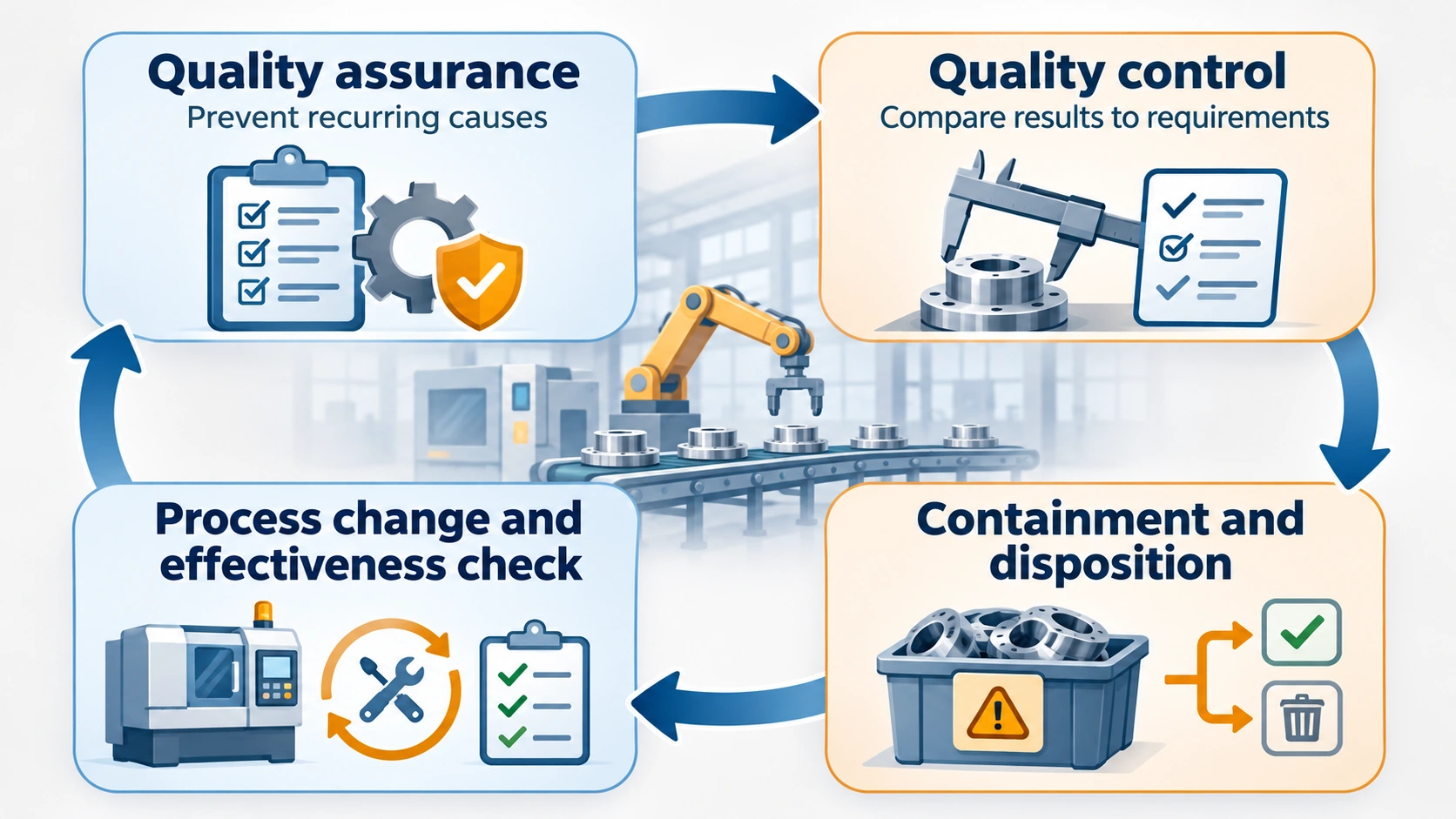
Quality assurance organizes the prevention and system activities intended to support quality; quality control checks and controls work against its requirements. In OEM parts procurement, QA concerns the way the order will be managed and made, while QC supplies checks and controls against the specified requirements. A useful supplier agreement connects both to clear responsibilities and acceptance evidence.
The purchasing question in quality assurance vs quality control has two parts: how will the supplier prevent an incorrect requirement or process from reaching production? What evidence will show that the delivered parts meet the order? An inspection report answers part of the second question. It does not, on its own, answer the first.
USGS summarizes QA through prevention and QC through detection. These are useful starting points, but the activities belong to a connected quality system. NASA’s White Sands program, for example, describes its QC work as an aspect of QA, with ongoing inspection and testing activities. For purchasing, the distinction is most useful when it identifies a decision, the person responsible and the evidence expected.
Consider a drawing revision. A proposed QA control might require the supplier to withdraw obsolete instructions when a new revision is released. A corresponding QC activity might compare the produced feature with the current drawing. The first addresses how the correct requirement reaches the job; the second evaluates the result against that requirement.
Do not equate QC with a check performed only before shipment. Operational controls can occur during production as well as at receipt or final inspection. Likewise, QA does not end when production starts. The agreed quality system and its feedback mechanisms continue to matter while work is being performed and when discrepancies are investigated.
| Purchasing question | QA-oriented agreement | QC-oriented evidence |
|---|---|---|
| Are the correct requirements being used? | Drawing review and revision distribution responsibilities | Result compared with the identified drawing feature |
| Can the planned checks be performed? | Review of methods, access and inspection responsibilities | Actual measurement or test record |
| Can the lot be identified? | Agreed identification and record-retention method | Matching part, label and report identifiers |
| What happens after a discrepancy? | Escalation, investigation and follow-up responsibilities | Recorded nonconformity, containment and disposition evidence |
This matrix is an original procurement framework, not a mandatory division between departments. A small supplier may assign several activities to the same person. Ask what the person does and what record follows, rather than assuming that a department called QA or QC performs every relevant task. Job titles cannot define the scope of an order.
NIST describes quality management systems as a structure for meeting applicable standards or technical specifications. In a supplier review, ask how that structure applies to the proposed order. A general procedure may explain the intended method; an order-specific record shows what happened for the identified parts. Review each against its own purpose.
For example, a procedure may say that inspection results are reviewed before release. The buyer still needs to agree what inspection is required and whether its report accompanies the shipment. Conversely, a completed report does not explain how the supplier resolves an ambiguous drawing note. Ask for the missing decision rather than expecting either document to cover both.
Agree the quality responsibilities while the RFQ is still being reviewed. Waiting until delivery leaves the buyer and supplier to interpret general promises under time pressure. Start with the released drawing, material requirements, quantity, inspection expectations and required documents. Ask the supplier to identify any unconfirmed item or proposed exception.
The buyer should identify the controlling document and connect it to the order line. Where a drawing, specification and purchase note differ, the responsible technical owner should resolve the conflict. Send the clarification to the supplier as part of the order information. Avoid leaving an important requirement inside an informal message that never reaches the people doing the work.
Separate technical approval from commercial approval. A buyer may accept a price without being authorized to change a material specification or a drawing limit. Name the route for technical questions and deviations. This lets the supplier ask the right person before proceeding and gives purchasing a clear status to track.
Ask the supplier to describe how the current requirements reach production and inspection. Keep the request proportionate to the part and contract. An explanation tied to a job document and its revision is more useful than an unrelated collection of procedures. The buyer should be able to identify how the proposed controls address the actual order.
Then ask which records will demonstrate completion. For a measured characteristic, identify the report feature reference and the required result format. For material documentation, identify the document and its connection to the delivered lot. For packaging identification, state the information that must remain with the shipment. Treat each as a specific deliverable rather than requesting unspecified quality paperwork.
The inspection plan should identify what will be checked, the applicable method, the agreed extent of inspection and the acceptance rule. This article supplies no universal sampling percentage or defect allowance. The appropriate plan depends on the requirements and risks of the particular order and should be approved by the responsible quality and technical personnel.
Also define who can release the lot and who can authorize a deviation. A delivery deadline should not silently transfer that authority to the person arranging transport. If evidence is missing, record the hold and the required action. If an exception is approved, identify its scope so it cannot become an undocumented change to future orders.
| Handoff | Decision to record | Evidence for the next person |
|---|---|---|
| RFQ to supplier review | Requirements understood; exceptions identified | Accepted drawing revision and clarification list |
| Review to production | Approved instructions and quality requirements released | Identified job information and inspection plan |
| Inspection to release | Results satisfy the applicable acceptance rule | Report, lot identity and authorized release status |
| Release to receiving | Shipment identity matches the order and records | Labels, required documents and receiving instructions |
| Discrepancy to follow-up | Affected scope and next action assigned | Containment record, disposition and action owner |
Give change notification its own line in the agreement. Ask what happens if the supplier proposes a different material source, process route, inspection method or other controlled condition. Identify which changes need review before implementation. The point is to agree the route for relevant changes, not to demand notification of every routine internal adjustment.
If the quotation includes an outside finishing or testing operation, ask the supplier how your requirements and required records reach that provider. Identify who reviews the returned evidence and connects it to the delivered lot. The buyer needs a clear contractual contact even when several organizations contribute to the finished part.
Do not assume that purchasing a finished component transfers every approval decision to the subcontractor. State which requirements need your technical owner’s review and which records the direct supplier must provide. This makes an outsourced operation visible in the same order-specific responsibility map without prescribing the supplier’s internal organization.
Finally, establish a practical record location and contact route. The buyer should know where to find the current clarification, report and approval when a receiving question arises. A carefully defined inspection plan loses value if the shipment cannot be matched to it. Responsibility includes handing the evidence to the person who makes the next decision.
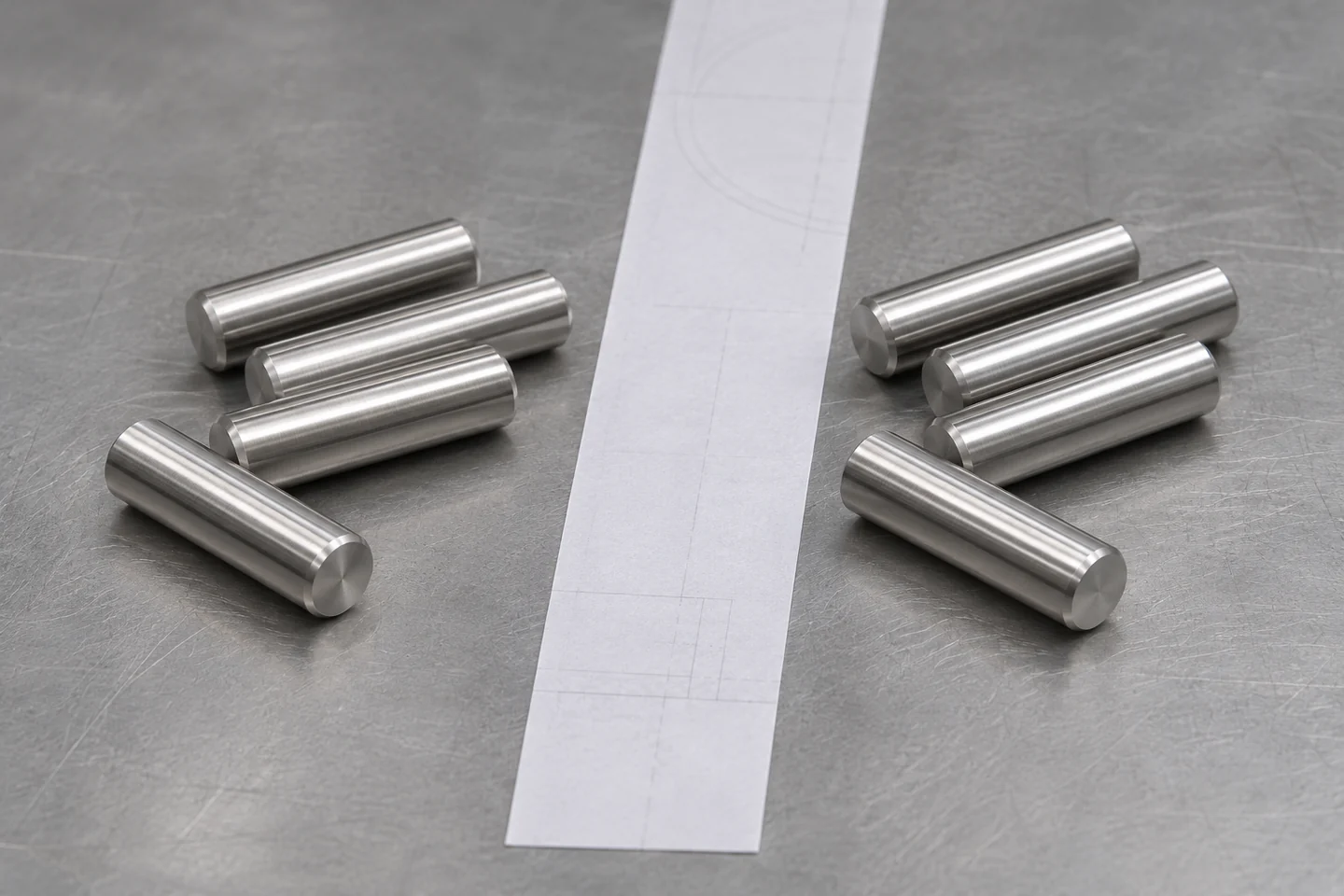
Consider a hypothetical shipment of locating pins. The order references the current drawing, but a receiving check finds that the report identifies an earlier revision. No dimensional conclusion has yet been established. The buyer has a document mismatch requiring investigation, not enough evidence to declare that every delivered part is physically incorrect.
The receiving team records the discrepancy and holds the affected material under the agreed procedure. It preserves the labels, shipment documents and inspection report. The buyer asks the supplier which job instructions and drawing revision were used, which lots may be affected and whether any related material remains at the supplier.
These requests make the immediate situation reviewable. They do not require the buyer to invent a root cause or demand an automatic replacement before the facts are known. The parties identify what must be verified to determine the status of the shipment. If the problem extends beyond the initially identified lot, the containment scope is updated accordingly.
The supplier compares its production and inspection records with the current requirements. In one possible outcome, the parts meet the current drawing but the report header is wrong. In another, the parts were made to the earlier requirement. Those situations need different evidence and disposition; neither should be assumed merely from the report’s appearance.
For a documentation error, the parties still need a supported correction that preserves traceability to the original inspection. For physically nonconforming parts, the authorized decision might involve return, rework or another formally accepted disposition. The responsible people choose the applicable route. The buyer records that decision against the affected material rather than using a general email as blanket approval.
Once the immediate status is understood, ask how the mismatch occurred and why the existing controls did not prevent or detect it. NIST’s Radiation Physics Division corrective-action guide connects cause investigation to implemented changes and monitoring of results. It governs that laboratory’s calibration and testing services, not OEM purchasing contracts. The useful distinction for this example is between identifying a possible cause, implementing a response and checking its effect.
In this hypothetical case, the team might investigate how drawings are issued to the job, how report templates are selected and what the release reviewer compares. These are questions to test against evidence, not predetermined findings. “Operator error” would be an incomplete explanation if nobody has established which information the operator received or how the report was generated.
The case also contains two different questions: why did the wrong revision appear, and why did it escape the release check? Keep both visible. Fixing the report header for the current shipment resolves an immediate record problem, but it does not necessarily change the route that allowed obsolete information into the job.
Suppose the investigation establishes that an obsolete report template remained selectable after the drawing was revised. A possible response is to withdraw that template and connect the approved report to the current job information. The team should first confirm that this response addresses the evidenced cause. It is an illustrative possibility, not a prescribed solution for every supplier.
Assign an owner to the agreed change and identify how completion will be demonstrated. Then define a follow-up that tests whether the changed control works on subsequent relevant jobs. The evidence might include the selected document revision and the release review record. The quality owner should choose a suitable follow-up scope rather than borrowing an arbitrary observation period.
Keep the closure questions separate: was the affected material disposition completed, was the process change implemented, and did the follow-up support its effectiveness? A replacement shipment may answer the first question without answering the others. An action report marked complete may document implementation while leaving effectiveness untested.
The purchaser’s task is to obtain and route that evidence, not to promise that recurrence is impossible. Where the same issue returns, reopen the relevant conclusion and examine what the earlier follow-up actually covered. A useful supplier conversation can name the original requirement, the observed mismatch, the agreed response and the remaining uncertainty.
Ask a supplier to connect its quality description to the proposed part. “We have QA and QC” does not identify the accepted requirement, inspection scope or release authority. A stronger response describes the drawing under review, the proposed evidence and any exception still awaiting a decision. It makes the order’s technical status visible before purchasing commits.
During qualification or an order review, choose a relevant example and ask how it moves from approved drawing to production, inspection and shipment. Request the level of evidence permitted by the review and confidentiality arrangements. You do not need another customer’s private documents to ask what identifiers and approvals your own order will use.
For an inspection claim, ask which characteristics the proposed check covers and what it leaves outside its scope. A statement about complete inspection is incomplete without a defined characteristic and method. It should not be read as a guarantee that every possible material, dimensional, surface and functional issue has been eliminated.
For a certificate or audit claim, identify the actual document, its holder, scope and applicable status when it is relevant to supplier approval. Keep that review separate from acceptance of the ordered lot. This article does not assert that Eugene holds a particular certificate or that a general quality-system description proves conformance of a specific shipment.
For a drawing-based fastener inquiry, include the part identifier and revision, material and finish requirements, quantity, required inspection evidence and the proposed delivery documentation. Identify any customer-specific approval requirement explicitly. Ask the supplier to separate confirmed requirements, technical questions and proposed deviations in its response.
For Eugene’s verified families—retaining rings, disc springs and washers, spring and locating pins, and spring-steel strip—the OEM and ODM service inquiry is a route for discussing those drawing and order requirements. Request confirmation of the exact inspection and documentation scope for the proposed item. General service information should lead to that discussion, not replace it.
Before order release, compare the supplier’s response with the quality requirements line by line. If a report is excluded, decide whether it must be added or whether another agreed record is sufficient. If the proposed method differs, send that difference to the technical owner. Resolve the actual exception rather than adding a broad assurance statement to the purchase order.
Carry the agreed decisions into receiving instructions. State which records the receiver checks, what triggers a hold and who resolves the question. This final handoff lets QA’s prevention arrangements and QC’s inspection evidence support the same purchasing decision: whether the identified material can be accepted under the agreed requirements.