4140 steel is a chromium-molybdenum alloy steel, but the grade name alone does not specify the hardness, strength or finished condition of a part. A purchase order also needs the applicable material specification, supplied condition, product form and drawing requirements. An annealed bar for further processing and a finished, hardened-and-tempered pin can both start with a 4140 description while representing very different deliveries.
For a buyer, the useful question is what must be true when the material or component arrives. Separate the grade identity from the condition, and separate both from dimensional acceptance. That distinction makes quotations comparable and prevents a material certificate from being mistaken for a finished-part inspection report.
The grade describes an alloy composition family. Chromium and molybdenum are part of that identity; the delivered condition still has to be stated. The same material description can appear on stock intended for machining, a prehardened product or a component receiving treatment after its main machining operations.
A bounded chemistry example helps explain the difference. The Atlas Steels 2021 bar datasheet lists carbon at 0.37–0.44%, chromium at 0.75–1.20% and molybdenum at 0.15–0.30%. These are entries from that named sheet, not a complete purchasing specification or a promise for every product sold under a 4140 label. The order must identify the governing specification and the certificate requirements.
Composition and condition answer different questions. A chemistry result can help establish whether a heat conforms to the ordered material specification. It cannot, by itself, show the final hardness of a machined pin, the straightness of a shaft or the size of a ground locating surface. Those are separate acceptance requirements with separate evidence.
This distinction also matters when a drawing uses a short material note. A note reading only “4140” leaves the supplier to ask whether the buyer expects soft stock for subsequent processing or a component already meeting final mechanical requirements. The quotation should expose that uncertainty before price and delivery are agreed.
Start with the exact material designation and applicable specification. Add the purchased form: bar, plate, blank or finished component. Identify the state at delivery. Finish with the requirements that apply to the completed item, including any inspection records needed to release it.
| Description layer | Question it answers | What it does not establish |
|---|---|---|
| Grade and material specification | Which material is ordered? | Final hardness, fit or geometry |
| Supplied condition | What processing state is delivered? | Acceptance of every finished feature |
| Product form and section | What stock or component is being purchased? | Transferability of another product’s property table |
| Drawing and inspection requirements | How will this delivery be accepted? | Material identity without traceability |
The layers should remain visible in the supplier’s response. A quotation that repeats the grade but omits the state has not answered the full material request. A report showing dimensions but no connection to the ordered material has a different gap. Neither omission is resolved by a broad statement that the part is made from alloy steel.
Supplied condition determines where responsibility passes between the stock supplier, component manufacturer and purchaser. The route must match the next operation in the buyer’s process. Purchasing material for in-house finishing is a different task from purchasing a part ready to assemble.
An annealed-stock quotation describes an intermediate material route. The buyer needs to know which further operations remain outside the quote: machining, hardening and tempering, finish grinding or final inspection. The requested stock condition is useful only when it fits that planned sequence.
Do not compare this quotation directly with the price of an accepted finished component. Add the work, records and responsibility still needed to reach the drawing requirement. Otherwise the lower material price can conceal an incomplete scope rather than a lower price for the same deliverable.
A practical stock request identifies the blank dimensions and which surfaces are intended to be removed. It should distinguish a stock-size allowance from the finished component tolerance. A receiving check for the blank can then focus on whether the material is suitable for the next planned operation, while final acceptance remains with the later manufacturing stage.
Prehardened describes a supplied state; it does not create a universal hardness specification. For example, the Industeel 2022 sheet for its prehardened 4140 plate identifies a 260–310 HB delivery range. Its typical mechanical-property example is tied to air-quenched-and-tempered plate of a stated section. That plate example cannot establish the properties of an unrelated pin or every available 4140 bar.
For a prehardened-stock inquiry, ask which delivery range the quotation actually includes and how it will be documented. Identify whether later machining is expected to produce the final part without another treatment. If a subsequent operation could change the accepted condition, the purchase documents need to say where final verification occurs.
The word “prehard” should therefore be expanded in the commercial response. A useful response states the actual supplied condition and refers to the relevant product specification or agreed property requirement. An unqualified marketing label leaves too much uncertainty for a drawing-controlled purchase.
A finished-part quotation includes a different obligation: the delivered item must meet the completed drawing. The supplier’s route may include machining before treatment and finishing afterward, but the order should make clear which final requirements are included in the price.
For example, a locating surface can have a dimensional requirement independent of the material’s hardness requirement. The buyer needs both satisfied on the delivered component. A heat-treatment record does not replace a dimensional result, and a close diameter measurement does not establish the material condition.

When comparing the routes, keep the acceptance point consistent. State whether the supplier is quoting stock at delivery, a blank ready for the next operation or a finished part ready for the specified receiving inspection. This makes the division of work explicit without prescribing a furnace cycle in the purchase order.
A generic heat-treatment recipe is not an adequate substitute for a finished-part requirement. The relevant grade, section and starting condition need to be considered together. The Atlas bar sheet itself separates supplied-property information by condition and diameter; its data should not be detached from those headings.
Where treatment is necessary, define the required outcome and the documentation expected from the responsible processor. The production route and its suitability remain a technical matter for the parties controlling that operation. A buyer can ask for a proposed route without converting an internet temperature table into an approved manufacturing instruction.
A hardness requirement should identify the scale, acceptable range and applicable test method or drawing reference. The inspection location matters as well. A result taken from an agreed location can be evaluated against that requirement; an unexplained number on a generic certificate cannot.
If hardness is only a convenient shorthand for a broader performance concern, clarify the concern before issuing the order. Wear, impact, deformation and fatigue are different design questions. A buyer should not silently translate one hardness reading into proof of all of them. Any additional mechanical testing must be separately specified when the application requires it.
For a repeat order, preserve the accepted requirement rather than merely asking the supplier to reproduce the previous color or appearance. The recorded scale, range and location provide a more useful basis for comparison. They also make it easier to recognize a changed requirement when a drawing revision arrives.
State which dimensions apply after the manufacturing operations included in the quote. A drawing-controlled diameter on a finished pin should not be reported only at an intermediate machining stage. If the quote excludes final finishing, that exclusion needs to be visible before the order is placed.
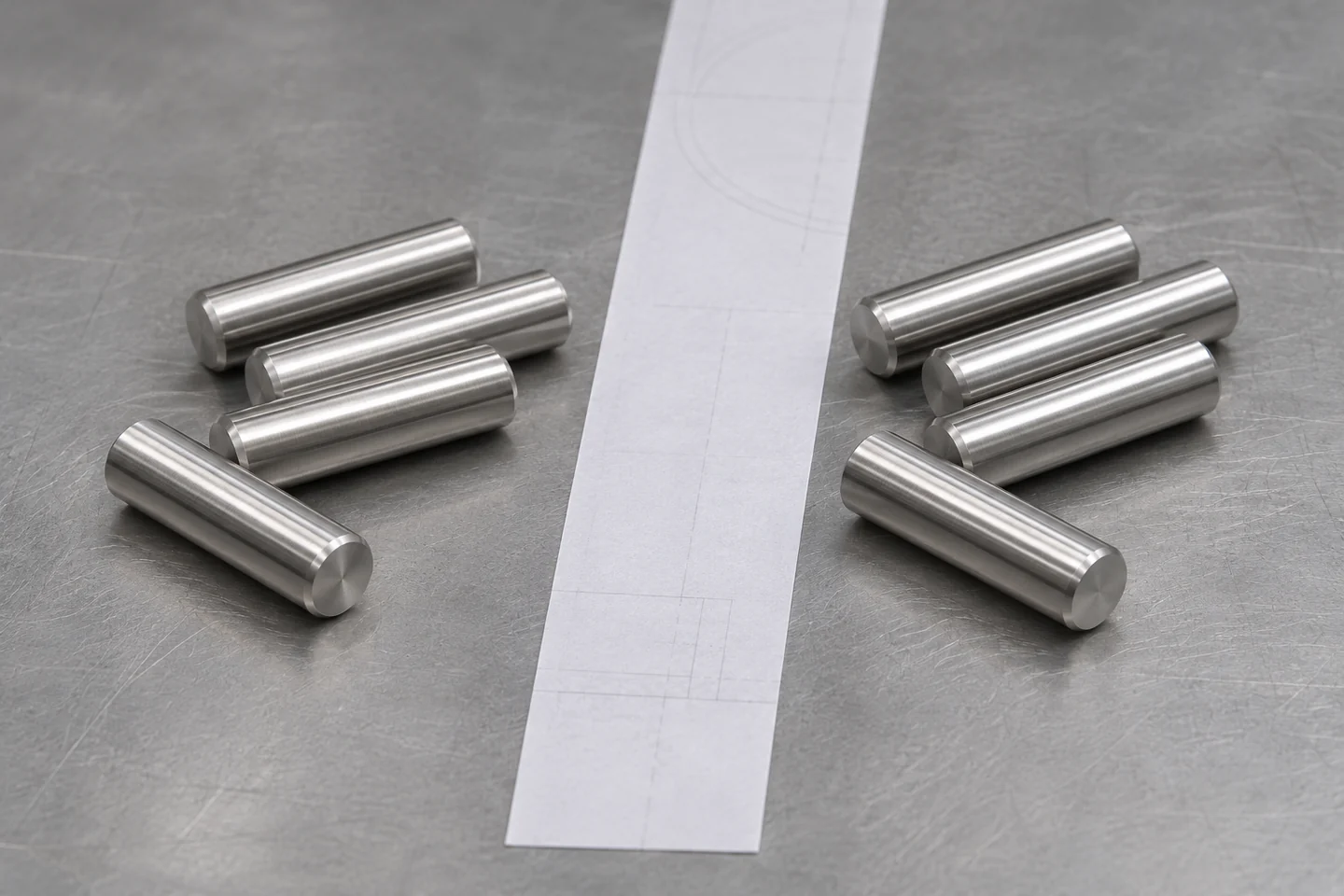
Review the relationship between the working diameter, overall length, shoulders and edge features. Each can affect assembly for a different reason. Mark the features that require recorded results and identify the applicable drawing revision. Do not leave the inspector to infer the functional surface from the material description.
For locating components, use the mating assembly requirements to define the fit task. The dowel pin sizes and fits guide addresses that separate decision. Choosing 4140 does not, on its own, select the pin-to-hole fit.
The Atlas sheet notes that bright stock may still require machining allowance for surface imperfections. Appearance therefore needs to be distinguished from an accepted working surface. If a surface will contact a mating component, identify its finish and inspection requirements in the drawing rather than relying on the stock’s visual description.
Record any coating or surface-treatment requirement separately. The request should identify whether the reported dimensions are before or after that operation. The quote can then address the complete delivery condition instead of assuming that the buyer will resolve the final fit later.
These checks are especially useful when quotations come from businesses supplying different stages of the manufacturing chain. One may quote a material blank, another a rough-machined component and another a finished part. The same grade on all three quotations does not make their scopes equivalent.
The following crosswalk is an original purchasing aid, not a prescribed certificate format. Its purpose is to connect the ordered item to evidence that answers the relevant question. Required records should be agreed before production, so the supplier can quote the actual scope.
| Ordered requirement | Useful evidence to agree | Receiving question |
|---|---|---|
| Material grade and specification | Material certificate linked to the delivery | Does the identified heat or lot correspond to the ordered material? |
| Supplied treatment condition | Condition declaration and relevant treatment record | Does the documented state match the quotation and order? |
| Hardness acceptance | Results with scale, location and acceptance reference | Can the result be compared with the specified requirement? |
| Finished dimensions | Inspection results against the current drawing | Were the required features checked in the delivered state? |
| Special mechanical requirement | Specifically ordered test report | Does the report address the required property and represented material? |
| Traceability | Consistent identifiers across labels and records | Can this delivery be connected to its supporting evidence? |
Begin by checking identity. Compare the order, drawing revision, component reference and delivery label. A technically detailed report can still be unhelpful if it belongs to another revision or cannot be connected to the received lot. Resolve that link before using its results to release the goods.
Read each result under its heading. A chemistry table, a hardness result and a dimensional report have different meanings. Do not treat a document titled “certificate” as proof of requirements that it never lists. Equally, do not demand extra documents without explaining which acceptance question they are supposed to answer.
Where the buyer requires test material representing a particular product section or processing lot, that representation must be agreed. A report for stock does not automatically represent a later component after additional processing. The evidence package needs a clear connection to the condition being accepted.
If the delivery lacks a required report, the immediate issue is missing evidence. If a report shows a value outside the specified requirement, the issue is a reported nonconformity. Keeping those situations separate makes the supplier discussion more precise and avoids describing an untested property as either passing or failing.
A disposition request should identify the affected requirement and delivery, then ask for the specific missing evidence or proposed resolution. Preserve the original record when a revised report is supplied. The replacement should make clear what was corrected, rather than silently changing the acceptance basis.
This approach also helps purchasing teams maintain useful supplier histories. Record the actual issue—wrong condition, incomplete traceability, missing final measurement or out-of-requirement result—instead of grouping every interruption under “material problem.” The next inquiry can address the recurring gap directly.
Consider a hypothetical buyer sourcing a drawing-based locating pin. The initial request gives the geometry and says “4140 steel,” but does not state the supplied condition. One supplier quotes an annealed blank. Another quotes a prehardened component with the main diameter machined to the drawing. These are illustrative quotation scopes, not actual supplier offers.
The buyer should not choose between them using price alone. The first offer leaves treatment and final finishing with a later stage. The second still needs clarification about the promised condition, final dimensional acceptance and supporting records. Both quotations need to be aligned with the intended delivered item.
The buyer’s technical team confirms that the purchase is for a finished pin rather than process stock. It identifies the required final material condition and the hardness acceptance reference. Purchasing sends the same clarification to both suppliers, so neither has to guess which downstream operations the customer will perform.
The revised request keeps the grade and specification distinct from those final requirements. It asks the supplier to state the condition included in its route and identify exclusions. A quotation for an annealed blank can still be retained as a separate stock option, but it no longer competes under the finished-part scope.
The buyer marks the working diameter and shoulder location for recorded inspection. It confirms that the results must apply to the delivered state after included finishing. Any surface treatment is stated separately, including its relationship to final dimensional inspection.
The quote response now needs to distinguish a proposed manufacturing route from a final acceptance commitment. It can describe planned operations without implying that listing those operations proves the component conforms. The inspection package closes that gap by addressing the agreed drawing features and material requirements.
The buyer can now compare like scopes: the finished component, identified condition, included finishing, required records and any stated exceptions. A lower quote with an excluded operation becomes visible as a different scope. A higher quote with unnecessary testing can also be questioned against the actual acceptance requirements.
The resulting order records which clarification controls where the original drawing was incomplete. Later repeat orders can reuse that settled requirement, subject to revision control, instead of restarting the same discussion from the grade name. This is the practical value of expanding a short 4140 note before production.
Send the current drawing and identify whether the request is for stock, a blank or a finished component. Include the material specification, required supplied condition, final property requirements and the features that control assembly. State the records needed with delivery and ask the supplier to identify any exception against each requirement.
If an alternative grade is proposed, keep it visible as a substitution. A nearby designation in a supplier catalog is not sufficient to approve interchangeability. The material specification, condition and relevant acceptance requirements need to be checked for the actual part before a replacement is accepted.
For a drawing-based locating pin or another verified fastener family, the OEM and ODM inquiry service provides a relevant discussion path. Attach the requirement package and ask whether the specific material, condition and inspection scope can be supported. Availability and treatment capability for a particular 4140 requirement must be confirmed for that inquiry.
A useful supplier response should leave the buyer able to describe the delivery without assumptions: which material, in which condition, to which drawing, with which acceptance evidence. That is the point at which a grade name becomes an actionable purchase requirement.
voestalpine: AISI 4140 product information
Atlas Steels: 4140 through-hardening alloy-steel bar datasheet, 2021