An OEM part number is a reference used in an original equipment manufacturer’s parts system to identify a particular item. For purchasing, keep that reference with the manufacturer’s name and the relevant equipment or configuration information. The number is a way to locate and discuss the item; it does not independently prove that a seller’s offered component is the correct replacement.
This matters when a reference from a parts list becomes an enquiry for a retaining ring, washer or locating pin. The buyer needs to connect the requested reference with the exact item offered, while keeping any proposed alternative visible.
Use the reference to identify the item within the issuing manufacturer’s system. Do not assume that the same characters identify the same product across unrelated manufacturers or that every prefix and suffix has a universal meaning.
Google’s manufacturer-part-number documentation describes an MPN as identifying a product among the products of the same manufacturer. Schema.org likewise defines MPN in relation to a product or the product an offer references. These are product-data definitions, not evidence that a particular part fits a particular machine.
For a real order, identify where the reference came from: a current parts catalogue, an equipment document, a controlled drawing or an earlier purchase record. Keep the source available so the technical team can check the context rather than retyping an isolated number through several emails.
If the marking is difficult to read, preserve the original image and ask for confirmation. Do not silently replace a letter with a digit or remove a suffix because another listing looks similar. A clean-looking reference copied incorrectly is still an unresolved identification question.
Record the manufacturer’s reference and the seller’s exact offer in separate fields. That makes it possible to see whether the seller proposes the identified item, a different manufacturer’s component or a drawing-based alternative.
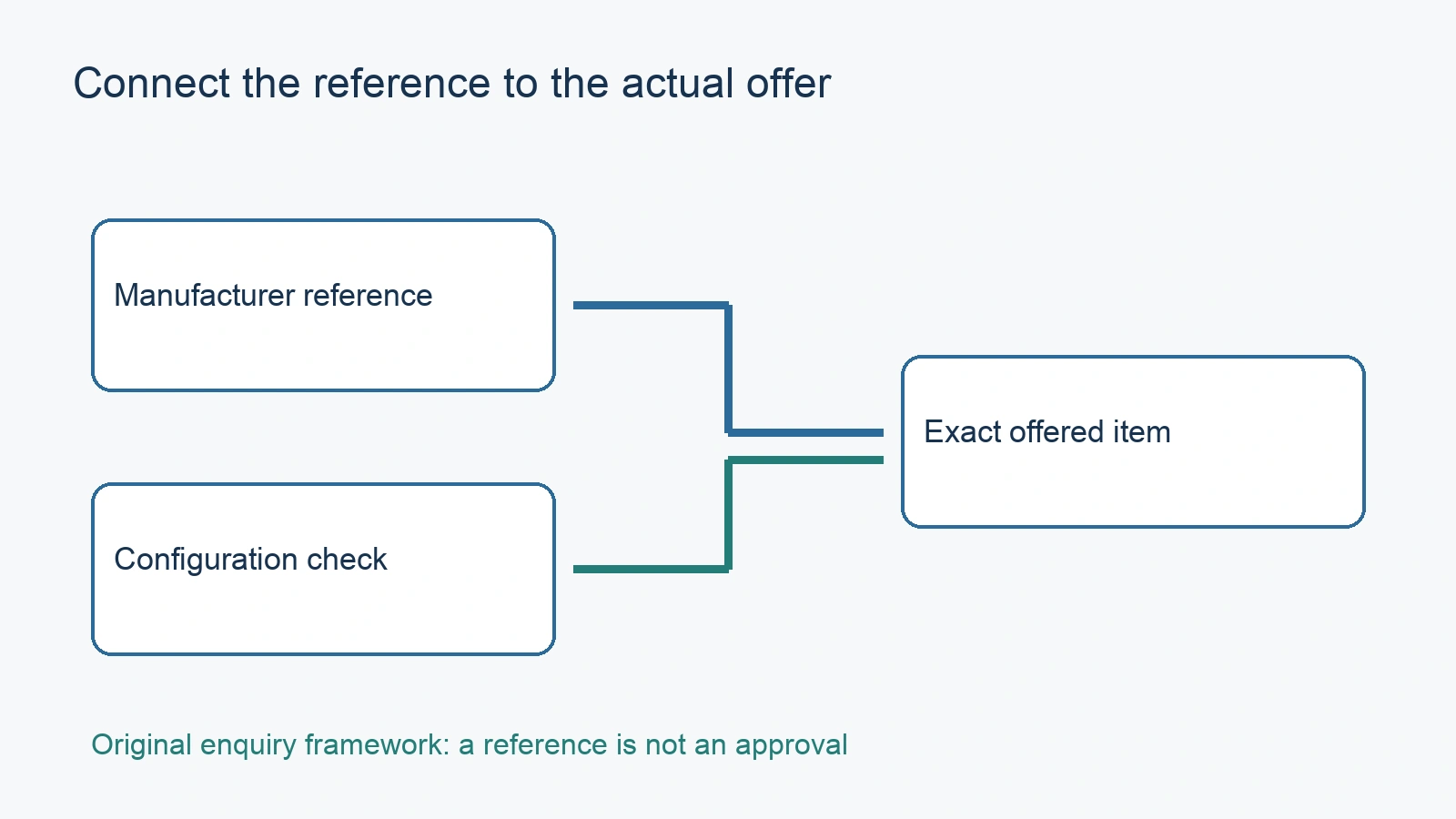
A distributor’s stock code may be useful for its own order processing. The buyer should still ask which manufacturer reference or defined specification that stock item represents. Do not assume that the two fields are interchangeable simply because the seller puts both in one catalogue line.
A buyer’s drawing number serves another purpose in the enquiry: it identifies the controlled requirement being submitted for quotation. Keep its revision visible. If a supplier offers to manufacture against that drawing, describe the proposal that way rather than presenting it as a confirmed branded replacement.
Google’s documentation makes a related distinction in its own product-data rules: the manufacturer of a compatible product should not be misrepresented as the OEM. Apply the identification principle carefully in a purchasing record. State who makes the proposed item and what comparison or acceptance basis is being used.
This separation does not decide whether an alternative is acceptable. It gives the responsible person enough information to make that decision without mistaking a cross-reference for an approval.
Ask for the documented relationship whenever a seller proposes a different reference. Keep the requested item, offered item and reason for the change visible together.
If the seller describes the number as replaced or superseded, request the relevant manufacturer’s current record and any stated application conditions. Do not infer that a changed reference means either complete interchangeability or automatic incompatibility. The task is to verify what the particular record says.
For a drawing-controlled component, confirm which revision the offer covers. An earlier quotation or sample record may help explain the history, but the current enquiry still needs a clearly identified baseline. Ask the technical approval contact to resolve a mismatch before release.
Keep uncertainty out of the order description. If a suffix is unreadable, an application note is missing or a replacement claim is unconfirmed, label that point as open. Assign the question to the supplier or the person controlling the equipment specification.
The useful result is a traceable decision about the actual proposed item. Avoid creating a new internal cross-reference that looks authoritative when its only source is an unverified sales listing.
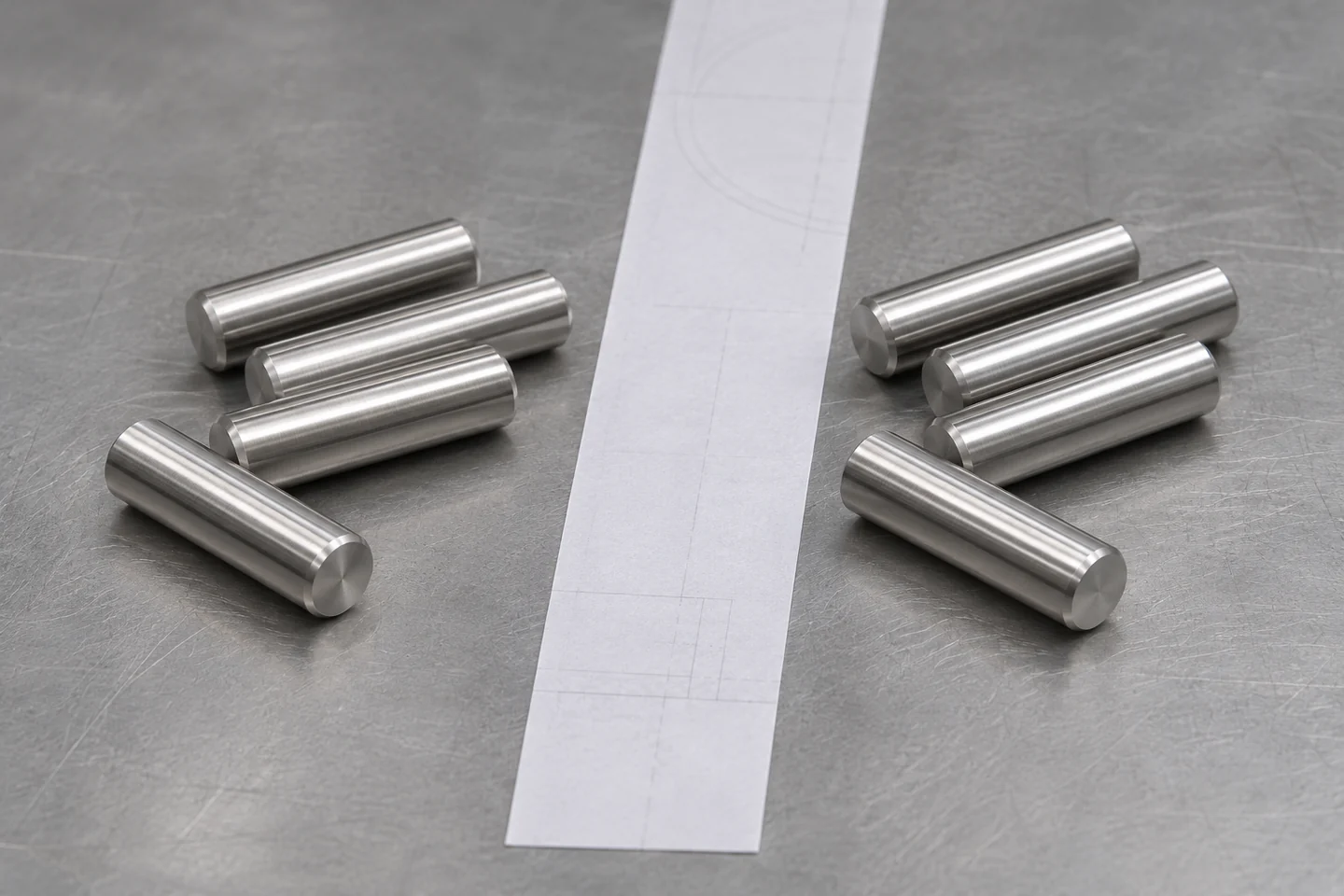
Consider a hypothetical buyer who has a locating-pin reference from an old equipment list. A supplier responds with a visually similar pin and says it is equivalent. No actual manufacturer number or compatibility claim is assumed in this example.
The buyer should ask the supplier to identify the offered item and explain the comparison basis. The original equipment reference remains the request; the proposed pin remains an alternative until the responsible technical person has evaluated it.
If the buyer has an authorised controlled drawing for the required component, a separate manufacturing enquiry can use that drawing, its revision and the specified material and finish. The supplier can then review the defined requirement rather than guess the design from a commercial reference.
If only a worn sample is available, state that limitation. A sample may help communicate shape, but it may not answer the original material, finished condition or required dimensions. Ask what further information is needed to create an appropriate acceptance basis.
The two enquiries therefore have different outputs. A replacement enquiry needs an identified offered item and supported application information. A manufacturing enquiry needs a technically defined component proposal. Calling both “OEM pin” would conceal that difference.
Compare the supplier’s final offer with the request before copying its reference into a purchase order. Use the original table below to expose missing links in the identification chain.
| Record | Check before release |
|---|---|
| Requested reference | Keep the complete value, issuing manufacturer and source document. |
| Application context | Provide the relevant equipment or controlled configuration information. |
| Offered item | Identify the actual manufacturer reference or defined drawing-based proposal. |
| Difference from request | Record any alternative, revision mismatch or proposed replacement relationship. |
| Acceptance evidence | Identify the required documents and the person authorised to approve unresolved points. |
| Order handoff | Ensure the quotation and order describe the same accepted item. |
A matching text string is one check, not the entire review. Read any qualification in the offer beside it. For example, a supplier may quote an alternative finished condition or ask the buyer to confirm the application. Those qualifications should remain visible until resolved.
Keep the seller’s stock code where it helps ordering, but preserve the accepted item description and reference alongside it. That gives receiving and technical teams a common basis for identifying what was ordered.
If a critical identification point is still open, hold the order for clarification rather than deleting the uncertainty from the document. The record should reflect the decision that has actually been made.
Choose the route from the information and approval basis available. For a branded replacement request, use the appropriate equipment-manufacturer or authorised parts channel to resolve application and reference questions. For new manufacture, supply the specification the proposed component must meet.
For Eugene enquiries within retaining rings, washers, pins and non-standard fasteners, the OEM and ODM service page provides a route for drawing-based discussion. Include the revision, material, finish, quantity and inspection requirements. Identify any equipment reference as context and state whether it is verified.
A reference in that enquiry does not establish Eugene’s affiliation with an equipment brand or an offer of its genuine replacement part. Ask for a defined response against the manufacturing requirement and keep the technical acceptance decision with the responsible buyer or engineer.
Google Merchant Center: Manufacturer Part Number identity and correct attribution