The melting point of steel is usually a grade-dependent range rather than one fixed temperature. For example, the British Stainless Steel Association lists type 304 stainless steel at 1,400–1,450°C, equivalent to 2,552–2,642°F. Other grades have different ranges. Use the actual alloy’s data for melting work, and do not treat a melting range as the allowable service temperature of a spring, fastener or finished assembly.
Steel is an alloy. On heating, melting begins at the solidus and is complete at the liquidus. Between those boundaries, solid and liquid can coexist. The interval depends on composition, so a single number labeled “steel melting point” can conceal an important material difference.
Identify the grade before selecting a range. “Steel,” “spring steel” and “stainless” each cover multiple materials. A value for one grade should not be assigned to another simply because both have a similar appearance or application.
Also identify the intended use of the number. Melting and casting calculations, heat-treatment planning and service-temperature selection ask different questions. A melting interval may be relevant to the first task while being insufficient for the others.
Alleima’s safety information sheet reports 1,300–1,520°C for its carbon-steel and low-alloy-steel product family. This is a broad family range, not the solidus and liquidus of one specified grade. The stainless examples below are grade-specific ranges published by BSSA. Fahrenheit values are calculated from the Celsius endpoints using °F = °C × 9/5 + 32.
| Material and source scope | Published range, °C | Calculated range, °F |
|---|---|---|
| Alleima carbon/low-alloy steel family, safety-information range | 1,300–1,520 | 2,372–2,768 |
| 304 / 304L stainless | 1,400–1,450 | 2,552–2,642 |
| 316 / 316L | 1,375–1,400 | 2,507–2,552 |
| 430 | 1,425–1,510 | 2,597–2,750 |
| 420 | 1,450–1,510 | 2,642–2,750 |
The family range cannot establish a melting interval for 65Mn, 40Cr or another named grade. For a process decision, check the current material data for the actual grade and composition. The comparison is useful for understanding why the alloy name matters; it is not a pouring-temperature instruction or a substitute for a qualified process specification.
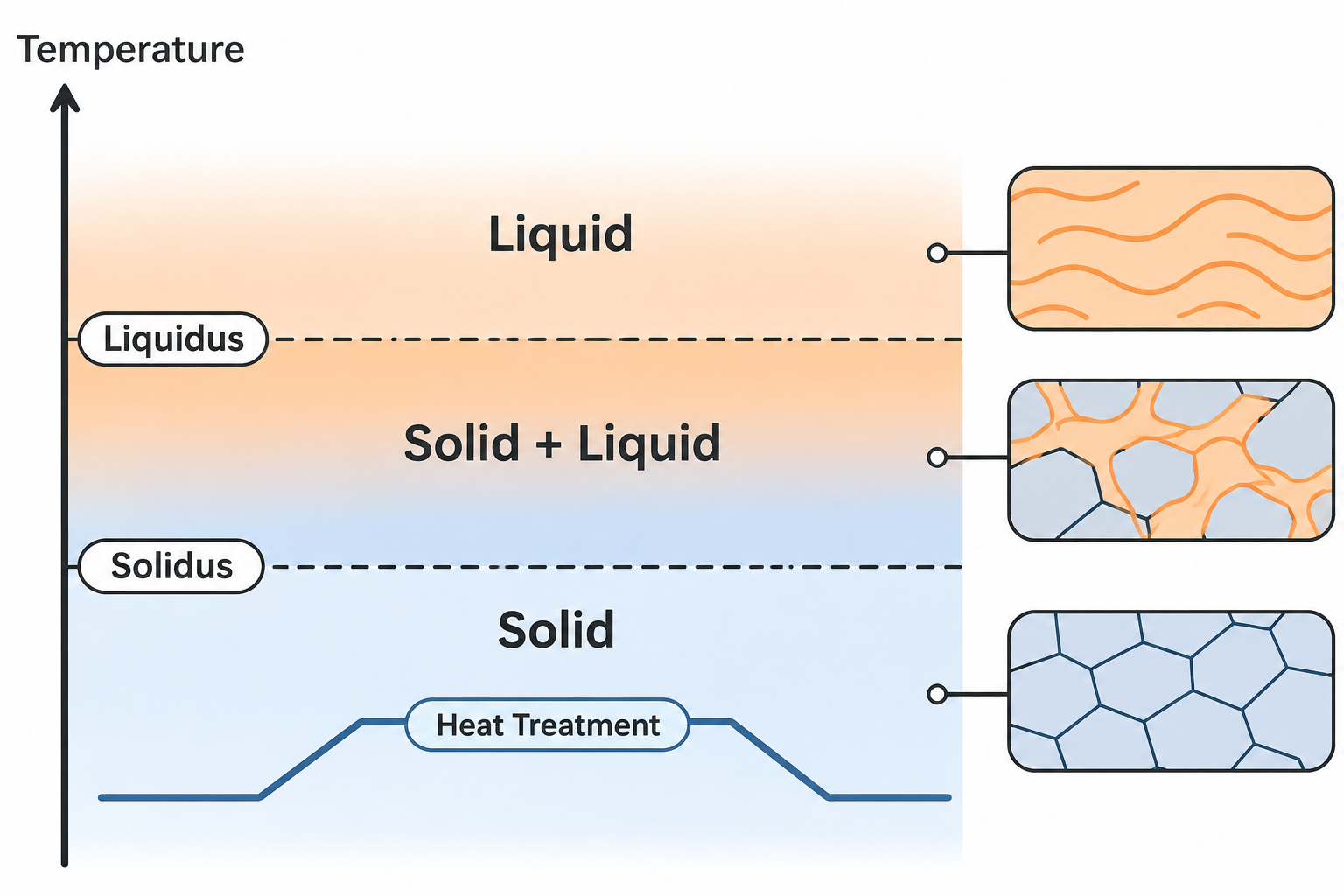
The solidus marks the start of melting for the specified composition; the liquidus marks the fully liquid boundary. The difference is an alloy melting interval, not a tolerance band around one universal steel temperature.
Conventional steel heat treatments such as annealing or hardening change the solid-state condition. They do not require melting the finished part. Their temperatures and cooling sequences must be selected for the grade and required properties.
Do not estimate a hardening or annealing cycle by subtracting an arbitrary amount from a melting point. The relevant transformations and process conditions require their own technical basis. A general melting-range table does not provide that information.
A component can lose required function while remaining fully solid. Its allowable service conditions depend on the property being protected, loading, duration, environment and supplied material condition. Being below the solidus is therefore not a sufficient acceptance criterion.
BSSA specifically distinguishes melting ranges from the oxidation-related service behavior of heat-resisting stainless steels. Grades can share a melting range while having different elevated-temperature applications.
For a spring or retaining component, define the required load response and acceptable change over the intended exposure. Request grade- and condition-specific evidence. Do not advertise a spring as suitable near its steel’s melting range on the basis of a general materials table.
A useful temperature-related inquiry identifies the material grade, delivery condition, component function, actual operating temperature, exposure duration and environment. State the acceptance requirement that must remain satisfied. This lets the technical review address the relevant property rather than only the melting interval.
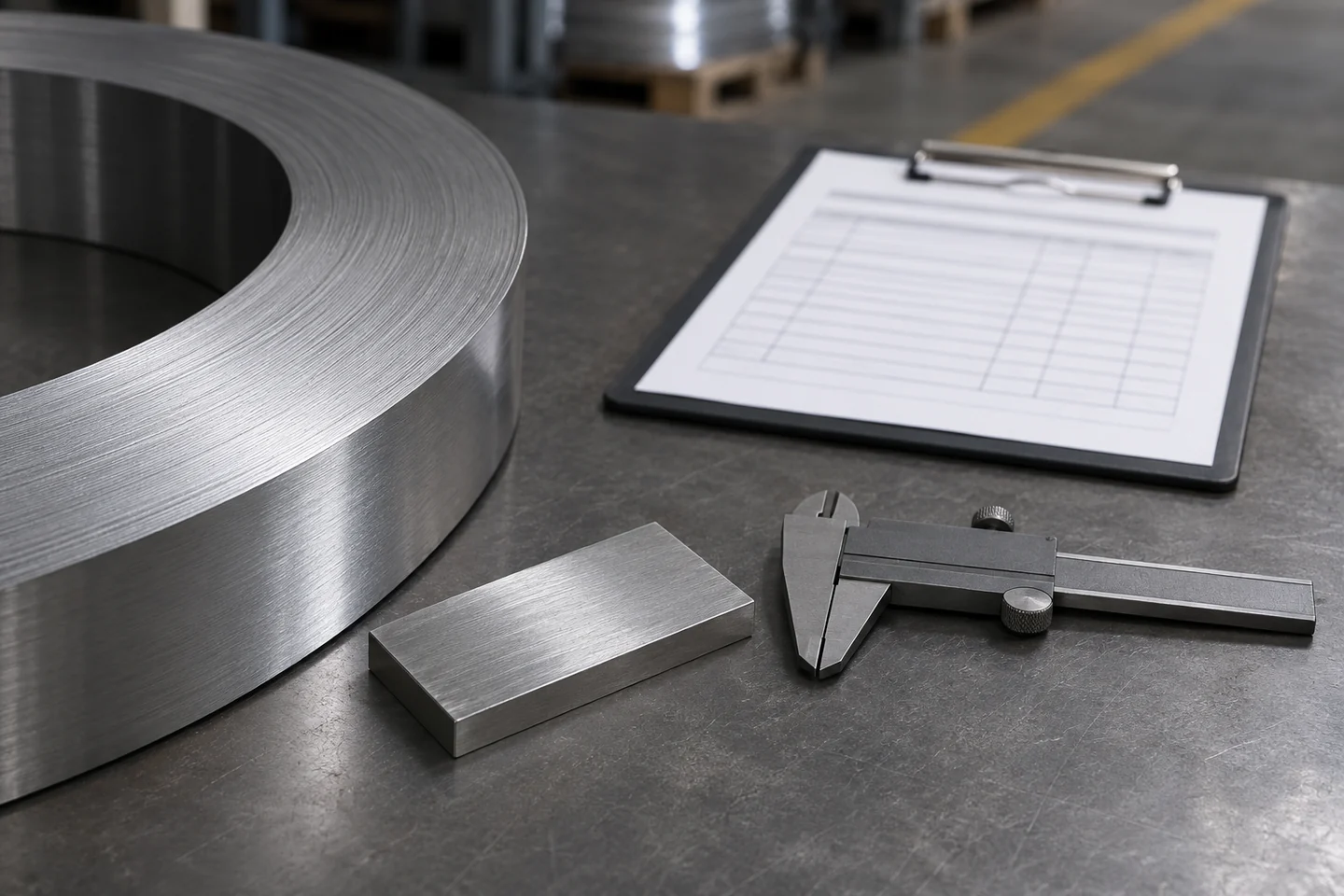
When evaluating heat-treated spring-steel strip, confirm the actual grade and supplied condition with the order. Treat any elevated-temperature application as a separate engineering requirement requiring appropriate evidence; the product-family name does not establish a service-temperature rating.
BSSA: stainless-steel melting ranges and their engineering significance; Alleima: carbon and low-alloy steel family safety information, section 9.

 Wenzhou Eugene Technology Co., Ltd.