Roll pin vs spring pin is usually a terminology question, not a choice between two completely separate fasteners. “Spring pin” names the general fastener family. “Roll pin” is a common trade name, but suppliers and industries do not always use it with the same precision.
The practical issue is construction. A spring pin may have one formed wall with a longitudinal slot, or it may use several wrapped layers. Those designs are not identical. A drawing, bill of materials, or request for quotation should therefore identify the construction and the governing requirements instead of relying on the informal name alone.
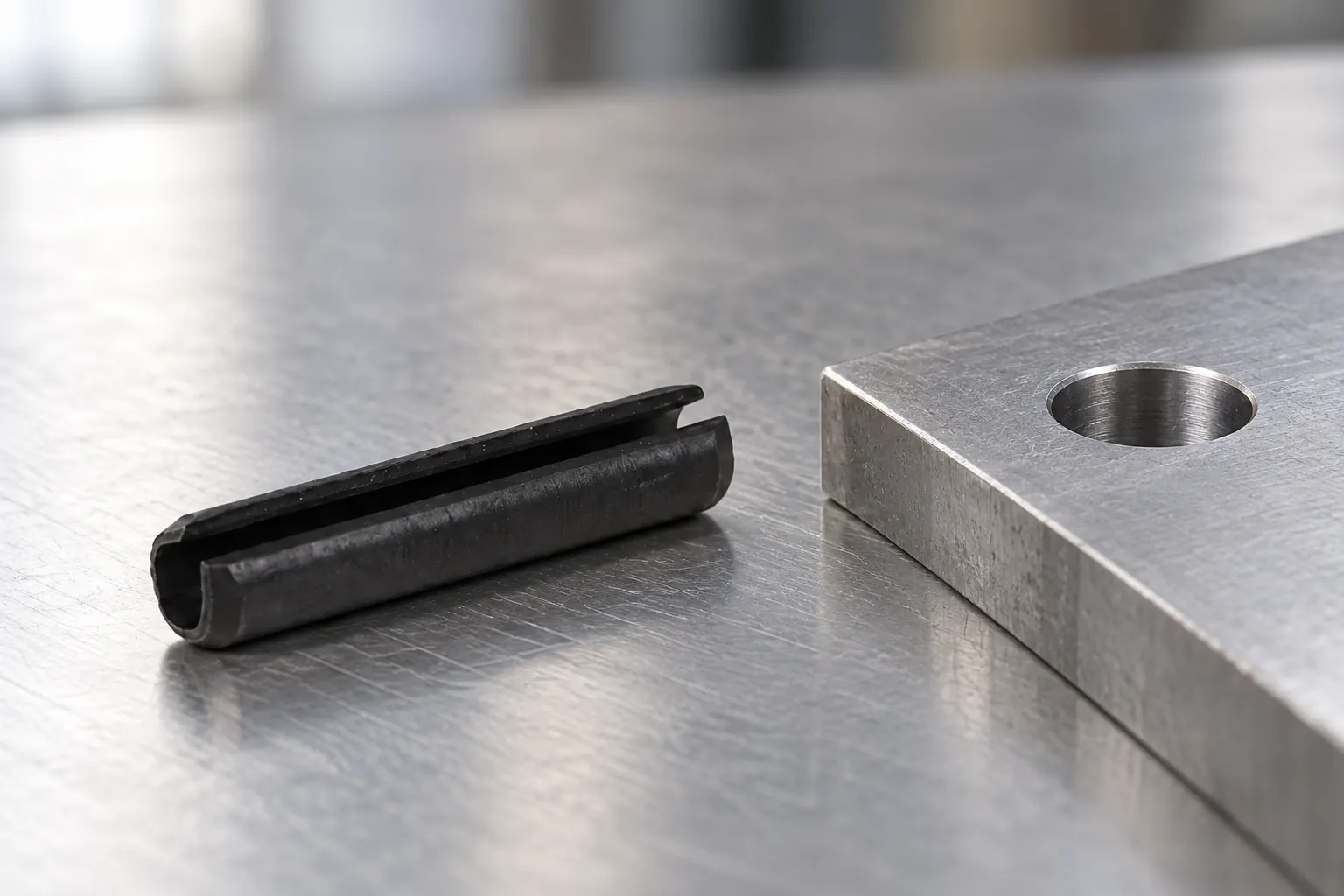
A spring pin is a hollow fastening element designed to compress as it enters a prepared hole. Its spring action creates contact with the hole wall. Depending on the joint, the pin may retain a component, connect moving parts, locate an assembly, or carry a defined shear load.
People often call this family “roll pins.” In some shops, that name refers mainly to the familiar slotted form. In other catalogs, it also includes coiled spring pins. This variation explains why the words alone cannot confirm the part.
“Spiral pin” can appear as another informal description for a layered or coiled form. Do not convert that wording into an approved construction without checking the cross-section, product specification, and drawing. The controlled term should remain “coiled spring pin” when that is the required design.
If a maintenance note says “replace the roll pin,” inspect the removed part and the assembly drawing before ordering. If a new design says only “spring pin,” add the missing construction, size, standard, material or finish, and hole requirements before release. Clear specifications prevent two reasonable readers from selecting different products.
For available fastener families, start with the TG Eugene product catalog. The comparison below focuses on the naming and design decision.
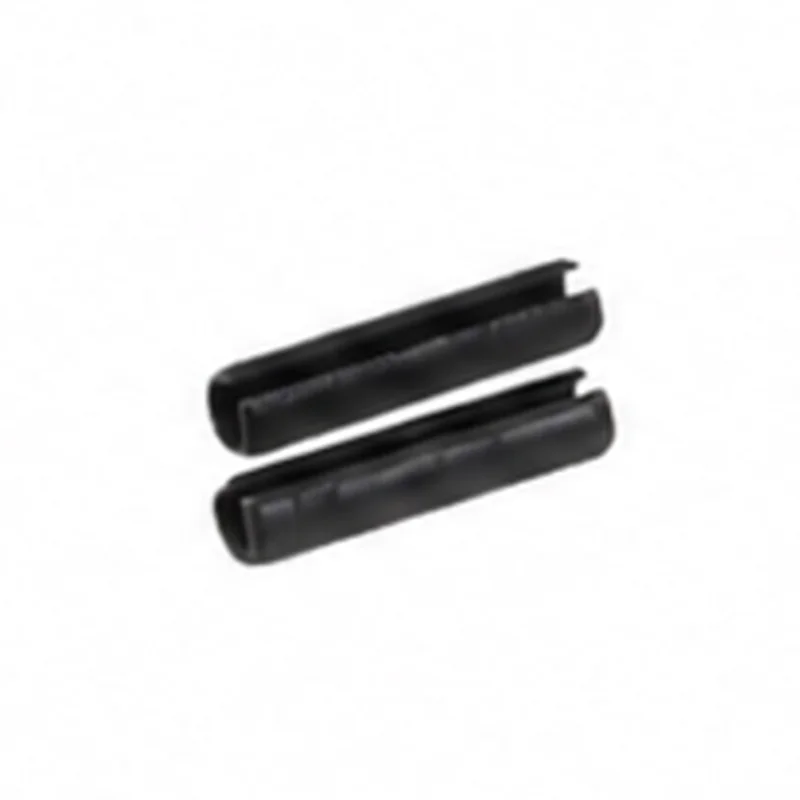
The two basic designs are easy to distinguish by cross-section. A slotted spring pin has one formed wall and an open longitudinal slot. A coiled spring pin has multiple layers wrapped into a coil. Both compress during installation, but their geometry controls how they respond to the hole and applied load.
| Decision point | Slotted spring pin | Coiled spring pin | What to record |
|---|---|---|---|
| Cross-section | Single formed wall with an open slot | Several wrapped layers | Name the construction |
| Visual identification | Visible longitudinal opening | Layered, spiral-like end | Use appearance for identification, not approval |
| Specification route | May follow a slotted-pin standard or drawing | Uses a coiled-pin standard or supplier specification | State the exact governing document |
| Selection basis | Joint function, load, hole, host material, installation, duty, and environment | Review the complete assembly | |
This is not a universal ranking. A slotted design may be correct for an existing assembly whose drawing, hole, and installation process already control that form. A coiled design may suit another joint. Compare verified engineering data for the selected size and application rather than assuming that one family is always stronger, easier to install, or longer lasting.
Separate retention, location, hinge, stop, and load-transfer functions. State the load direction and whether the duty is static, repeated, reversing, or subject to shock. A name and nominal diameter do not show how the joint works.
The approved hole range belongs to the exact pin design, nominal size, and duty. Record the finished-hole diameter and any relevant controls for roundness, alignment, surface condition, burrs, and lead-in. Do not transfer a hole recommendation from a slotted pin to a coiled pin, or from one duty class to another, without engineering review.
Host material matters as well. Thin walls, soft alloys, molded polymers, brittle materials, and stacked components can respond differently to the pin’s outward pressure. Include wall thickness, edge distance, hardness or condition, and the number of supported interfaces when they affect the joint.
Define the insertion direction, access, support, tooling, and final installed position. Misalignment can damage the pin or the hole before the joint reaches its working condition. If technicians must remove the pin during service, record the removal path and the project’s reuse or replacement rule.
For detailed dimensional review, use the roll pin size and hole-fit guide. It separates nominal diameter, free outside diameter, length, and receiving-hole requirements.
A controlled order should answer six questions. The exact callout format can follow the customer’s drawing system, but each field needs an unambiguous value or approved reference.
These fields also improve quotation quality. A supplier can identify conflicts before production rather than guessing whether a generic nickname means a slotted or coiled design. The buyer can then compare quotations on the same technical basis.
Legacy records may use “roll pin,” while the current supplier uses “slotted spring pin.” Do not revise the part identity from vocabulary alone. Compare the released drawing, the installed sample, the receiving hole, and the governing standard. Record any difference in construction, free diameter, length, finish, or installation direction.
A sample can help identify the cross-section, but wear and removal can change its shape. Measure the assembly interfaces from controlled features and use an unused approved part for dimensional confirmation when possible. If the drawing and sample disagree, the design owner should resolve the conflict before purchasing approves a substitution.
Document the resolution in the bill of materials and production inspection plan. A note such as “use existing roll pin” leaves the same ambiguity for the next order. A controlled record should show which construction was approved, which product data supported the decision, and whether the receiving hole or installation process also changed.
Keep that approved record available for future production and replacement orders.
TG Eugene provides an ISO 8752 slotted spring pin product route. Use it when the approved design calls for that product family. The page does not represent coiled pins and does not, by itself, approve a hole or load case.
Send the released drawing and the assembly inputs with the RFQ. Confirm the standard edition, nominal size, part condition, quantity, inspection needs, packing, and destination. If the drawing uses only “roll pin,” resolve the construction before the supplier quotes or samples the part.
In common trade use, roll pin usually refers to a spring pin. The name does not always identify whether the part is slotted or coiled, so the drawing should state the exact construction.
The cross-section changes from one slotted wall to several wrapped layers. That difference affects installation and load response. Select from application-specific data, hole requirements, and the governing specification.