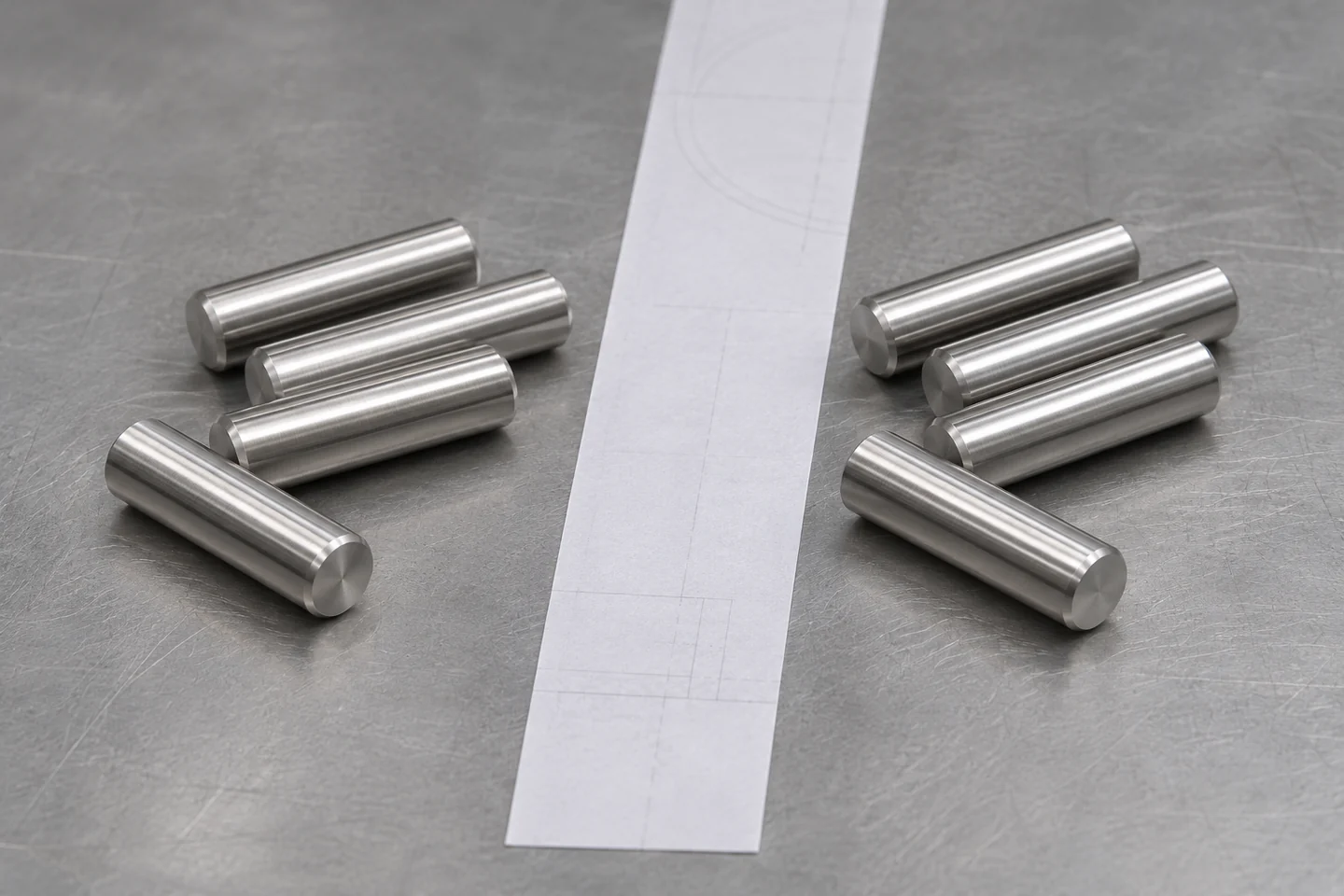
Common types of pins used in mechanical assemblies include solid dowel pins, slotted and coiled spring pins, taper pins and removable retaining pins. Choose the family by its job: locating parts, joining them, providing a pivot or preventing disengagement. A shared nominal diameter does not make different pin types interchangeable. The pin, mating hole, host material and removal requirement must be evaluated together.
Start by describing the function in the assembly. Precise repeat location, a rotating hinge and a removable connection present different requirements. A pin selected only by its outside appearance can meet the dimensional description while missing the intended function.
Separate the loads as well. A joining pin may experience transverse loading, while its retention method must prevent unwanted axial movement. The same feature does not necessarily establish both requirements.
Identify which component should hold the pin and which should move or separate. This clarifies whether the design needs an interference fit, elastic retention, a separate retainer or another controlled arrangement. Select the pin family before discussing an exact standard size.
| Pin family | Recognizable form | Main question before selection |
|---|---|---|
| Solid dowel | Solid cylindrical body | What location accuracy and hole-fit strategy are required? |
| Slotted spring pin | Hollow body with a longitudinal slot | How will pin compliance and the specified hole work together? |
| Coiled spring pin | Coiled strip construction | Which duty and flexibility suit the application? |
| Taper pin | Body diameter changes along its length | What mating geometry and insertion direction are specified? |
| Removable retaining or clevis-style pin | Form includes a retention arrangement, often a cross-hole | How is it secured and intentionally removed? |
For repeat positioning, a solid dowel is a common starting point; suitable dowel designs can also serve as pivots or shafts. Slotted and coiled spring pins can hold joined components through elastic retention, with the chosen construction and duty matched to the joint. Taper pins secure and position parts in matching tapered holes. A clevis-style pin with a separate retainer suits a connection intended for removal. These uses overlap: the actual load, fit, movement and retention arrangement determine suitability.
The table groups mechanical families; it is not a dimensional standard or a statement that every family is supplied by one manufacturer. Use the actual drawing or governing specification for the final geometry.
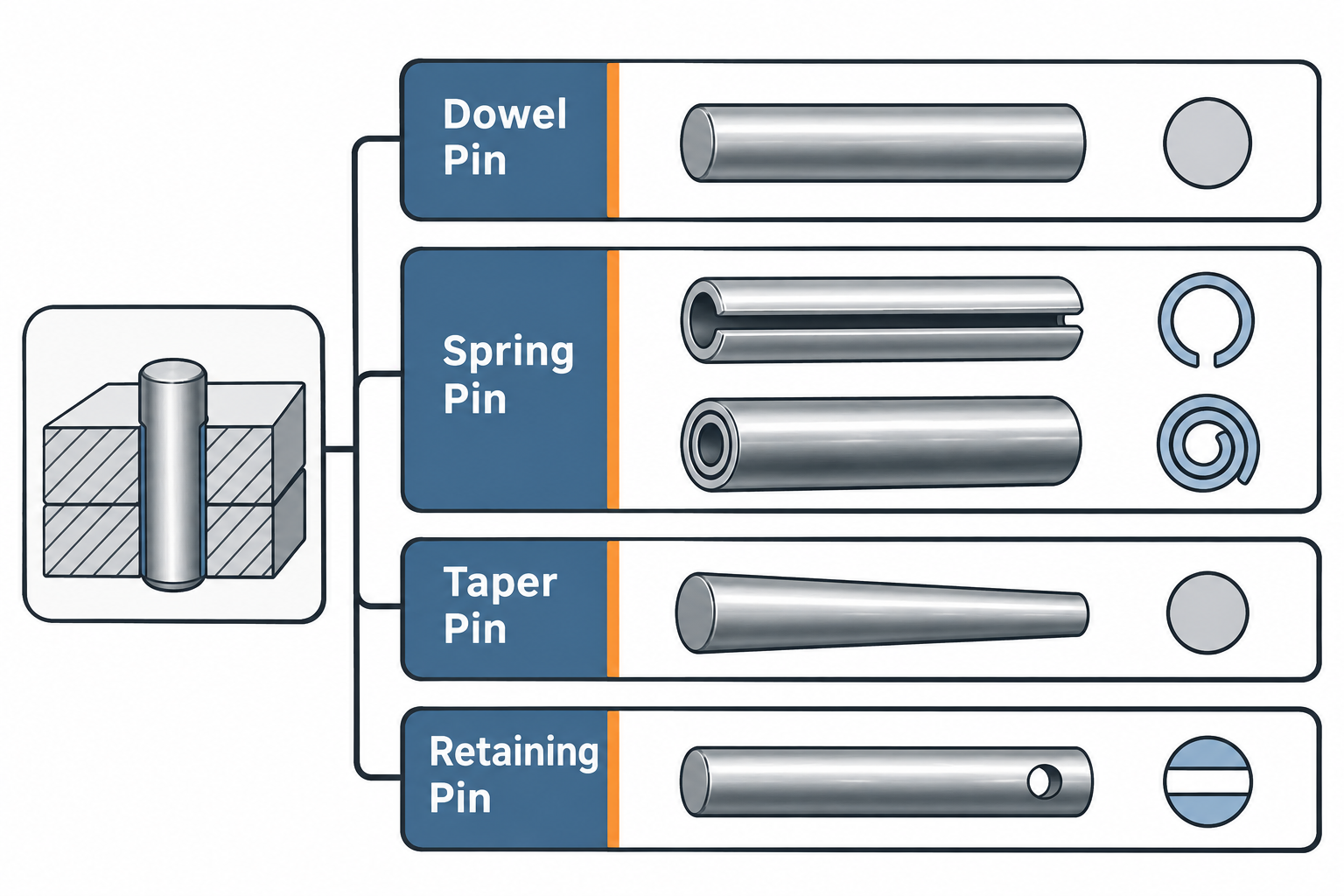
Solid dowels and spring pins use different fit strategies. Spring-pin compliance can accommodate the intended installed condition; a ground solid dowel places different demands on the hole and interference arrangement. Do not substitute one family based only on diameter.
Review the hole limits, alignment between components, wall or boss geometry and host material with the selected pin. Ask the supplier to evaluate the actual assembly when insertion force or host-part damage is a concern.
Also distinguish locating accuracy from retention. A pin can remain installed without delivering the alignment required by the assembly. Conversely, a pin that locates a component still needs a defined arrangement against unwanted movement in service.
State whether the connection is permanent, occasionally serviced or repeatedly disassembled. Identify the available access for insertion and removal. A blind hole presents a different removal task from a through-hole.
Where a removal feature is required, show it on the drawing rather than assuming it is included in every member of a pin family. Confirm that the removal method is compatible with the surrounding assembly and maintenance access.
Keep installation requirements with the selected product. The pin’s entry geometry, hole condition and installation arrangement should be evaluated together. A general illustration of a pin family is not an installation instruction for a specific part.
Send the function, assembly drawing, proposed pin family, hole requirements, host material, load description and service needs. Include finish and environment where they affect selection. Ask for deviations or alternative family proposals to be stated explicitly.
If the design calls for a slotted spring pin, Eugene’s slotted spring-pin product page is a relevant inquiry starting point. Confirm the exact specification and mating-hole requirements for the application. Do not assume that an alternative solid or coiled pin is interchangeable with the specified slotted pin.
SPIROL: press-fit solid and spring-pin selection; SPIROL: spring-pin constructions; McMaster-Carr: pin-family forms and assembly functions.

 Wenzhou Eugene Technology Co., Ltd.