The production part approval process, or PPAP, provides evidence that a supplier understands the customer’s design requirements and that the manufacturing process can produce conforming parts under production conditions. It combines product and process evidence with a customer approval decision. A sample dimensional report is one possible input, not a complete substitute. Define the applicable requirements and submission scope before arranging the production run.
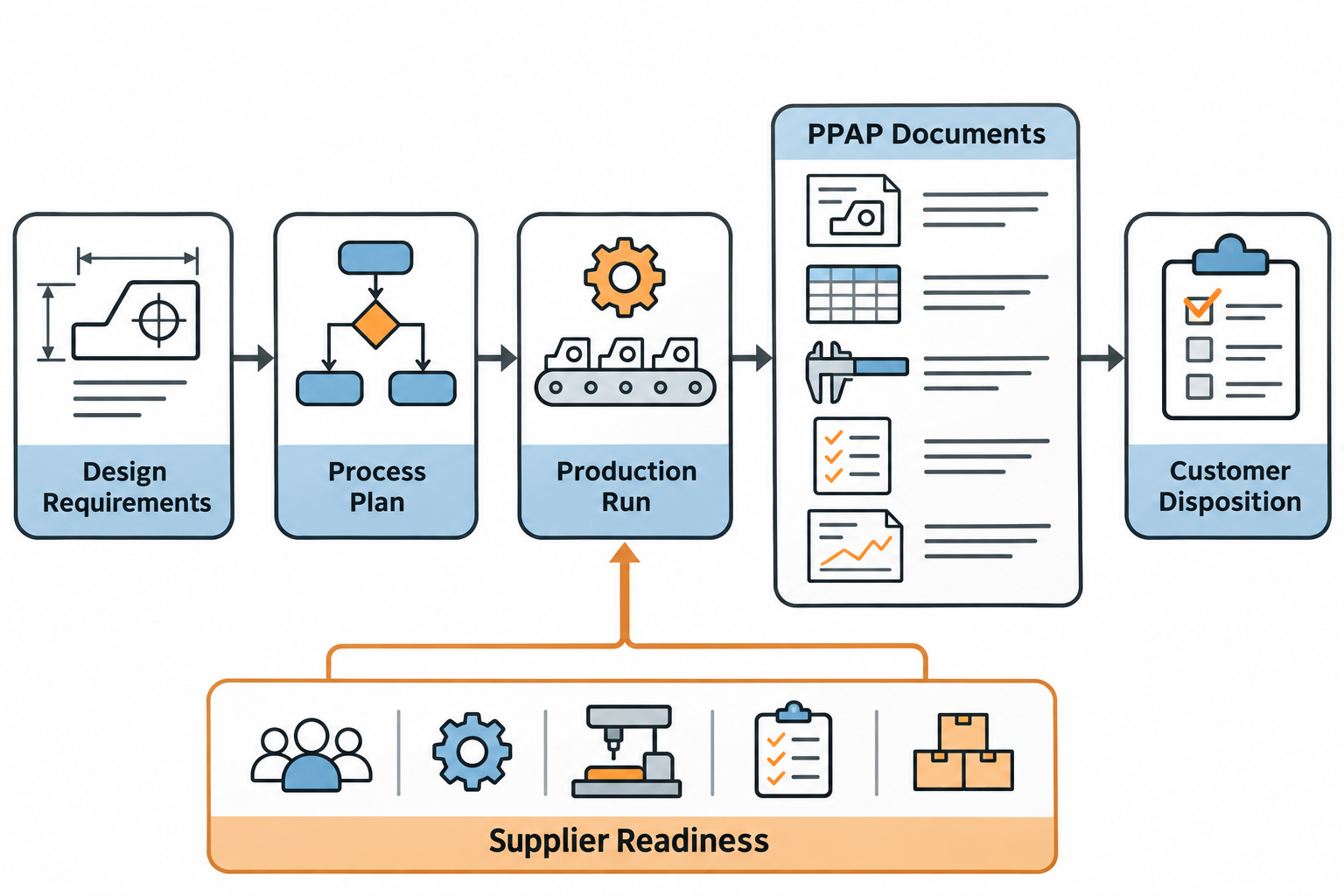
PPAP connects the design record to the production process and the evidence obtained from it. AIAG describes its purpose in terms of consistently meeting design and specification requirements during an actual production run at production rates.
This distinguishes production approval from simply making an acceptable prototype. A development sample may have been produced using a route that does not represent repeat production. The submitted evidence needs to correspond to the process being proposed for supply.
PPAP is a customer approval process, not a general third-party certification awarded to every supplier that prepares documents. The customer’s requirements determine what must be demonstrated for the specific part and supply arrangement.
Organize the work around the question each record answers. This makes missing connections easier to find than treating the package as unrelated files with similar part numbers.
| Evidence group | Question it supports | Examples to discuss with the customer |
|---|---|---|
| Design definition | What requirements apply? | Design records, approved changes and customer-specific requirements |
| Process planning | How will production be controlled? | Process flow, process risk analysis and control plan |
| Measurement and results | Can the required characteristics be evaluated and met? | Measurement-system evidence, dimensional results and material or performance reports |
| Production performance | What does the representative process demonstrate? | Applicable process studies and production-run evidence |
| Submission and disposition | What is being declared and approved? | Part Submission Warrant, samples and customer decision |
These groups explain the evidence logic. They do not replace the applicable PPAP manual or the customer’s complete requirements list.
The submission level affects what is supplied for customer review. It should not be interpreted as permission to ignore the underlying evidence requirements. Distinguish records retained by the supplier from records transmitted with the submission.
Ask the customer to confirm the required level, applicable documents, sample expectations and submission channel. Identify any customer-specific additions and who can approve deviations. Resolve unclear or inapplicable items explicitly rather than leaving unexplained blanks.
The Part Submission Warrant, or PSW, is part of this submission framework. It does not transform incomplete evidence into approval. Keep the warrant, supporting records and customer disposition tied to the same part, revision and production baseline.
A first article inspection can establish whether a submitted article meets the agreed drawing requirements. PPAP asks the broader question of production readiness and consistent conformance under the required process conditions.
A dimensional report can therefore contribute to a PPAP package without being the entire package. Conversely, a purchase requiring FAI does not automatically invoke every PPAP requirement. State both deliverables explicitly when both are needed.
Use common traceability across them. The drawing revision, sample identity, material evidence and process description should agree. A mismatch between otherwise acceptable documents can leave the customer unable to determine what production configuration was actually evaluated.
Resolve the design baseline, process scope and evidence responsibilities before scheduling the run. Identify which operations are subcontracted and how their records will be obtained. Confirm the agreed measurement methods and document formats early enough to address gaps.
For a drawing-based fastener, include material condition, finish, critical characteristics and the requested approval package in the RFQ. Eugene’s custom fastener service provides an inquiry route for this discussion. Request explicit confirmation of the documents and activities available for the particular order.
Separate the requested submission date from customer approval. A completed supplier package still needs the required customer disposition before it can support the agreed production-release decision.
Preserve the approved part and process baseline. When a material source, process, tool, site or design changes, evaluate notification and resubmission requirements against the customer’s rules. Do not assume that an old approval automatically covers a changed route.
Make change responsibility part of supplier management. Identify who raises the change, who evaluates its effect, who communicates with the customer and which records demonstrate approval. This keeps PPAP connected to actual production control after the initial submission has been accepted.
AIAG: PPAP purpose and manual; AIAG: quality core tools; SOLIDWORKS: PPAP submission overview.