The central OEM vs ODM distinction is the design starting point. In an OEM sourcing arrangement, the buyer typically brings the design for a manufacturer to produce. In an ODM arrangement, the buyer starts from a supplier-developed design and agrees any adaptations. Neither label, by itself, establishes design ownership, exclusivity, tooling rights or the exact engineering work included. Those details need a written agreement.
Use the labels to open a scope discussion, then describe the work. A complete buyer drawing, a performance requirement and a physical sample are different inputs. Each leaves a different amount of engineering definition for the supplier to resolve.
| Question | Buyer-design starting point | Supplier-design starting point |
|---|---|---|
| What starts the project? | Buyer drawing or controlled design definition | Existing supplier design with agreed changes |
| What needs agreement? | Manufacturing scope, feasibility feedback and permitted deviations | Allowed adaptations, usage rights and product definition |
| What remains explicit? | Tooling rights, inspection and change approval | Tooling rights, inspection and change approval |
For a mechanical component, an RFQ should make the design baseline identifiable even when the commercial discussion uses the broad term “custom.”
Ask who provides the original design, who may modify it and what deliverables the buyer receives. Keep product drawings, manufacturing know-how and tooling documentation distinct. Paying for a sample does not, by itself, explain which documents or rights are included in the price.
If exclusivity is important, define its scope rather than assuming it follows from OEM or ODM terminology. Identify the relevant product, territory, customer arrangement or period in the commercial discussion, and have the responsible parties settle the agreement.
Also agree how confidential drawings are shared with subcontractors. The practical purchasing objective is a clear record of permitted use and responsibility, not an informal understanding inferred from a supplier’s website heading.
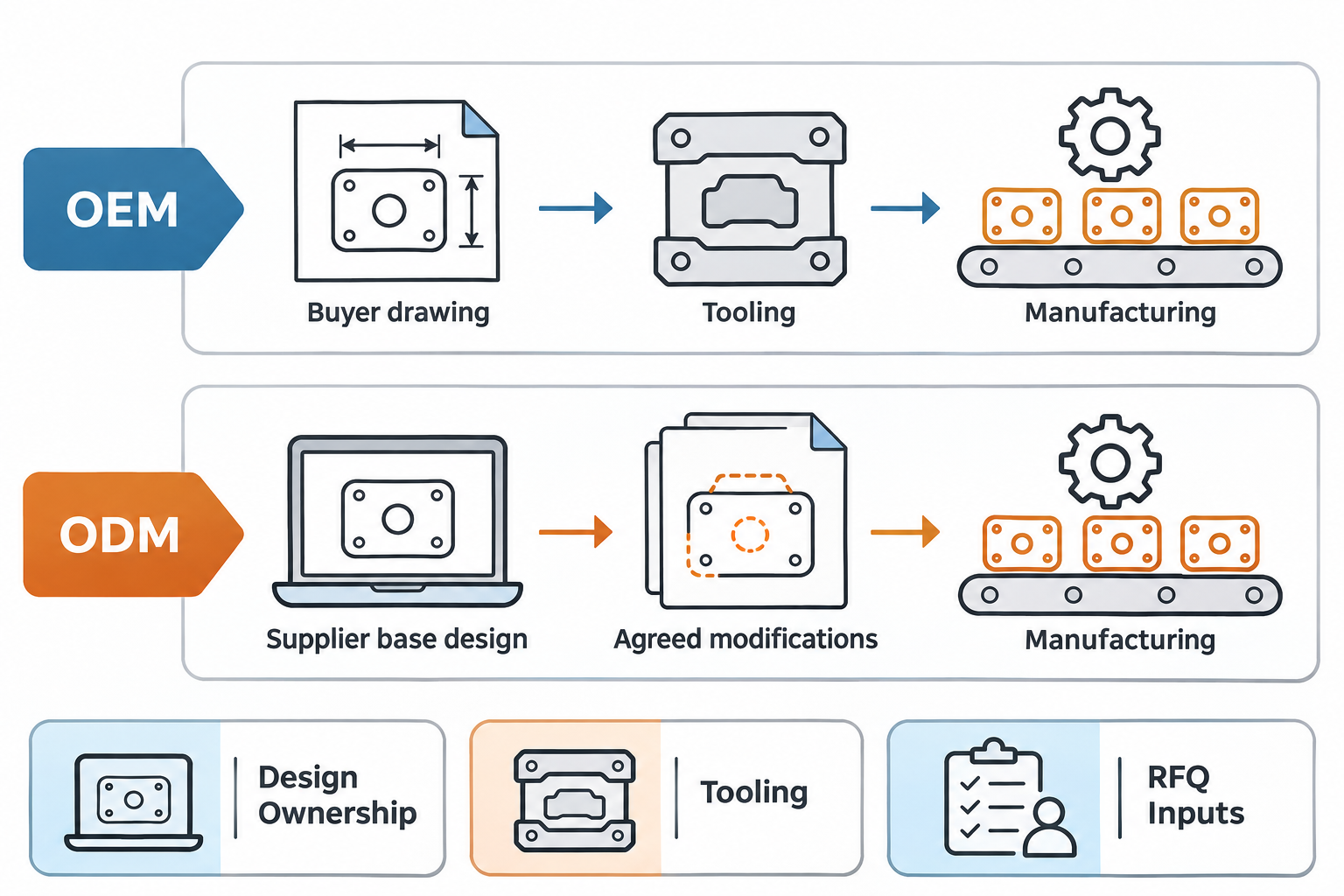
Separate the tooling charge from the rights and support associated with the tool. Ask who owns it, where it is kept, how maintenance is handled and what happens if production moves. Include the expected treatment of replacement or modified tooling.
Sample approval also needs a defined basis. Identify the drawing revision, material condition, finish and inspection evidence being approved. A visually acceptable sample does not settle an unresolved dimensional or material requirement.
For later changes, agree who can authorize them and which changes require another sample or inspection. Keep the approved revision attached to the production order. A shared description such as “same as last time” is weaker than a traceable design and process baseline.
When fit depends on an existing assembly, the buyer’s controlled drawing is often the most useful starting point. State the interface and acceptance requirements, then ask the supplier to identify feasibility questions or proposed alternatives.
If evaluating a supplier’s existing design, request enough specification detail to judge compatibility. Similar appearance does not establish the same fit, material condition or load-related suitability. Identify what can change and what must remain fixed.
Keep technical customization separate from branding. A manufacturer may customize dimensions, material or finish while supplying neutral parts. Private labeling, engraving and logo printing are separate services and should never be inferred from an OEM/ODM label.
Include the controlled drawing or sample definition, application, material and hardness requirements, finish, critical dimensions, quantity and inspection deliverables. Identify any design work you expect the supplier to perform. Ask for a quotation that separates recurring production from development and tooling work.
Eugene’s custom fastener service describes drawing-based technical customization. Its stated neutral-product policy excludes logo printing, brand engraving and private-label customization. Use the inquiry to discuss the part specification and requested engineering scope, with responsibilities and commercial terms confirmed for the actual project.