The main DAP vs DDP difference is import responsibility: under DAP the buyer handles and pays import clearance, while under DDP the seller takes that role. Both Incoterms® 2020 rules provide for delivery at the agreed destination, ready for unloading. Before comparing quotations, check the exact destination and whether the proposed import arrangement can actually be carried out.
For a buyer ordering retaining rings, washers or pins, a delivered total needs a visible scope. The comparison below focuses on the questions that make two component offers technically and commercially comparable.
Use the import-clearance allocation as the first comparison point. The ICC Academy’s DAP/DDP explanation identifies this as the central difference between the two rules. A label such as “door delivery” is too vague to establish that allocation.
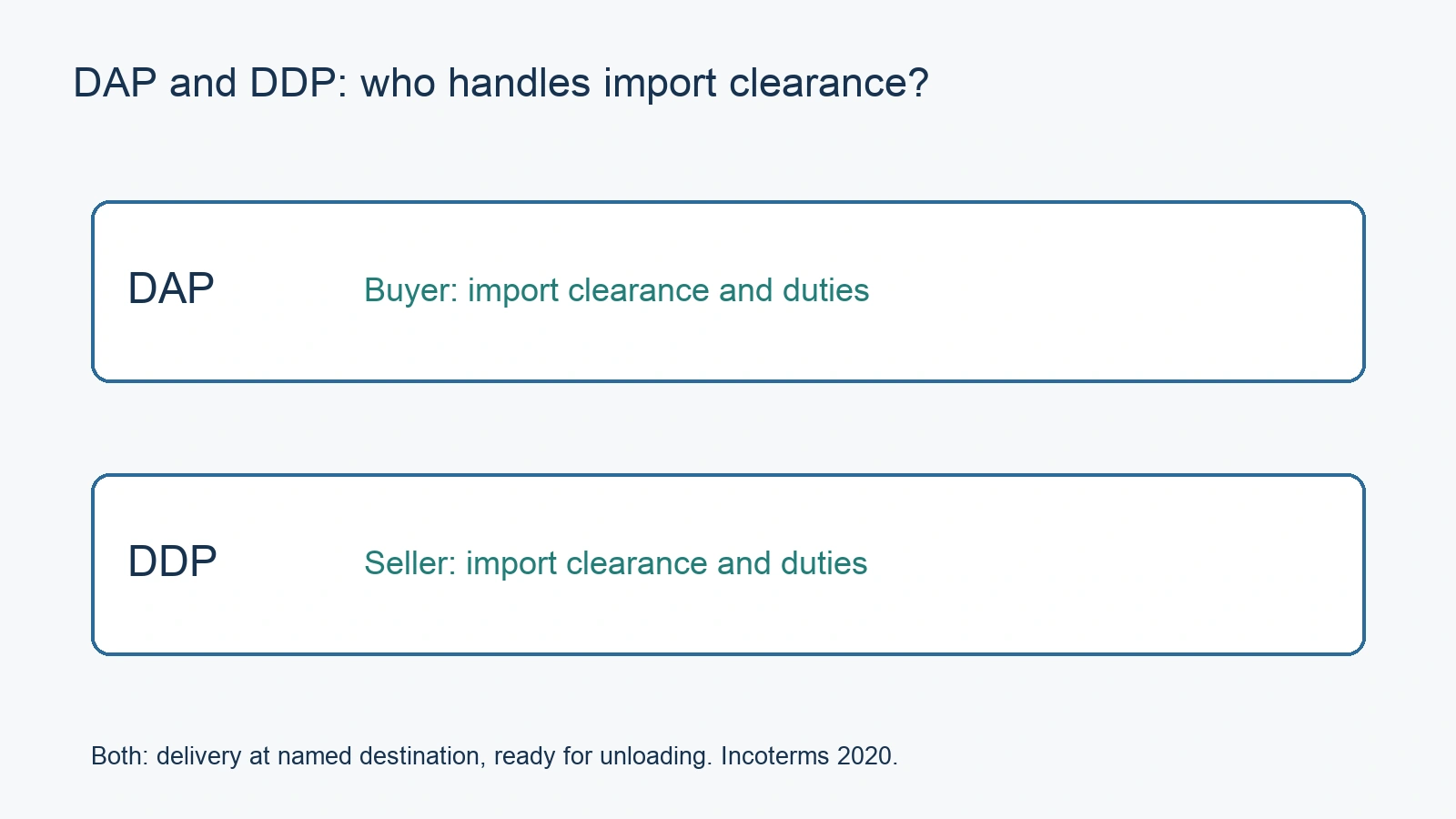
In the ordinary delivery case, the risk boundary is the agreed destination handover, with the goods available on the arriving vehicle ready for unloading. This does not make either term an unloading service. It also does not remove the buyer’s cooperation and receiving obligations or decide every possible delay or default situation.
Keep the rule’s allocation separate from practical feasibility. A seller offering DDP still needs a workable way to meet the destination-country requirements. A buyer considering DAP needs to understand the import work it will arrange. Neither question can be answered from the letters alone.
This article is an educational quotation guide under the 2020 framework. It does not provide a tariff rate, determine importer eligibility or prescribe a customs or tax structure for a particular country.
Compare offers to the same place and point. A destination terminal and the buyer’s warehouse are different boundaries even when they are in the same region.
Give the supplier the intended receiving address and identify any delivery access information already known. Ask which location the quotation actually covers. If the offer names a terminal, identify the additional movement needed to reach the receiving site before comparing it with a warehouse-based proposal.
The receiving team may also need an appointment, contact or handling arrangement. Ask that team what information is required, then coordinate it with the parties organising the movement. A delivery rule is not a warehouse booking.
When a supplier proposes a different destination, keep the change visible in the comparison. Request the missing route scope or show it separately. Avoid replacing a precise location with a broad city name merely to make the offers look consistent.
Use one final description across the quotation review and shipment instructions. That gives the buyer a defined point against which to ask about arrival, receiving and remaining transport questions.
Suppose two suppliers quote cartons of washers to the same buyer. One offer uses DAP and another uses DDP. This hypothetical example assumes no duty rate, tax amount or freight saving.
First align the component scope: drawing revision or exact product reference, material, finish, quantity and agreed inspection records. A delivered-price comparison is not meaningful if one offer covers a different washer configuration.
Then compare the route and import assumptions. The original worksheet below exposes the questions before the totals are treated as equivalent.
| Comparison item | Question for the buyer’s review |
|---|---|
| Component | Do the offers cover the same specification and quantity? |
| Destination | Do both reach the same exact receiving point? |
| Import responsibility | Which party will handle and pay the applicable import formalities? |
| Quotation assumptions | What shipment information and declared scope underpin the offer? |
| Separate items | Which handling or receiving services are outside the quoted total? |
| Feasibility | Who will confirm that the proposed arrangement is workable? |
For the DAP proposal, obtain the buyer-side information needed to evaluate the import work outside the supplier’s allocation. For the DDP proposal, ask the seller to explain its included scope and the assumptions requiring confirmation. The table does not calculate either total; it identifies the inputs needed for that calculation.
If an item is unresolved, retain it as an open question. Do not enter zero because the quotation lacks a line for it. A useful comparison can show a provisional total with stated gaps rather than a falsely complete number.
Identify the party responsible for the import process and ask it to confirm the proposed route with the relevant service providers. Selecting DDP in an email does not establish that the seller can complete destination formalities.
Official KVK guidance highlights the need for a DDP seller to check destination-country feasibility in advance. Apply that as a practical question: which party will perform the required tasks, which information does it need and what remains to be confirmed?
For DAP, the buyer should obtain the corresponding information from its nominated import and logistics contacts. Communicate the planned clearance coordination to the party organising onward delivery, particularly when the named point is beyond the border or arrival terminal.
Keep commercial allocation separate from an unsupported legal conclusion. Do not assume that a foreign seller is eligible to perform every import task, or that a buyer can recover a tax simply because of the delivery term. Those questions depend on the actual transaction and relevant rules.
If the proposed arrangement is not yet confirmed, hold that part of the quotation review and assign the question to the responsible specialist. A clear unresolved item is more useful than an apparently inclusive price built on an untested assumption.
Arrange receiving and unloading explicitly. Both DAP and DDP reach a ready-for-unloading delivery state in the general framework; the receiving team still needs to know how the goods will be handled.
Ask whether an unloading cost is already included in the transport arrangement and what the receiving site must provide. The physical unloading operation and its commercial treatment should be understood together. Avoid using “everything included” to cover activities that nobody has defined.
Product acceptance is another separate task. For drawing-controlled pins or retaining rings, identify the records the buyer requires and whether they must be reviewed before shipment. Delivery to a warehouse does not resolve an open drawing deviation or demonstrate that a technical submission has been accepted.
Connect the final package and order references with the agreed component records. If the buyer requires lot identification or a specified document set, include that requirement in the component enquiry. The delivery basis and the technical release process should support the same order.
Keep a confirmed goods-ready date distinct from a proposed arrival date. Ask the parties managing the route to identify the assumptions behind the latter rather than presenting a provisional estimate as a guaranteed commitment.
Send the component requirement, intended destination and requested comparison basis together. Ask the supplier to state the delivery rule and edition, exact point, included scope and unresolved import assumptions.
For a drawing-based enquiry, include the revision, material, finish, quantity and inspection needs. Identify whether the order concerns samples or repeat production. If the final packing details are unknown, request them and keep the freight comparison provisional.
Within Eugene’s retaining-ring, washer, pin and related industrial fastener scope, use the service enquiry process to request the technical and delivery information. A DAP, DDP or other arrangement must be confirmed in the actual quotation; the enquiry itself does not establish a customs service or tax outcome.
ICC Academy: DAP and DDP responsibilities under Incoterms 2020
Business.gov.nl / KVK: DDP scope and destination feasibility