Ex Works (EXW) means the seller makes the goods available at the agreed collection place, without loading them onto the collecting vehicle. Under the Incoterms® 2020 framework, the buyer arranges the onward route and the relevant clearance formalities. Before accepting an EXW fastener quotation, identify the exact pickup point, the loading arrangement and the information your forwarder needs.
A factory price is only one part of that decision. The practical questions below help a buyer compare a complete collection proposal while keeping product inspection separate from transport handover.
Read EXW with a named place and the stated rules edition. A supplier’s town or a phrase such as “our factory” may be insufficient for arranging a vehicle. Ask for the full address and the precise collection point within the premises.
The ICC Academy’s EXW explanation places delivery and risk transfer where the goods are made available to the buyer, before loading. It also explains that the seller is not required under EXW to arrange export clearance or the main transport. Those distinctions are the starting point for reviewing the quotation.
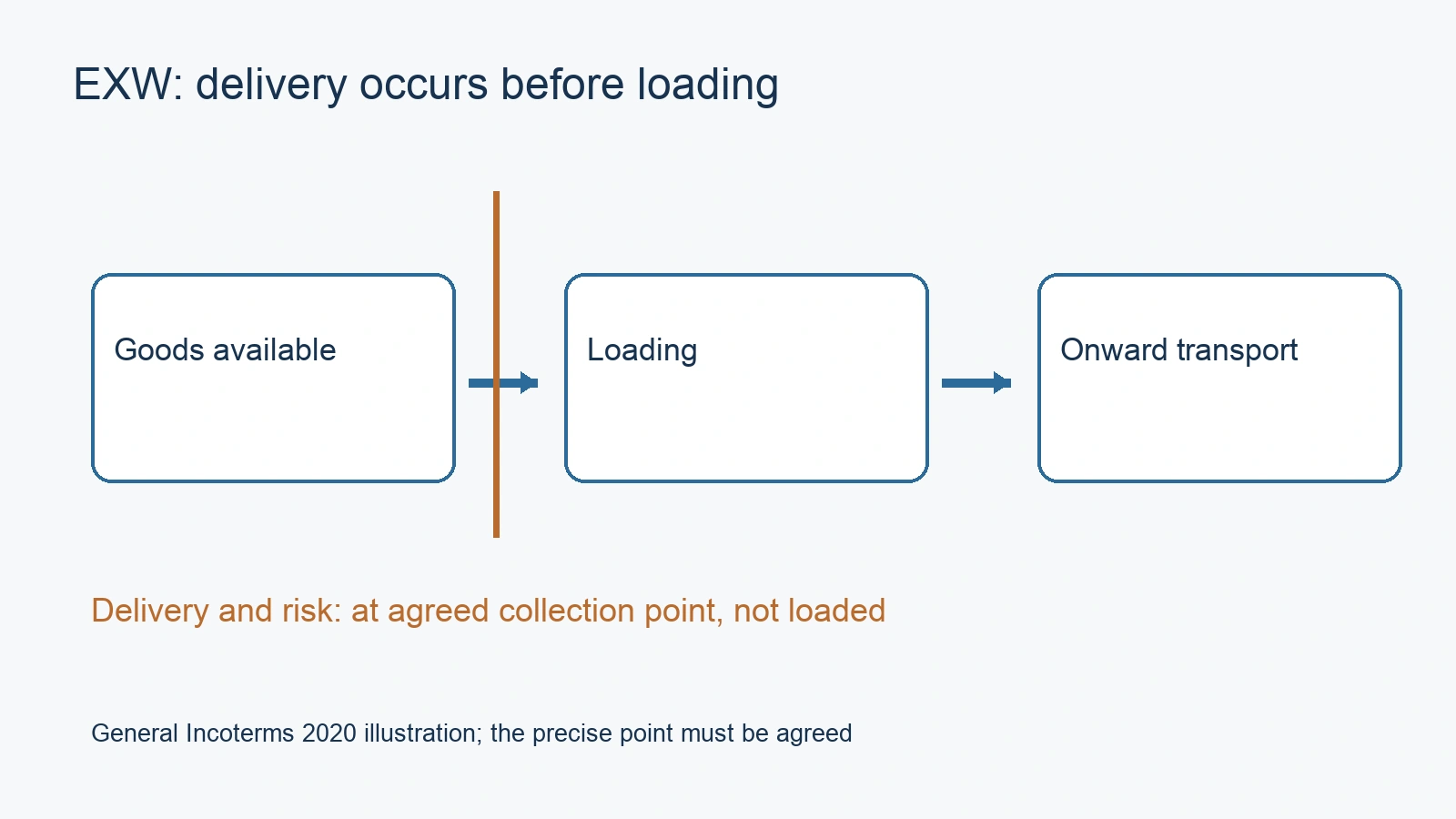
The term does not tell the driver which entrance to use or establish that the selected vehicle can access the loading area. Obtain those operational details from the collection contact. A clear address and a ready date are different pieces of information; both are needed to organise a pickup.
This guide explains general purchasing questions under the 2020 rules. It does not establish who is eligible to make a particular export or import declaration in any country.
Clarify who will physically load the shipment and how the parties intend to handle that operation. A seller having a forklift does not, by itself, resolve the EXW loading question.
Describe the actual proposal to the forwarder: goods available at the named collection point, the intended loading method and the collecting vehicle. If the seller will assist with loading, ask the parties to settle the responsibility explicitly before the vehicle arrives. Avoid leaving the issue to a driver and warehouse contact on collection day.
Check export arrangements just as early. Ask the forwarder which information, documents and authorised parties are needed for the proposed movement. The EXW abbreviation does not demonstrate that the buyer can complete those formalities in the country of dispatch.
The Netherlands’ official business guidance also highlights collection, loading, transport and exact location as practical EXW questions. Its country-specific tax and intra-EU recommendations should not be treated as universal instructions for a shipment from another jurisdiction.
If the practical arrangement involves seller loading and seller export clearance, request a clearly defined FCA alternative for comparison. The appropriate choice depends on the agreed shipment; changing three letters on a quotation without reviewing the route leaves the operational gap in place.
Give the collection contact and forwarder one consistent shipment description. The following original sheet is a coordination aid, not an official customs form or a substitute for the forwarder’s document requirements.
| Pickup item | Information to confirm | Question it resolves |
|---|---|---|
| Location | Full address, collection point, entrance and warehouse contact. | Where should the collecting vehicle report? |
| Availability | Confirmed ready date and collection window. | When can the goods actually be collected? |
| Shipment description | Package count, agreed packing form, dimensions and weight when available. | What vehicle and handling arrangement should be quoted? |
| Loading | Loading method, responsible party and agreed risk treatment. | Who will perform and coordinate the handoff? |
| Documentation | Agreed commercial documents and forwarder-specific information requests. | What must be available before collection is released? |
| Identification | Order, part revision and lot or package references required by the buyer. | How will the correct consignment be recognised? |
Ask for confirmed information rather than inserting estimates as facts. If packing is still being designed, show that the freight comparison is provisional and identify when the final dimensions and weight will be available. A transport offer based on an assumed carton arrangement may need revision after packing is complete.
Use the same sheet when comparing forwarder proposals. If one includes collection handling and another excludes it, the difference should be visible before either price becomes the internal budget.
Compare like-for-like product and transport scopes. Separate the component quotation from collection, loading where separately charged, onward freight and the clearance services required for the proposed route.
Suppose a buyer receives an EXW offer for cartons of pins and another offer based on a seller-arranged delivery stage. This is a hypothetical comparison with no assumed freight rate. The buyer should first confirm that both offers cover the same drawing revision, material, finish, quantity and inspection scope.
Next, describe the delivery boundary for each offer. Obtain a forwarder quotation for the transport and handling left with the buyer under the EXW proposal. Record exclusions and assumptions, including whether the stated packing information is final.
Keep duties and taxes separate from invented estimates. Their treatment depends on the actual movement and applicable requirements; the word EXW is not a tariff calculation. Have the responsible parties establish the needed customs inputs for that transaction.
The output can be a short comparison showing the supplier price, separately quoted route costs and unresolved items. An unknown cost is an open question, not a zero. This helps the buyer see whether a price difference reflects the component itself or a different allocation of logistics work.
Agree the product-release evidence before asking a carrier to collect. Goods being available for pickup does not, by itself, demonstrate that the buyer has received the inspection records or technical answers it requires.
For a drawing-based retaining ring or washer, identify the revision and the order-specific records to accompany the shipment. If the buyer requires review before release, state the approval route and who will communicate that decision to the warehouse.
Likewise, distinguish an available shipment from a reserved transport booking. Confirm the pickup window with both parties and record any outstanding packing or document item. That reduces the chance of the vehicle arriving for goods that are still awaiting release.
Keep the commercial delivery basis and the quality requirements in their proper places. EXW describes a logistics allocation; it does not replace the component specification, settle an unresolved drawing note or define every condition for accepting the goods.
Ask for an FCA comparison when seller loading and export clearance are important to the proposed arrangement. At the seller’s premises, FCA has a different delivery boundary from EXW. Confirm the precise location and the proposed tasks instead of assuming that the alternatives are interchangeable.
A useful comparison request identifies the same component specification and quantity, then asks the supplier to state the delivery rule, edition, named point and included activities for each option. Discuss the resulting route with the forwarder before selecting it.
For Eugene’s retaining rings, washers, pins and related fastener enquiries, the service enquiry process can be used to request component and collection details together. Include the drawing revision, quantity, intended collection arrangement and any missing packing information. Availability of a particular delivery arrangement remains subject to confirmation in the quotation.