OEM sourcing starts with matching a defined component requirement to a supplier that can explain how it will make, inspect and deliver the part. Before asking for a price, confirm the drawing baseline, the proposed manufacturing site, any outside operations and the evidence needed to evaluate samples. A responsive sales contact is useful; a technically answerable quotation is the next test.
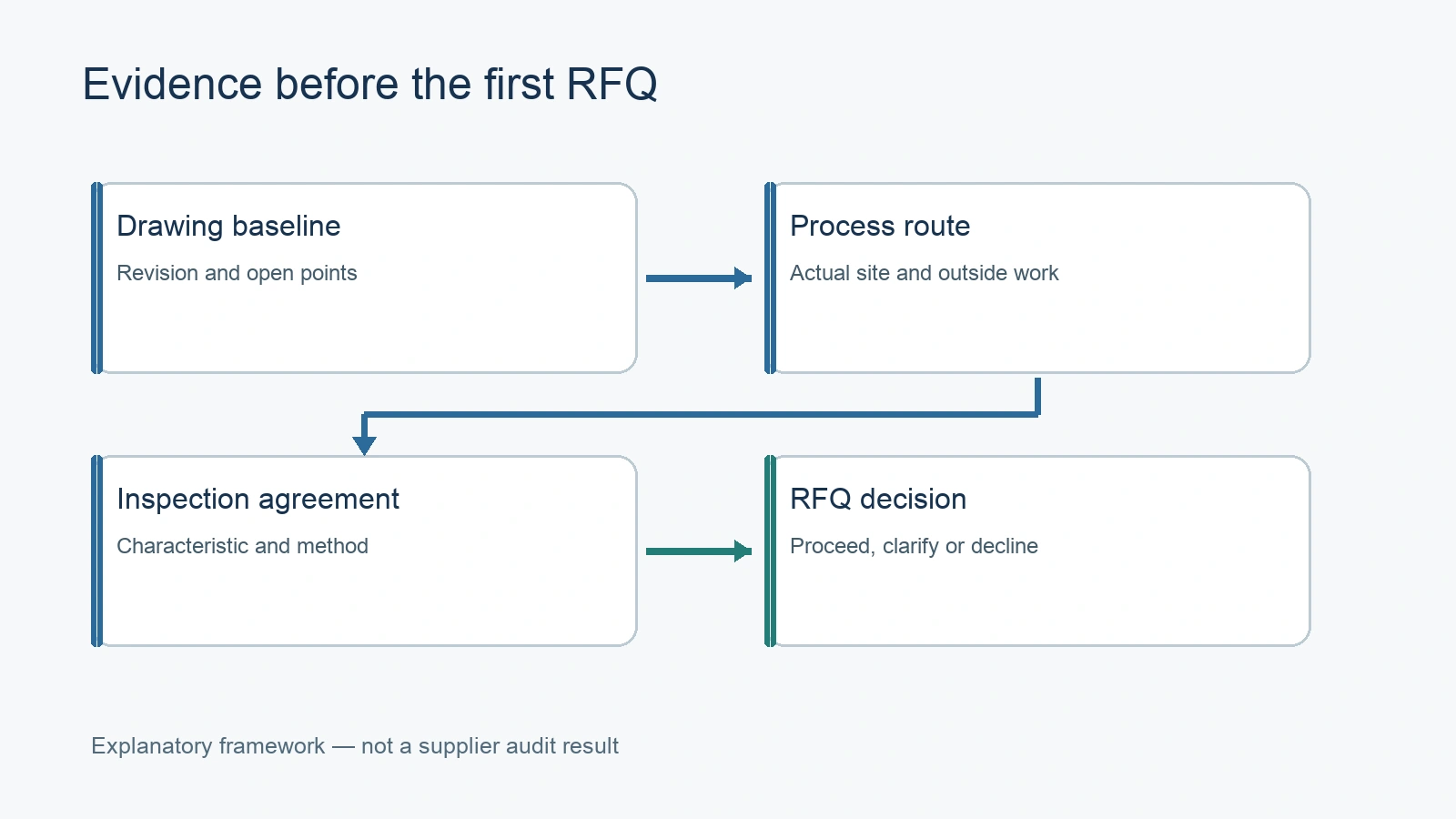
For retaining rings, washers, pins and other drawing-based components, use the screening process below to decide whether to issue an RFQ, request clarification or stop the enquiry. The checklist is a purchasing framework, not a substitute for approving a part against its specification.
Give every candidate the same requirement baseline. Identify the drawing number and revision, product description, material, finish, quantity and intended purchasing stage. State whether the enquiry concerns feasibility, prototype samples or repeat production. Otherwise, suppliers may price different assumptions while appearing to quote the same component.
Separate confirmed requirements from open questions. If the material condition is undecided, label it as a question for technical review. If a dimension is critical to assembly, identify it and provide the relevant drawing requirement. Do not let an informal email sketch silently replace the controlled drawing.
A short enquiry brief can be more useful than a large, inconsistent attachment folder. Put the drawing revision on the brief, identify which documents take precedence and assign a contact for technical questions. Include the expected demand pattern, even if it is provisional, so the supplier understands the difference between the sample quantity and the potential production order.
This approach follows the capability-matching principle behind NIST MEP supplier scouting: define the production and technical need before trying to identify a suitable manufacturing capability. NIST’s own service concerns US manufacturers; it is not evidence about a particular overseas supplier.
Ask which legal entity will quote, which facility will manufacture and who will release the goods. These may be different parties. A distributor or sourcing company can be a legitimate supplier, but the relationship should be clear before technical information, samples or tooling payments change hands.
Request a proposed process route in plain language. For a steel component, that might identify forming or machining, heat treatment when specified, finishing and final inspection. Ask which operations are performed at the manufacturing site and which are outsourced. Subcontracting is a fact to manage, rather than an automatic reason to reject a supplier.
For each outside operation, clarify who communicates the requirements, controls changes and checks the returned work. A certificate attached to a sales presentation does not answer those questions. Where a quality-system certificate is relevant, check its entity, location, scope and validity rather than assuming that it covers every quoted process.
NIST MEP’s supplier-selection discussion recommends looking beyond unit price and reviewing capabilities, quality documentation, capacity and logistics. Use direct discussion and, where appropriate, a site visit to resolve the gaps that matter to the component.
Write down the claim that matters and the evidence that would make it useful. Keep the request specific enough for the supplier to answer without exposing another customer’s confidential information. A relevant, anonymised example is generally more informative than an unrelated catalogue page.
| Supplier statement | Useful follow-up | Decision supported |
|---|---|---|
| “We make this type of part.” | Proposed process route and relevant component experience. | Whether the manufacturing approach fits the enquiry. |
| “We can meet the drawing.” | A revision-specific response identifying exceptions and questions. | Whether the quotation covers the actual requirement. |
| “We inspect every shipment.” | Characteristics checked, methods, records and release responsibility. | Whether inspection addresses the important features. |
| “Our partner performs the finish.” | Responsibility for communicating the finish requirement and checking returned work. | Whether an outsourced operation has a defined owner. |
| “We can supply repeat orders.” | Proposed change-notification and repeat-order controls. | Whether the initial approval can remain meaningful. |
This matrix is an original screening aid, not a supplier score or an audit result. Record unresolved items beside the evidence request. Avoid assigning a reassuring numerical score to a critical requirement that nobody has answered.
Consider a hypothetical enquiry for a retaining ring. The buyer sends a controlled drawing, a material requirement, a finish requirement and a request for sample and production quotations. One candidate returns a price without identifying the revision. Another asks whether an ambiguous drawing note applies before or after finishing and lists the inspection records included in its offer.
The second response is not proof that the supplier will make acceptable parts. It does, however, expose an assumption that the buyer can resolve before comparing quotations. Send the clarification to every candidate affected by it and request updated confirmation against the same baseline.
Read exceptions as part of the offer. A quotation for an alternative material, a different surface condition or a commercial tolerance is a different proposal unless the buyer approves that change. Keep the original requirement and the proposed alternative visible; do not accept a substitution simply because the part description looks familiar.
Ask the supplier to identify what information is still needed to quote responsibly. The useful output is a closed set of requirements or a visible list of questions, not an unqualified “yes” to an incomplete drawing.
Define what the sample is intended to demonstrate. A stock sample may help the buyer discuss a product family or visible geometry. It does not necessarily demonstrate the proposed material, process route or finished condition for the drawing under review.
For a representative sample, agree the revision, specified characteristics, measurement records and any assembly evaluation the buyer will perform. Identify who can approve the result and how exceptions will be handled. Keep the approval linked to the evaluated configuration so that a later change can be reviewed against it.
Sample acceptance and ongoing production control answer different questions. An accepted sample supports a decision about that submission. Repeat-order discussions should also cover material or process changes, drawing updates and how the supplier will communicate deviations.
When the enquiry reaches this stage, use a separate first-article inspection plan to define the evidence needed for approval. Supplier screening establishes whether that evaluation is worth starting; it does not complete the evaluation in advance.
Compare offers on the same commercial and technical basis. Separate the component price from tooling, sample preparation, testing, packaging and transport items where these are quoted separately. Identify what is included rather than assuming that every supplier uses the same quotation format.
Check the named delivery basis and location, the quantity on which the price depends and the assumptions behind repeat orders. A low unit price can be difficult to interpret if the offer leaves an essential inspection or finishing operation outside the quoted scope.
Discuss ownership and access to any dedicated tooling before committing to it. Record who maintains it, how a proposed change is approved and what happens if the supply arrangement ends. The exact arrangement belongs in the parties’ agreed terms; an OEM label alone does not establish it.
Use total cost as a comparison question, not as an invented savings figure. NIST MEP discusses why supplier capabilities and operating arrangements can affect total cost beyond the quoted unit price.
Issue the RFQ when the candidate fits the product family, has identified the proposed supply route and can respond to a stable requirement. Include the drawing baseline, the remaining commercial questions and the evidence expected with the quotation.
Hold the enquiry for clarification when an essential requirement, manufacturing responsibility or sample purpose remains unclear. Assign the question to a named person and record what answer will allow the enquiry to continue. A hold is a practical control, not a prediction that the supplier will fail.
Decline the proposed route when it cannot address an essential requirement or the parties cannot agree who will resolve a critical gap. Keep the reason tied to the requirement so that the sourcing team can explain its decision.
For a drawing-based enquiry within Eugene’s retaining-ring, washer, pin and non-standard fastener scope, the next step is to send the agreed drawing revision, material, finish, quantity and inspection needs through the OEM and ODM service enquiry. Identify open points explicitly. That gives the supplier a defined proposal to evaluate and gives the buyer a response that can be compared.