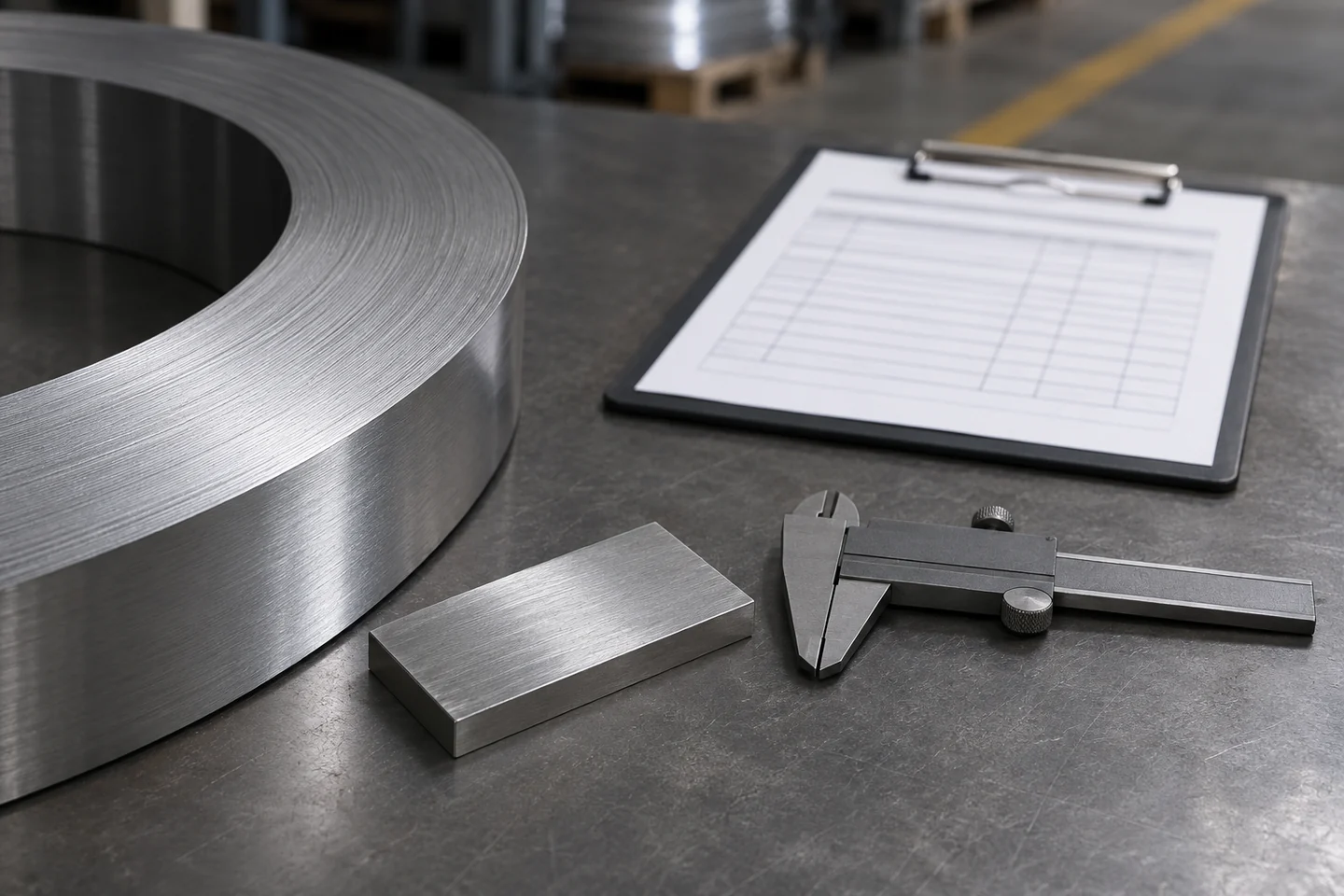
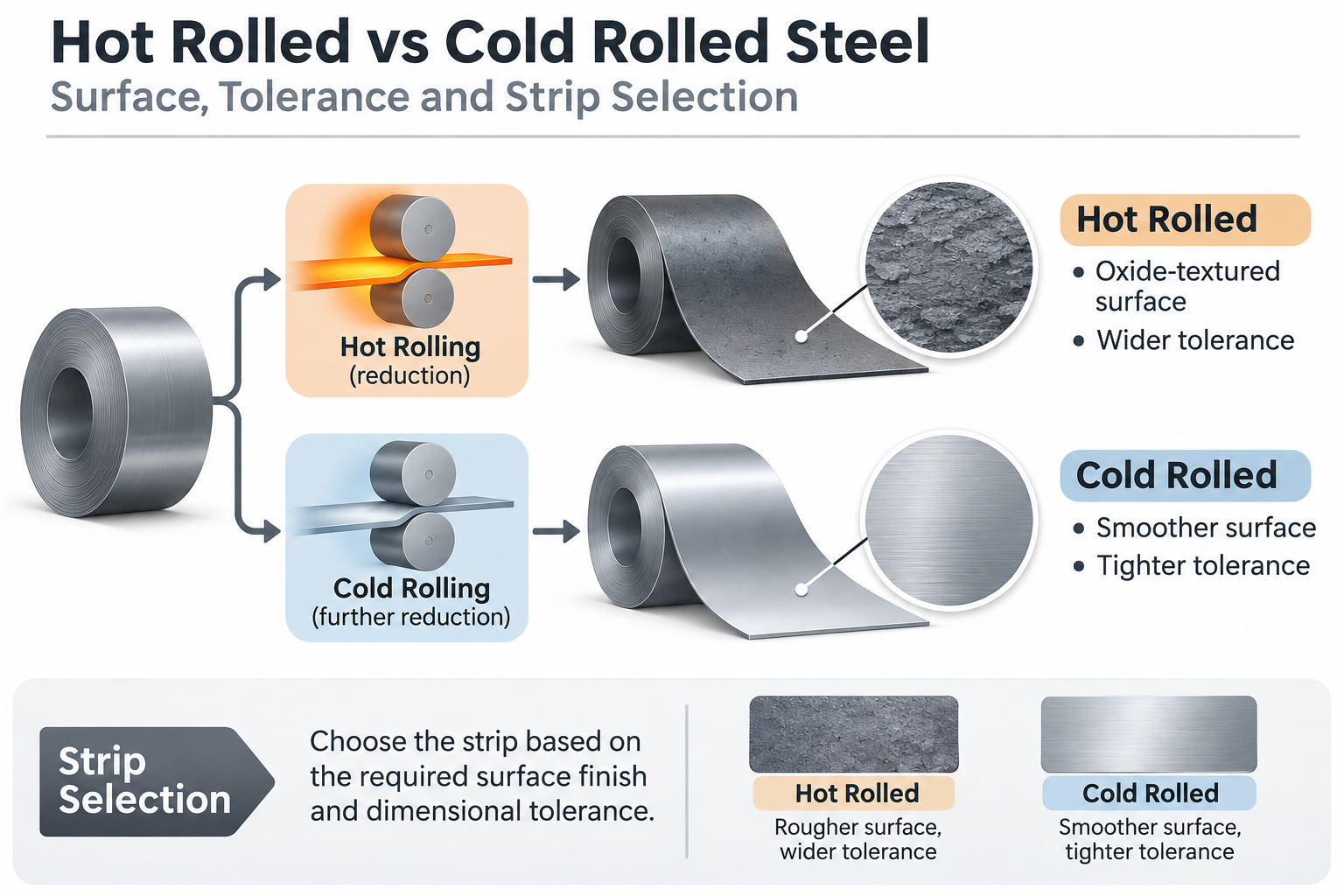
Cold/hot rolled steel comparisons start with the processing route. Hot rolling shapes steel above its recrystallization conditions; cold rolling further reduces steel below those conditions and can introduce work hardening. Cold rolled products commonly offer smoother surfaces and closer dimensional control. However, the rolling route does not tell you whether a strip is annealed, half-hard or hardened. Specify the grade, delivery condition and tolerances together.
Choose the route by the finished requirement. A surface that will be machined later presents a different purchasing task from thin strip entering a forming die. The comparison describes common processing differences; the actual product specification determines what a supplier must deliver.
| Decision | Hot rolled route | Cold rolled route |
|---|---|---|
| Processing | Reduction above recrystallization conditions | Further reduction below recrystallization conditions |
| Surface | As-rolled material commonly carries scale; subsequent treatments can change it | Commonly selected for smoother, controlled surfaces |
| Dimensions | Order the applicable product tolerances | Often selected for closer control, with limits still specified |
| Mechanical condition | Depends on grade and processing | Depends on reduction and subsequent treatment; not automatically soft |
Neither route is universally stronger, easier to form or less expensive. Comparing different grades or conditions can hide the actual reason for a property difference.
“Cold rolled” identifies processing. “Annealed” identifies a heat-treated condition. “Hardened” identifies a different condition that also needs a defined property requirement. A cold-rolled strip can undergo later heat treatment, so these descriptions are not competing names for the same characteristic.
Write the requirement as a combination: grade, product form, delivery condition and mechanical acceptance criteria. If forming needs a soft condition, say so through the agreed specification. Do not expect the supplier to infer it from “cold rolled spring steel.”
This improves quotation comparison. Annealed strip and hardened strip are not comparable merely because both quotes list the same nominal thickness and a cold-rolled route. Ask which condition each quoted property describes.
Define the dimensions that control the next process: thickness, width, length or coil format, and any flatness or edge requirements. A nominal size without an acceptance range leaves an important comparison unresolved. Identify whether the requirement applies to supplied strip or a later processed component.
Surface language should describe a usable condition. If scale, roughness, oil or marks affect the next operation, state the acceptance requirement instead of asking for “good surface quality.” When a supplier proposes a different route, request a sample for the operation that matters.
Keep grade-specific evidence in view. A mill’s forming-steel data sheet demonstrates how properties and tolerances are specified for that product; its values do not become requirements for spring steel.
Start with the operations rather than the finished part’s name. Will the strip be blanked, bent, drawn, heat-treated or finished after forming? Which operation controls the incoming condition? These questions help determine whether to evaluate annealed or already hardened stock.
For substantial forming, compare the proposed grade and condition against the forming requirements. If harder stock is suggested, ask how the route accommodates the geometry and final properties. When heat treatment follows forming, include the resulting dimensional and surface requirements in the discussion.
Retain the trial sample’s grade, condition and batch documentation. A later order should reproduce the material basis that was evaluated, not just the nominal strip dimensions.
Include the material designation and specification, delivery condition, thickness and width limits, edge and surface requirements, coil or cut-length format, quantity and inspection documents. State the forming sequence when it affects material choice. Ask suppliers to identify deviations clearly rather than burying them in a general note.
Eugene lists cold-rolled annealed spring-steel strip. This is a relevant starting point when the task is strip in an annealed condition for subsequent processing. Confirm the grade and order-specific properties before treating it as interchangeable with another cold-rolled product.
Metal Supermarkets: hot rolled and cold rolled steel; SSAB: product-specific cold-rolled properties and tolerances.