Passivation of stainless steel parts is a surface-treatment decision intended to support the material’s passive condition, including the removal of relevant surface contamination. It does not change the alloy grade, replace cleaning or make every stainless component immune to corrosion. A useful specification identifies the stainless grade, surface condition, required treatment and appropriate acceptance evidence.
For a precision pin or other drawing-based fastener, begin with the actual surface problem. Grease, transferred iron, heat tint and a rough surface are different conditions. A general note saying “passivate” should not be expected to resolve all of them or define the finished dimensions.
Carpenter Technology explains that clean stainless steel develops a thin protective oxide film in an oxygen-containing environment. Manufacturing can introduce surface contamination, including transferred iron. Cleaning and an appropriate passivation treatment address the surface condition; they do not turn a different material into the specified stainless alloy.
The distinction matters during sourcing. A material certificate identifies the alloy supplied, while treatment records describe a surface-processing step. The buyer may need both, but one does not replace the other. A treatment declaration cannot establish that an unidentified component was made from the ordered grade.
If a stainless part shows staining, do not assume the cause from appearance alone. Ask what material was supplied, what processing occurred and what exposure the part experienced. Surface contamination is one possible concern, but a photograph does not establish the complete corrosion mechanism or the suitability of the alloy for service.
For a new order, the grade should be an explicit input to the treatment discussion. The processor also needs to understand the supplied surface condition and the applicable drawing requirements. A treatment chosen for an unrelated stainless component should not automatically be transferred to the current part.
The purchase request should distinguish what is known from what remains to be determined. For example, the buyer may know that the part was machined and cleaned but lack evidence of the specified final treatment. That is a documentation gap. It is different from confirmed contamination or a demonstrated failure against an agreed acceptance criterion.
The protective surface film is not a decorative coating whose condition can be certified from a catalog photograph. A shiny component does not, by itself, prove that the required treatment was performed. A darker surface does not automatically identify the absence of an acceptable passive condition.
Use the drawing and agreed evaluation requirements to define acceptance. If appearance is also important, specify it separately. This keeps an aesthetic preference from becoming an improvised substitute for technical evidence.
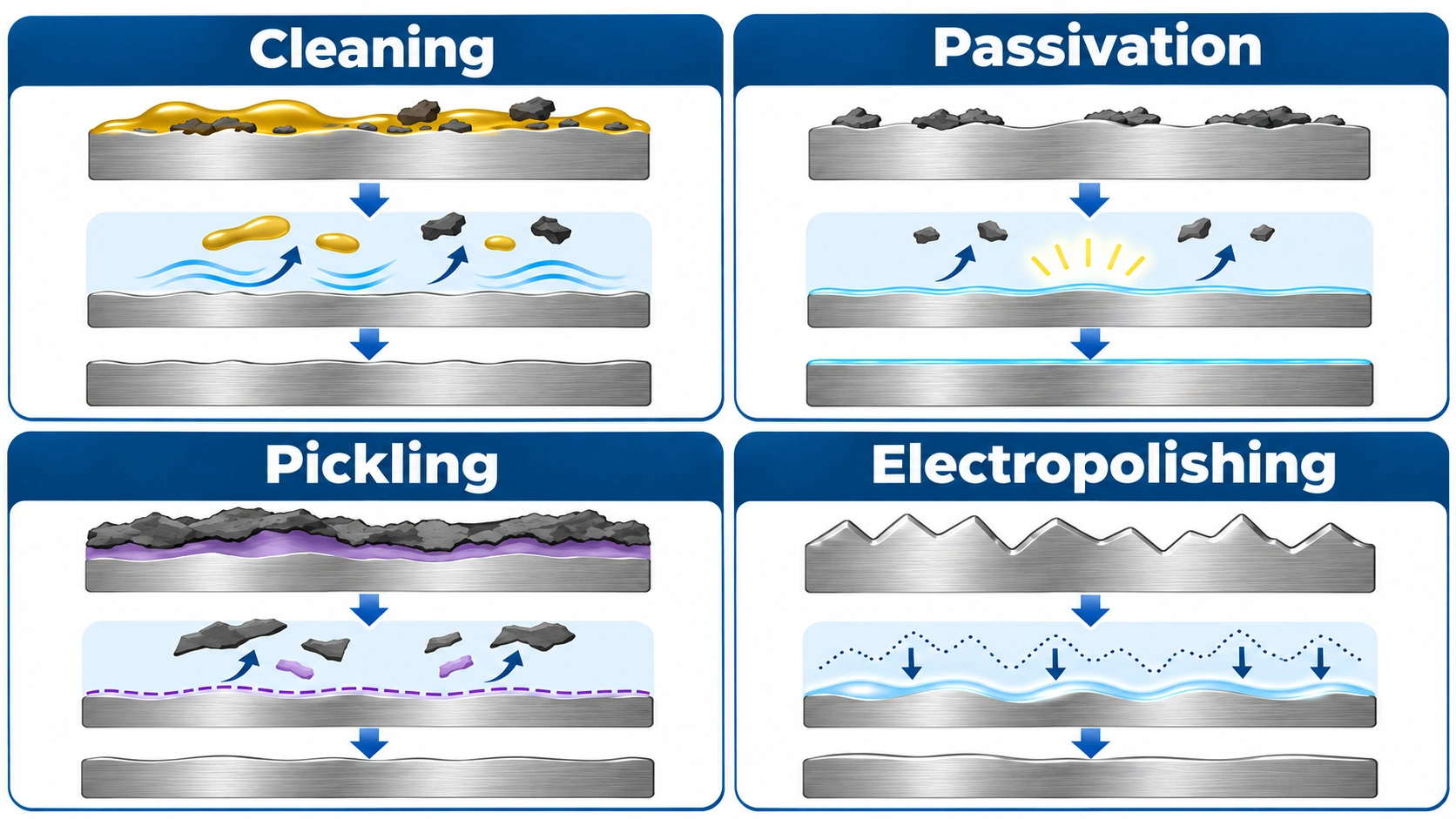
These process names describe different purposes. ASSDA distinguishes pickling, passivation and electropolishing by their effects on the stainless surface. Worldstainless also emphasizes that pickling and passivation do not replace removal of grease and oil. The initial condition therefore determines which question needs to be addressed.
Cleaning is the preparation question when oil, grease or other removable contamination interferes with the intended treatment or cleanliness requirement. Ask what condition the component must reach before subsequent processing. Do not assume that adding a passivation note makes a separate cleaning requirement unnecessary.
For a purchased finished part, state whether the supplier’s quoted scope includes the required final cleanliness. A quote for a surface-treatment operation alone may leave handling, cleaning or packaging outside its scope. Those exclusions need to be identified before the buyer expects a ready-to-assemble delivery.
Passivation is relevant to the chemical condition of the stainless surface and appropriate contamination removal. It is not a general method of correcting dimensional errors, deep machining marks or an unsuitable alloy choice. The requested treatment should be matched to the material and controlling specification.
In an RFQ, retain the exact treatment reference when the drawing provides one. If the note is incomplete, request clarification of the method and acceptance basis. A supplier’s usual process may be suitable, but that suitability needs to be established for the actual requirement.
Pickling removes oxide or scale and involves removal of surface metal. That distinguishes it from a simple request to clean away grease or remove transferred contamination. Where heat tint or scale is present, identify the condition rather than assuming passivation alone will remove it.
Because material removal can matter to a precision feature, the buyer should identify the dimensions and surfaces that must remain within the drawing requirements. The process response should explain how the complete delivered part will be accepted, without silently changing the specified geometry.
Electropolishing removes metal electrolytically and can smooth the surface. It should not be used as an interchangeable word for passivation in a purchase description. If electropolishing is required, identify it directly and clarify the final dimensional and surface requirements.
A supplier proposing electropolishing as an alternative should state what changes in the quoted scope. The buyer can then review the proposal against the component’s functional requirements. Similar cleanliness language does not make two different processes equivalent.
The following original matrix helps separate the initial purchasing questions. It does not diagnose a returned component or select a chemical recipe. The actual treatment needs to suit the grade, condition and governing requirement.
| Condition or requirement | Question to resolve | What not to assume |
|---|---|---|
| Oil or grease remains | What cleaning is required before treatment and delivery? | That passivation replaces degreasing |
| Possible transferred iron | What evaluation and grade-appropriate treatment apply? | That every stain proves the same contamination |
| Heat tint or scale | Is oxide removal included in the required route? | That a passivation note alone removes scale |
| Surface smoothing is required | Which finish and material-removal process are specified? | That passivation corrects roughness or tool marks |
| Corrosion appears in service | What material, surface and exposure information is available? | That repeating treatment resolves an unsuitable service condition |
The treatment request should identify the exact stainless grade and its material specification. Carpenter’s guidance notes that evaluation needs to suit the grade, including differences relevant to free-machining stainless materials. A generic test request should therefore be checked for applicability rather than copied from another component.
The grade information should remain linked to the delivered lot. A surface-treatment record is more useful when its component and lot identifiers agree with the material and delivery records. Otherwise the buyer may have a technically detailed declaration with no clear connection to the goods received.
For a locating pin, identify the working diameter, shoulder and other fit-critical features. State which dimensions apply after the operations included in the quote. If a proposed route includes pickling or electropolishing, its material-removal implications belong in the dimensional review.
The dowel pin sizes and fits guide addresses that assembly requirement separately. A treatment requirement neither selects the fit nor proves that the finished dimensions are acceptable. Keep the fit and surface-treatment requirements visible in the same controlled drawing package.
If the buyer requires a particular final surface texture or edge condition, identify the relevant feature and acceptance reference. Do not leave the supplier to interpret a broad phrase such as “smooth finish” as permission to alter an edge or working surface. The response should distinguish a proposed process from a confirmed drawing requirement.
A useful treatment quotation states the referenced requirement, included preparation, treatment identity and agreed evidence. If a specification permits alternatives, the supplier’s selected or proposed route should be made clear where the order requires that detail. The buyer should not assume that every supplier has quoted the same option.
Where the drawing says only “passivate,” ask the technical owner to establish the controlling requirement. A general article cannot choose the applicable standard, edition or acceptance method for a customer’s design. Once clarified, send the same requirement to all suppliers being compared.
Any proposed deviation should remain visible until accepted. This includes a change of process, an excluded preparation step or a different evidence package. Recording these items separately is more useful than relying on a statement that the supplier follows its normal procedure.
Inspection begins with the acceptance question. The buyer may need evidence of material identity, treatment completion, cleanliness or a specified surface evaluation. Those are different subjects. A single “passivated” statement may be sufficient for one agreed record purpose while leaving another requirement unanswered.
Ask the supplier to identify the evaluation method and its applicability to the ordered grade and requirement. Do not assume that every listed alternative test must be performed on every lot. The agreed specification and order determine the required evidence.
A report should identify the represented component or lot, the requirement evaluated and the result under that requirement. If the order calls for a particular record format, provide it before production. This allows the supplier to quote the requested documentation as part of the actual delivery.
Keep dimensional results separate from surface evaluation. A part can have acceptable dimensions while its required treatment evidence is missing. Conversely, a treatment declaration does not establish the diameter of a finished pin. Each result should remain connected to the characteristic it addresses.
Appearance requirements can identify visible conditions the buyer will accept or reject, but they should be defined. A photograph taken under unknown lighting is a weak basis for deciding whether a different delivery matches a finish requirement. Where a visual reference is used, agree its role and the relevant viewing conditions.
If staining is found, preserve the component identity and available processing history. Describe the location and observed condition without assigning an unverified cause. That information supports a more useful technical investigation than immediately labeling the whole lot as improperly passivated.
The delivery plan should address how treated parts are handled and packaged after acceptance. Ask how the required cleanliness and identification are maintained through the quoted supply chain. The answer should reflect the actual component and delivery requirements rather than a generic claim of contamination-free processing.
For the buyer’s receiving process, keep the parts associated with their records and preserve relevant handling information. If a later operation changes the surface condition, review whether the original treatment evidence still answers the final requirement. Acceptance before that operation should not be silently treated as proof of the later state.
Where components are divided into several packages, agree how their labels preserve the connection to the treatment and inspection records. A report stored separately from unidentified bags may not help receiving establish which material it represents. The order can specify the needed identifiers without dictating an unsupported packaging material or storage-life claim.
Consider a hypothetical buyer sourcing a stainless locating pin. The drawing specifies the grade and final geometry but adds only the note “passivate.” One supplier quotes its usual surface treatment. Another asks whether cleaning, oxide removal or a particular acceptance evaluation is required. These are illustrative responses, not actual customer or supplier records.
The buyer first confirms the intended starting and delivered conditions. The inquiry concerns newly machined parts, not the restoration of used components with an unknown service history. It identifies the expected surface condition so the supplier does not have to infer the treatment task from a broad process name.
The buyer clarifies whether the delivered parts may retain oil or other processing residue. It states the required final cleanliness and asks the supplier to identify the included preparation. If heat tint or scale is expected from an earlier operation, that condition is raised explicitly rather than hidden inside the passivation note.
The supplier can now distinguish cleaning, any required oxide-removal step and passivation in its proposed scope. A proposal including additional material removal is reviewed against the working surfaces. The buyer does not accept a changed process solely because its description sounds more comprehensive.
The buyer supplies the exact stainless grade and controlling material requirement. It asks which treatment requirement the supplier has quoted and what grade-appropriate evaluation is included. Any uncertainty about applicability remains open until the technical requirement is settled.
This clarification also improves cost comparison. A quote including an agreed evaluation and lot-linked record can be distinguished from a quote for treatment alone. Purchasing can assess whether each deliverable is required, instead of choosing a price based on an undefined process label.
The buyer marks the pin’s fit-critical surfaces and states that dimensional acceptance applies in the delivered state. It identifies which results must be recorded and how the treatment and inspection records must refer to the supplied lot. The supplier lists any exception against those requirements.
If a later clarification changes the treatment route, the dimensional and evidence requirements are reviewed with it. The final order retains the accepted method reference and documentation scope. A repeat order can then use that settled requirement rather than relying on a memory of the previous part’s appearance.
If staining later appears, the buyer can identify the affected lot, material, recorded treatment and subsequent exposure history. That information does not predetermine the cause, but it gives the technical discussion a useful starting point. The response can distinguish a record gap, a surface-condition issue and a question about suitability for the service environment.
The buyer should also identify what resolution is being requested: missing evidence, an investigation, a replacement proposal or an authorized reprocessing plan. A precise request helps avoid repeated treatment being offered as an automatic answer to every stainless-surface complaint.
Send the stainless grade, current drawing, known surface condition and controlling treatment requirement. Include the final geometry, required appearance or cleanliness, evaluation evidence and lot-identification needs. Ask the supplier to state the included preparation and identify alternatives or exclusions explicitly.
For locating pins and other verified fastener families, use the OEM and ODM inquiry service with that requirement package. Confirm whether the specific material, treatment and inspection scope can be supported. The discussion should establish the actual order requirement, rather than promise universal corrosion resistance from the word “passivation.”
ASSDA: chemical surface treatments for stainless steel