Annealing is a heat treatment used to change a material’s condition, commonly to reduce hardness and improve workability. In steel processing, it can help restore ductility after cold work and prepare stock for further forming. The required cycle depends on the grade, starting condition and intended result. An annealed label alone does not define the hardness, microstructure or forming performance of a purchased strip.
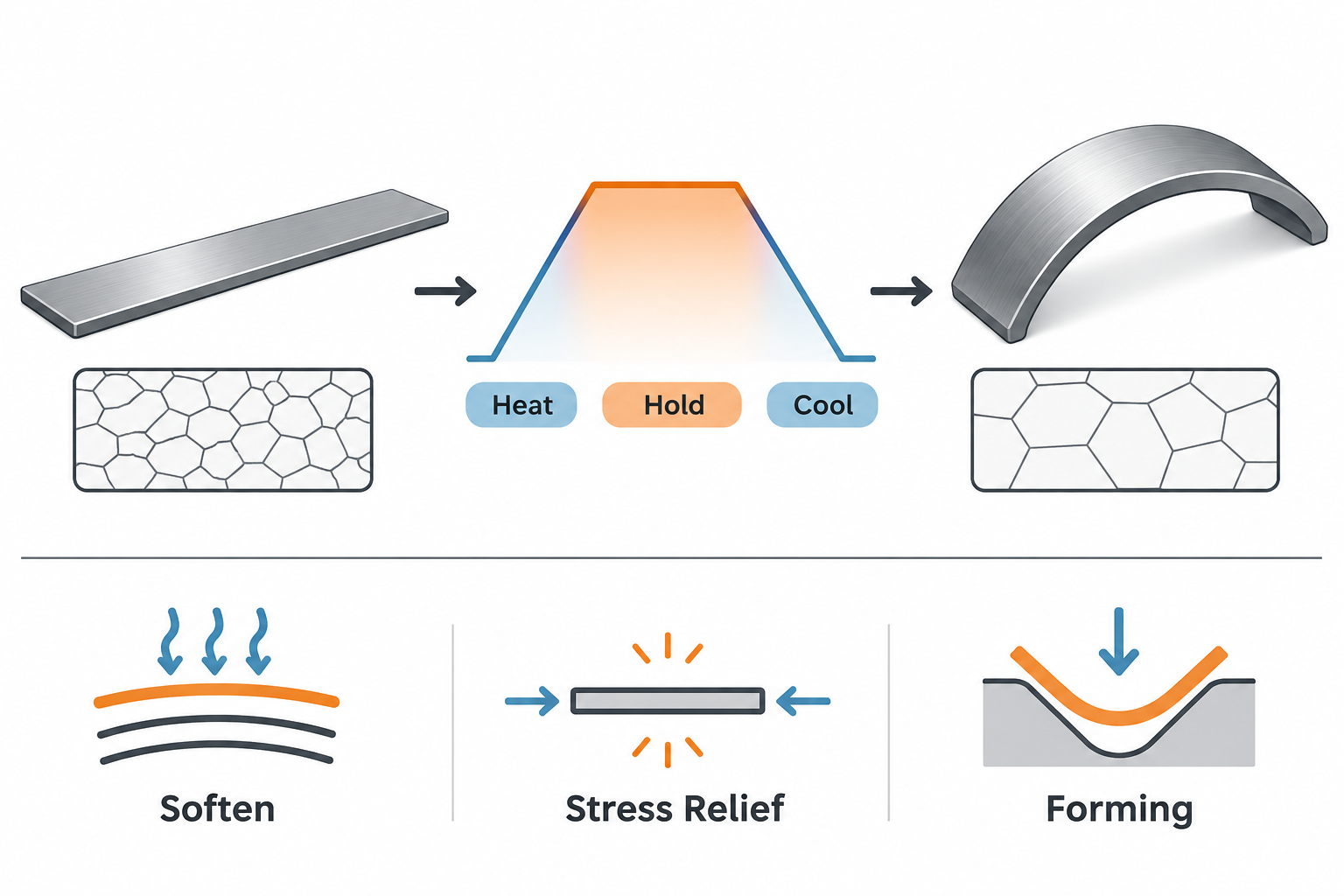
Cold working can make steel harder and reduce the remaining capacity for deformation. Annealing can change that condition through controlled heating, holding and cooling. The useful result is a specified material condition for the next operation, rather than simply evidence that the material entered a furnace.
Different annealing treatments pursue different outcomes. A treatment intended to soften a steel for forming is not interchangeable with every other thermal operation. The processor must choose a route appropriate to the grade and starting structure.
For purchasing, describe the desired supplied condition and how it will be accepted. That allows the supplier to evaluate the process against a result. Asking for an unspecified anneal leaves both the treatment and the acceptance basis open to interpretation.
Softening concerns the material condition needed for deformation or machining. Stress relief primarily concerns residual stresses. Although heat treatment can affect both, a stress-relieved label should not be treated as proof that stock has reached a fully softened forming condition.
Ask which problem the proposed treatment addresses. Is the issue excessive hardness, insufficient formability, movement after machining or a specified microstructure? Those questions lead to different process and inspection discussions. A single word on a quotation cannot resolve them.
Avoid prescribing a universal temperature from a general guide. Heating, holding, cooling and atmosphere have to suit the material and objective. For an order, agree the required condition and applicable process documentation with the responsible technical team.
Determine when the material needs its forming condition. A component may be formed from annealed strip and receive later treatment to achieve its final properties. Another production route may begin with material already supplied in a harder condition. The geometry and required properties determine which route deserves evaluation.
Discuss the actual operations: blanking, bending, drawing, subsequent treatment and finishing. Identify the operation that places the most important demand on the incoming strip. A trial should use the proposed grade, thickness, edge condition and delivery condition together.
Record those inputs with the trial result. If a later purchase changes the condition or edge preparation, the earlier forming trial may no longer represent the supplied material. Keep the accepted material basis attached to the order.
“Soft” is a description, not a complete acceptance requirement. Where hardness matters, specify the agreed range and test method. Where the forming operation depends on additional properties, identify those requirements and the supporting inspection records.
Formability also involves the part and process. Bend geometry, tool condition and material edges belong in the investigation when cracking occurs. Do not assume that annealing eliminates every cracking risk or that any annealed grade will perform identically.
Surface condition also needs attention. State whether the stock will be cleaned, coated or processed further, and identify any acceptance requirements that affect the next operation. An acceptable mechanical condition does not automatically establish an acceptable surface for every production route.
Request the material designation, governing specification, delivery condition, thickness and width tolerances, edge requirements, surface condition and inspection documents as one package. Describe the forming operation and whether heat treatment follows it. Ask the supplier to identify any proposed alternative condition explicitly.
Eugene lists annealed spring-steel strip for subsequent processing. Use the inquiry to confirm the grade and acceptance requirements for the intended part. Agree a representative trial where forming behavior is a purchase-critical question, and retain its material identification for repeat orders.