Steel grades identify materials within a particular designation system; they are not complete purchasing specifications. AISI and SAE labels, European steel names and numbers, and JIS references must be read with their governing documents. To order a strip, pin or retaining ring, also identify the product form, delivery condition, drawing requirements and verification needed.
The most useful steel grades chart is therefore one that separates what each notation tells you from what still needs confirmation. A cross-reference can help locate a candidate material, but it does not approve substitution for a particular part.
A grade identifies material within a defined system. A product standard addresses a specified product scope and its requirements. A delivery condition identifies the state in which material is ordered. These fields work together; none should be silently substituted for another.
| Notation or field | What to establish | What remains to check |
|---|---|---|
| AISI/SAE label | Recognized grade designation and governing reference | Applicable product specification and ordered condition |
| EN symbolic name | Steel identity under the relevant naming rules | Product standard, dimensions and condition |
| European steel number | Registered numerical grade identity | Requirements for the actual product being supplied |
| JIS document reference | Standard number, edition and product scope | Grade symbol and ordering requirements within that document |
| Delivery condition | Condition explicitly agreed for the order | Required properties and how they are verified |
For example, a short purchase description can contain a familiar grade but omit whether it concerns strip or bar. Another can name a product standard without identifying the grade within it. Both descriptions leave a supplier with an unanswered question.
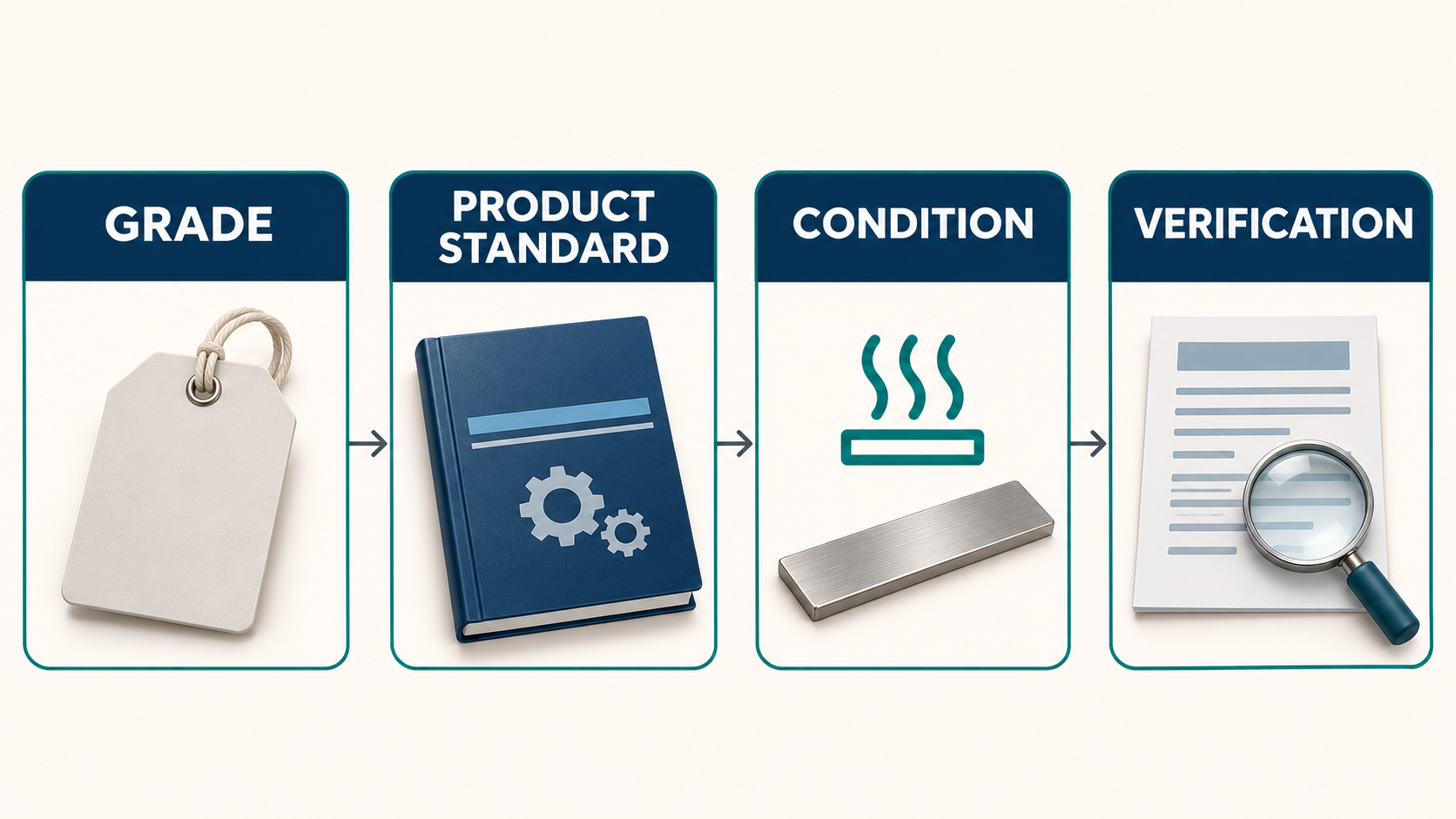
Use separate quotation fields for those items. If the drawing already fixes them, provide its revision and ask the supplier to confirm alignment. If a field is genuinely undecided, ask for a proposal and retain the distinction between the requested specification and the offered alternative.
This makes a quote easier to compare and a later disagreement easier to resolve. The reviewer can identify the exact field that changed instead of trying to interpret a compressed string that mixes a grade, a finish and a supplier’s shorthand.
AISI and SAE frequently appear together in commercial steel descriptions, but the label should lead you to the governing reference. SAE’s public description of J403, covering carbon-steel chemical compositions, states that AISI no longer issues steel grade designations and that grades listed in that document are SAE grades.
That distinction matters when an old drawing and a new supplier quotation use different prefixes. Do not resolve the difference simply by deleting the letters. Ask which document and edition each party is using, whether the intended grade identity matches, and which product requirements apply to the offered material.
Consider a hypothetical enquiry that says only “1045 steel.” The short label helps start the material discussion, but it does not state the dimensions, delivery condition, required properties or certificate basis. The buyer should complete those fields before comparing offers. This example does not assign chemical limits or mechanical properties to the label.
A proposed review record can preserve three entries: the drawing’s original notation, the supplier’s proposed notation and the governing reference used to explain their relationship. Keeping the original wording prevents an informal clarification from becoming an undocumented drawing change.
Where the order depends on chemical composition, obtain the applicable requirements and the agreed evidence of conformance. A memorized naming shortcut is not a replacement for the actual limits in the governing document. Likewise, a composition designation does not by itself establish every mechanical property of a finished component.
If a supplier offers a different grade, record it as an alternative. The familiar appearance of its number should not determine whether it is acceptable. Approval belongs to the process that controls the drawing and application requirements, supported by the relevant material and product evidence.
European steel names and steel numbers are complementary identification systems. DIN Media describes EN 10027-1 as the rules for steel names formed with letters and numbers that indicate important characteristics. EN 10027-2 addresses the numerical designation system and its registration and allocation.
A symbolic name can therefore carry information about characteristics such as application, properties or composition under the applicable naming rules. The numerical system provides another grade identifier suited to registration and data handling. Neither replaces the requirements of the product standard for the material actually ordered.
For a purchasing database, preserve both fields when both are supplied. Do not overwrite the drawing’s symbolic name with a material number merely to make the record shorter. A reviewer may need both to check whether the quotation, certificate and product specification refer to the same intended material.
Also keep the designation reference separate from the product reference. A document explaining how names are constructed is not automatically the document that specifies the supplied strip, bar or finished component. Ask which requirement controls product dimensions, condition and inspection.
A useful enquiry might say: “Please confirm the steel name and numerical identifier applicable to the proposed material, together with the product specification and delivery condition used for this quotation.” If the supplier identifies a mismatch, resolve that field explicitly rather than assuming the two identifiers must agree because they were placed on the same line.
Avoid applying one decoding rule to every European name. The naming system covers different kinds of characteristic information. Use the applicable standard and a documented identification record for the exact grade; do not infer a chemical composition or strength value from an unfamiliar string by analogy alone.
A JIS document number identifies a standard, not necessarily the complete grade description needed for an order. For example, the official JSA preview identifies JIS G 4401:2025 as a carbon-tool-steel standard. The enquiry still needs the required grade and the relevant ordering details.
The same preview illustrates why “based on an ISO standard” does not mean “identical.” Its introduction identifies the relationship to ISO 4957:2018 as MOD, meaning modified. It also explains the distinction between IDT, MOD and NEQ correspondence labels. Those labels concern relationships between documents; they do not approve an unreviewed pair of grades for substitution.
When a quotation says “JIS equivalent,” ask for the exact JIS designation, edition and grade symbol, followed by the basis for the proposed comparison. A phrase without those details is difficult to verify and does not identify which differences have been considered.
Check the product scope as well. The JSA preview’s scope describes carbon tool steels mainly manufactured by hot rolling or hot forging. A buyer ordering a particular strip or component must establish the applicable requirements for that form and condition, rather than assuming the broad standard title settles every manufacturing detail.
Keep an edition field in the specification record. A supplier may cite an older drawing requirement while a catalog points to a later edition. The correct action is to agree the applicable basis and review any material difference, not silently change the order to whichever document is easiest to find.
The public preview supports this explanation of scope and correspondence. It does not provide a complete replacement for the licensed technical tables. Use the required authoritative document when an actual order depends on a detailed grade comparison.
Material identity does not describe everything about the product being bought. Product form, dimensions and delivery condition belong in the order because the relevant specification can treat them separately. ASTM A684/A684M, for example, covers high-carbon cold-rolled strip and distinguishes supplied conditions in its public scope.
Its listed categories include annealed, intermediate-hardness and full-hard conditions. Those are specification terms to check in context. Do not automatically replace a condition such as “full hard” with a different processing description, or assume that a product offered under one condition has the properties required for another.
The practical consequence is to compare complete offers. If one quotation states the required grade and condition while another gives only the grade, the second is not yet a matching offer. Request the missing condition and associated verification before using the price as the deciding comparison.
For strip-specific selection, the carbon spring-steel grades and properties guide addresses the narrower material-selection task. This designation guide concerns how those choices are recorded and checked, rather than reproducing a strip-grade table.
Unit-system requirements also belong to the product specification. ASTM’s public A684/A684M scope treats SI and inch-pound requirements separately and cautions against treating their values as exact interchangeable conversions. Keep the chosen ordering basis explicit; a dimension converted on a calculator does not automatically establish compliance with another tolerance system.
For an actual purchase, record the agreed product standard, dimensions, condition and inspection requirements together with the grade. If a supplier proposes an exception, identify which field changes and obtain the required approval before the quotation becomes an order.
A cross-reference helps locate a material worth investigating. It is not an approval record for a finished application. The useful next step is a comparison of the specific requirements that matter to the drawing, product form and delivery condition.
| Substitution field | Evidence to compare | Question for approval |
|---|---|---|
| Material identity | Both governing grade definitions | Which differences require review? |
| Product scope | Form, dimensions and relevant product standard | Does the proposed supply match the order? |
| Condition and properties | Required state and acceptance evidence | Are the specified properties demonstrated? |
| Manufacturing and function | Drawing and application-specific requirements | What additional verification is necessary? |
| Approval record | Named deviation and authorized decision | What exactly has been approved? |
Consider an original procurement scenario. A drawing specifies a European grade and condition; a supplier proposes a familiar grade from another system and attaches a generic equivalence chart. The buyer should request the proposed product specification, condition and evidence for the drawing’s requirements. The chart locates the candidate, while the completed comparison supports the decision.
In a second scenario, the grade remains unchanged but the quoted delivery condition differs. This is still a change that needs review. Matching the short grade name does not make the offered supply identical to the requested supply.
Record unresolved differences rather than forcing them into a yes/no “equivalent” column. The responsible drawing authority can then approve a defined deviation, reject it or request further evidence. Keep that decision with the relevant order or drawing revision so a later purchaser knows its scope.
A material document becomes useful acceptance evidence when its identity and scope connect to the order and delivered material. Begin by checking the grade notation, governing specification, represented condition and traceability information against the requirements being purchased.
A certificate can contain a recognizable grade and still leave an important question unanswered. It may not identify the requested product condition, or the buyer may not yet have established which shipment it represents. Resolve that link before interpreting the listed results as evidence for the received lot.
Keep the original document alongside a short review record. Identify the drawing revision and order reference used for the check, record any clarification from the supplier, and name the unresolved requirement if one remains. Avoid editing the certificate’s designation to make it resemble the purchase order.
For repeat orders, reuse the approved specification but review the new shipment evidence on its own basis. A prior approval of one substitution or document does not establish that a later lot has the same material condition or that every original exception remains authorized.
If a test result is missing, ask for that specific evidence rather than selecting another available property as a substitute. A composition result, hardness result and dimensional inspection address different requirements. The product standard and drawing determine what is needed for the purchase.
When the evidence disagrees, preserve the material identification and ask the issuing party to explain the discrepancy. A clear record should show whether the issue was a notation clarification, a document correction or an actual proposed change to the supplied material. Those outcomes have different implications for the order and should not be merged into a generic “accepted” comment.
Give the supplier the full material question at the quotation stage. Include the original drawing notation, governing document and edition, product form, dimensions, delivery condition and required inspection evidence. Identify whether alternatives are permitted and who must approve them.
A useful original enquiry structure is: “Please quote the material and condition identified on the attached drawing revision. State the governing grade and product references used for the offer. List any deviation separately and identify the evidence available for the specified requirements.” Replace the general descriptions with the approved references for the actual part.
If the supplier uses a different naming system, request a documented comparison rather than a rewritten grade line. Preserve both the requested and proposed designations. This allows a technical reviewer to assess the difference without losing the original requirement.
Eugene’s business includes retaining rings, disc springs, pins and spring-steel strip. For a custom fastener, the OEM drawing and material enquiry provides a relevant discussion route. Ask which specific material, condition and inspection requirements can be confirmed for the proposed order; do not infer supply to every grade from a general product-family description.
The quotation should make the final comparison easy: requested material, offered material, product basis, condition, verification and any exception. Once those fields are resolved, the grade label becomes part of a clear purchasing instruction. Retain the approved comparison so that repeat sourcing follows the same defined requirement rather than an informal claim of equivalence.
SAE J403: public description of SAE carbon-steel compositions and designation context
DIN Media: EN 10027-1 steel names
DIN Media: EN 10027-2 numerical steel designations
JSA: official preview of JIS G 4401:2025, introduction and scope
ASTM A684/A684M: public scope for high-carbon cold-rolled strip