Stainless steel can be magnetic. Ferritic, martensitic and duplex stainless steels commonly attract a hand magnet, while fully austenitic material usually shows little attraction. Processing can change that response. A magnetic retaining ring or pin therefore cannot be rejected as “not stainless” from a magnet check alone.
Buyers asking “is stainless steel magnetic” often need to answer a more specific purchasing question: whether a delivered part matches its material specification or will interfere with an assembly. Those are separate decisions. Establish the grade and delivery condition, identify the functional requirement, and choose evidence that addresses each one.
Stainless is a material category, not a promise of negligible magnetic response. The British Stainless Steel Association distinguishes the stronger attraction of ferritic, martensitic and duplex families from the low response normally associated with austenitic material. That distinction explains why apparently similar metal components can behave differently near the same magnet.
Start with the family recorded in the material documentation. Then check the actual grade, product form and condition. A description such as “stainless ring” omits information needed to interpret attraction. A stamped spring component and a soft flat coupon may also have different processing histories, even when their paperwork refers to the same grade family.
| Material family | Typical hand-magnet response | Useful purchasing question |
|---|---|---|
| Austenitic | Usually low in a fully austenitic condition; processing can change it | What was the final forming and delivery condition? |
| Ferritic | Commonly attracts a magnet | Does this specified family meet the assembly requirement? |
| Martensitic | Commonly attracts a magnet | Are grade, hardness and magnetic requirements separately specified? |
| Duplex | Can attract a magnet because of its mixed structure | Was a magnetic response expected in the selected material? |
This comparison is qualitative. The entries do not define a test force, a permeability limit or equivalence between grades. Use the table to select the next question, rather than turning it into an incoming-inspection specification.
For example, a drawing that permits a magnetic stainless family may be fully consistent with a noticeable pull. Replacing that material solely to eliminate attraction changes the engineering question. The proposed alternative still needs to satisfy dimensions, mechanical behavior and service exposure. Review those requirements together before requesting a material substitution.
Some austenitic stainless steels develop a stronger magnetic response after cold working. BSSA explains that deformation can transform some austenite into ferromagnetic martensite. Composition and processing influence the extent of that change, so a simple rule covering every finished austenitic part would be misleading.
For a formed component, record where the response occurs. A local observation at an edge or heavily worked region has a different context from a comparison made only on an untouched flat area. Draw a small location map or mark the photograph so another inspector can find the same region without guessing.
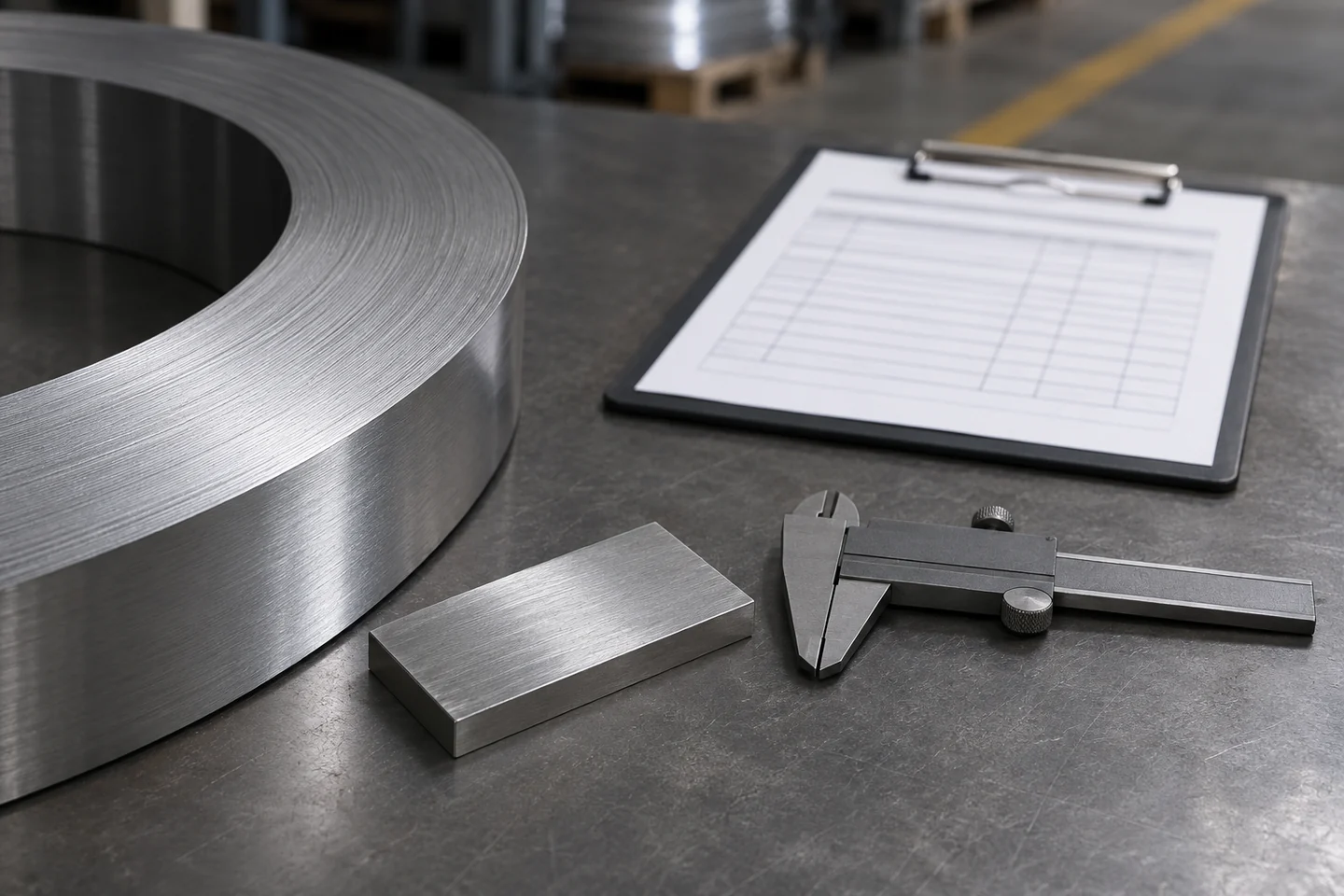
Also identify when the observation was made. A raw strip observation belongs to the strip in its delivery condition. A later observation belongs to the finished component after its recorded operations. Keeping those stages separate prevents a supplier and buyer from comparing different objects while believing they have repeated the same check.
Consider a hypothetical retaining-ring order. The buyer has an approved flat sample and later notices attraction at a formed region of the delivered ring. The appropriate first response is to compare the material traceability and processing records. The difference in attraction is a reason to investigate; it does not, by itself, prove that another grade was substituted.
Do not use a proposed heat treatment as an informal way to make that disagreement disappear. A finished spring part has other requirements that a process change could affect. Any revised route needs approval against the complete drawing and delivery condition. A magnetic observation should therefore remain linked to the part revision and manufacturing stage at which it matters.
In repeat orders, retain the agreed reference condition in the inspection instruction. “Compare with last year’s sample” is incomplete when nobody knows whether that sample was incoming strip, a finished part or a previously modified specimen. A short history record gives the comparison a usable meaning.
A hand magnet can support a qualitative screening observation. It does not identify chemical composition or produce a quantified magnetic acceptance result. Write down exactly what was observed, without extending the conclusion beyond the evidence available.
A practical observation record can include the part identifier, lot, location, reference specimen and checking arrangement. Describe whether the magnet was moved across the part or brought to one named point. These details are proposed ways to make the discussion repeatable, not a standardized magnetic test method.
Use a consistent comparison arrangement if screening is part of an agreed process. Changing the magnet, the contact arrangement or the part being compared makes a disagreement harder to interpret. Recording those changes is more useful than describing the later result as simply “more magnetic.”
A record might say: “At the marked formed region, this specimen shows noticeable attraction with the agreed reference magnet; the central flat region shows less noticeable attraction.” That statement describes a comparison. It avoids claiming a material identity, an instrument reading or a corrosion rating that was never established.
Keep observations separate from dispositions. The observation can trigger document review, a repeat check or an application-specific test. The disposition states what happens to the lot under the purchase agreement. Combining them into “magnet sticks, reject lot” is defensible only when the approved acceptance contract actually specifies that screening rule for the relevant part.
If different people report different results, preserve both records. Identify the checking arrangement before escalating the material allegation. A buyer can still hold the lot while clarifying the requirement, but the hold reason should describe the unresolved evidence. That wording allows a targeted investigation and avoids requesting an unnecessary change in material.
Grade identity asks what material was supplied. Magnetic performance asks how the component behaves under a specified magnetic requirement. A material certificate and an application test answer different parts of that investigation; neither should silently stand in for the other.
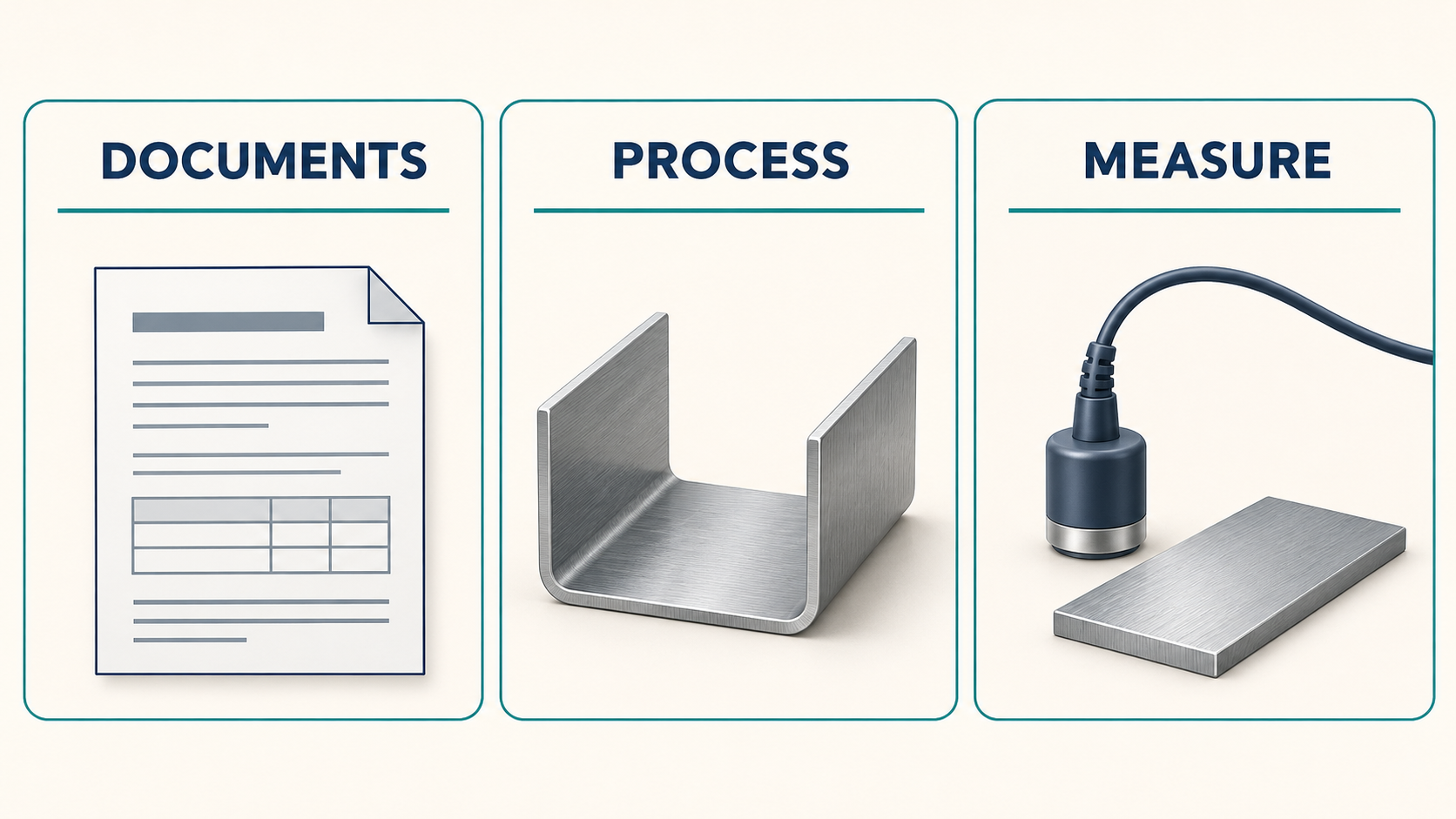
For identity, ask which document is required by the order and how it relates to the delivered lot. Match the grade designation, product description and lot references. If an independent material-identification check is needed, agree its method and scope with the responsible specialist. Do not assume that any single analyzer resolves every distinction in the specification.
For performance, define the concern in the assembly. A sensor application may have a different requirement from a component that is merely handled with a magnet during sorting. “Must be nonmagnetic” leaves both the observable property and the acceptance arrangement unclear. The technical owner should identify what must be limited and in what finished condition.
Maintain a separate corrosion requirement. Low attraction is not evidence of suitability for a particular liquid, cleaning regime or outdoor exposure. Conversely, attraction does not establish that a stainless component will corrode in its intended environment. Treating magnetism as a proxy for corrosion resistance creates a purchasing shortcut with no demonstrated acceptance basis.
A useful review therefore has separate lines for identity, functional magnetic behavior and service requirements. Each line names its evidence and its acceptance owner. The supplier can then identify what information is available and what additional verification would need to be agreed, without implying that a general product description certifies all three.
A formed ring needs to meet its complete drawing, not just a visual or magnetic expectation. Use a magnetic concern to investigate the relevant property while preserving requirements for fit, material condition and intended function.
In an illustrative case, a buyer orders rings to a drawing that specifies stainless material and a mechanical condition but contains no magnetic limit. A receiving inspector compares them with a different ring and notices stronger attraction. The immediate decision is to establish whether the comparison has exposed a specification mismatch or an additional application requirement.
Ask the drawing owner to distinguish those possibilities. If the ordered material and condition are correct, the new observation may still matter to the assembly. That does not automatically make the delivered lot acceptable or unacceptable; it means the functional concern needs a defined assessment. Record who can approve that assessment and what evidence will close it.
If the identity documents do not match the order, address that discrepancy directly. There is no need to use attraction as indirect proof when a traceability mismatch already exists. Keep the material issue and any resulting functional checks together in the nonconformance record, while stating which evidence supports each finding.
For a proposed replacement, prepare a change review instead of a one-property comparison. Include the drawing revision, required material condition, critical dimensions and the newly stated magnetic need. Ask the supplier to identify departures from the original requirement rather than describing the replacement as simply “better stainless.”
This review method also prevents an approved sample from becoming an undocumented standard. If a physical reference matters, identify it and state its role. A reference used to demonstrate appearance is not automatically a certified reference for magnetic behavior. Keeping that distinction explicit makes subsequent lots easier to inspect and discuss.
A useful requirement identifies the property, the relevant finished condition, the verification method and the acceptance basis. The exact technical limit must come from the application owner and an appropriate specification; a general material article cannot supply it.
Start with the function. Explain whether the concern involves an electromagnetic field, an inspection process or a handling operation. Describe the location of the component and which neighboring equipment is relevant. That background helps the technical team decide what kind of measurement or functional check addresses the concern.
Then specify the specimen condition. A test on a raw strip coupon may not answer a requirement for a fully formed ring. Identify any operations that occur before the verification point. If the part is tested in an assembly, state which assembly condition is controlled and which component result is being recorded.
| Requirement field | Information to agree |
|---|---|
| Property and purpose | The magnetic behavior that affects the application |
| Part condition | Drawing revision and manufacturing stage at verification |
| Method and locations | Agreed procedure, specimen arrangement and checking points |
| Acceptance basis | Applicable limit or functional criterion approved by the technical owner |
| Records and disposition | Lot traceability, retained results and authority for exceptions |
This worksheet does not require a supplier to possess an unverified testing capability. It gives both parties a way to establish whether the proposed verification can be provided and under what conditions. Confirm any laboratory, instrument or reporting requirement before including it in the order.
For recurring purchases, control revisions to this requirement just as carefully as changes to dimensions. A stricter criterion introduced after delivery can create a new qualification task. Record its effective order or revision so future comparisons refer to the same agreement.
Separate the observations before attempting to explain them. Mixed containers, unidentified reference pieces and missing process records can turn a limited screening difference into a broad material dispute. Preserve lot identity while the evidence is reviewed.
For a hypothetical delivery containing two labeled lots, first record which specimens came from each lot. Keep the sampling locations and any individual part identifiers with the observations. Do not combine the pieces into one comparison group and then ask the supplier to explain a result that can no longer be traced.
Compare the specification and documentation next. Determine whether the lots were ordered to the same grade and condition, and whether the reference specimen represents that same contract. Differences in the order should be resolved before differences in attraction are interpreted as a manufacturing deviation.
When the requirements match but the observations still differ, agree a focused next step. That might be review of processing history or a specified verification performed by a qualified party. Name the question to be answered. “Test everything” can generate reports that still fail to address the particular acceptance concern.
A clear closure record states the original observation, the additional evidence obtained and the disposition approved by the responsible person. Keep a concession separate from a finding of full conformity. If a lot is accepted for a restricted use, record that restriction rather than letting the acceptance become a general precedent.
Finally, update the incoming instruction only when the review justifies a change. If the problem was an unidentified reference specimen, improve reference control. If it was an omitted functional magnetic criterion, revise the specification. Different causes require different changes; a blanket magnet test should not become the default response to every disagreement.
Send the part drawing and explain the material question in terms the supplier can act on. Include the required grade designation, delivery condition, quantity and application context. Identify whether the issue concerns a new design, a repeat order or an investigation of an existing lot.
For a magnetic concern, attach the observation record and mark the checking locations. Describe the reference used and provide the actual acceptance requirement if one exists. If the requirement is still being developed, say who owns that decision and what information is needed from the supplier.
For a retaining ring or locating component, keep the dimensional and functional requirements in the same enquiry. A proposed material or process change may need review beyond the property that started the discussion. Ask for an explicit statement of any proposed deviation so the drawing owner can assess it.
Eugene’s OEM and custom-component enquiry route provides a relevant place to discuss those drawing inputs. Request confirmation of the proposed material, condition and available documentation for the specific component. Any special magnetic verification should be agreed separately rather than assumed from a general product category.
The resulting enquiry should allow a practical answer: whether the specified component can be discussed as drawn, which requirement needs clarification, and what evidence is needed before approval. That is more useful than a request for “stainless that does not stick to a magnet,” because it connects the material observation to the part’s actual job.