Tempering steel is a heat-treatment step normally performed after hardening to adjust the balance between hardness and toughness. It uses controlled heating below the relevant critical transformation temperature. The appropriate treatment depends on the steel grade, its prior condition and the required final properties; there is no single tempering temperature that suits every steel part.
For a purchaser, “tempered” is therefore an incomplete delivery description. The order also needs the material identity, supplied condition, finished-part requirements and evidence used for acceptance. A process name or surface color cannot replace that information.
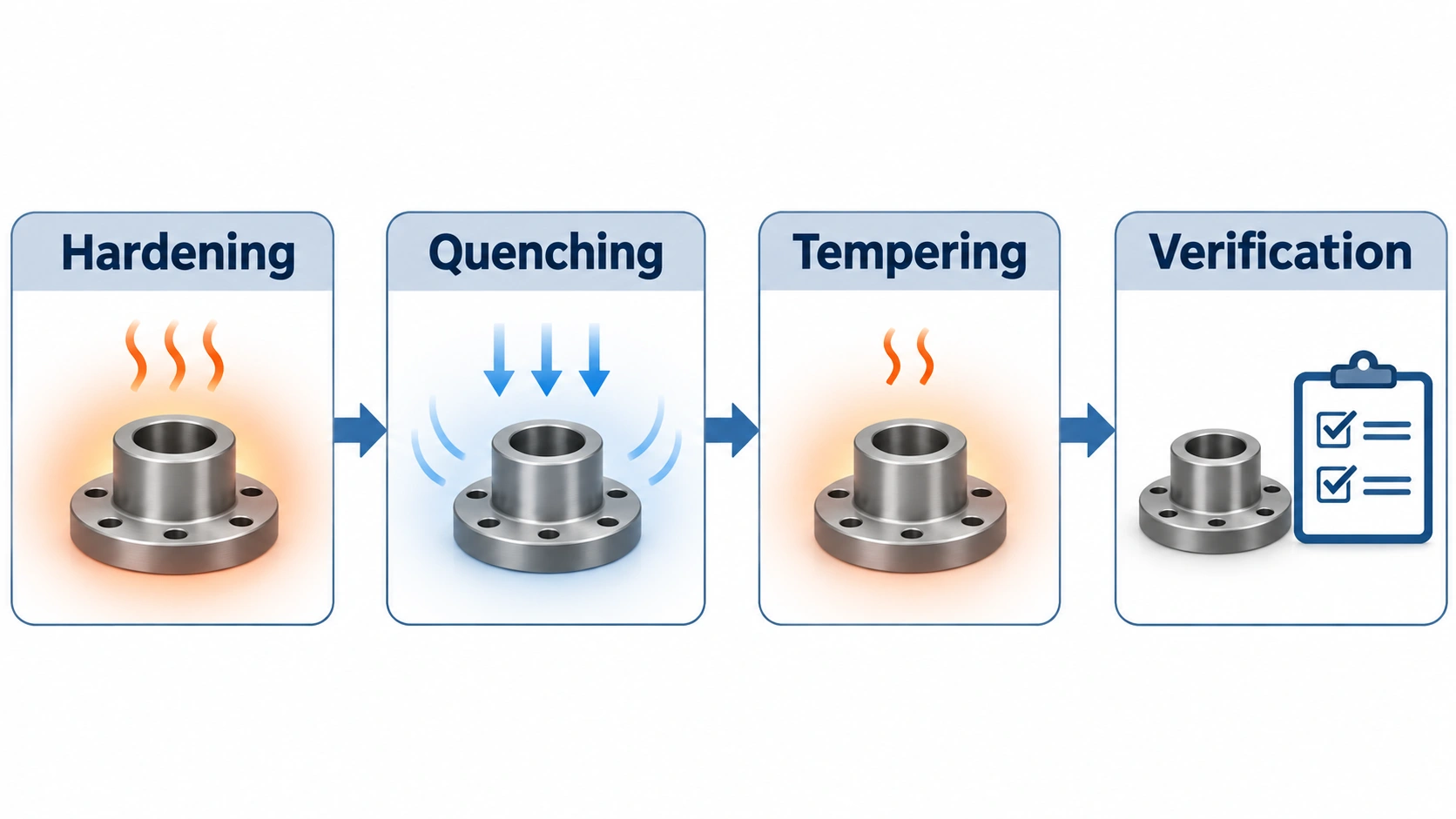
HTS describes tempering as a treatment following hardening, with the process selected for the required material properties. Ipsen distinguishes hardening from the subsequent tempering step. For the applicable hardened steels, tempering addresses brittleness while adjusting the resulting condition.
Hardness and toughness describe different aspects of behavior. A hardness result is not a complete statement about a component’s resistance to fracture, fatigue or every service load. When the application requires a particular mechanical property, that requirement needs its own technical basis and, where specified, its own verification.
In a conventional quench-hardening route, the controlled heating stage prepares the steel for the required transformation during subsequent cooling. Quenching is part of that hardening route. Tempering follows to adjust the hardened condition toward the required application properties.
Do not treat these words as interchangeable purchasing descriptions. A quote that mentions hardening has not necessarily stated the final tempered condition. A quote saying “heat treated” may leave the entire required state undefined. Ask the supplier to identify what condition is actually included at delivery.
The process sequence also does not establish whether every final requirement has been inspected. A supplier can list the planned operations while still omitting a required hardness result or finished dimensional check. The order should distinguish the proposed route from the evidence needed to accept its output.
A buyer may be concerned about a pin deforming, a spring component responding incorrectly or a working surface meeting its specified condition. Those are different tasks. The technical requirement should state the necessary outcome rather than asking for an undefined amount of “extra hardness.”
This approach gives the supplier a clear question to answer. It can identify whether the material and proposed route can support the specified condition, which operations are included and what information is still needed. The buyer can then compare complete deliverables instead of process labels.
A tempering requirement has to be considered with the actual steel. HTS notes that tempering temperature and time depend on steel type and geometry. Its description also identifies secondary hardening as a possible response for applicable materials. This is a reason to use grade-specific technical guidance rather than copying a generic furnace chart.
It is also a reason not to assume one simple hardness response for every alloy. The processor needs the correct material identity and starting condition. The buyer’s specification should make those inputs visible without attempting to turn a general educational example into an approved production cycle.
State the grade and applicable material specification. Where the component is ordered to a drawing, keep that material reference tied to the current revision. A trade description such as “spring steel” does not identify every material variable needed for a particular treatment decision.
If an alternative grade is proposed, treat it as a substitution for review. Similar commercial descriptions do not establish that the original treatment instructions or property expectations transfer unchanged. The supplier’s response should identify the alternative explicitly and explain the requirement it is proposing to meet.
For stock purchases, identify the form and supplied condition as well. A strip, bar and finished pin can represent different manufacturing stages. A quotation for one should not silently stand in for another simply because both use the same grade name.
A buyer purchasing material for later forming or machining needs a condition suitable for that planned work. A buyer purchasing a finished component needs the final drawing requirements met at delivery. These are different acceptance points, even when a shared material designation appears on both orders.
If treatment occurs after the buyer receives the material, the stock supplier’s records do not automatically prove the later component’s final condition. Conversely, if the supplier delivers the completed treated part, the quote should identify the final requirements and records included in that scope.
The distinction is useful when comparing annealed stock with hardened-and-tempered stock or a finished treated component. List the operations still required to reach the intended delivery. A lower price that leaves additional processing to the buyer is a different scope, not necessarily a lower price for the same accepted item.
The Atlas 4140 bar datasheet relates supplied hardened-and-tempered properties to condition and diameter. That is a concrete example of why product data must be read with its headings. A table for a named stock product should not be assigned automatically to an unrelated finished component.
When supplier literature is used during sourcing, record which product form and state it describes. Ask what evidence will represent the actual order. A general datasheet can help explain a material option, but the delivery still needs to be connected to the agreed acceptance requirement.
A useful final-condition specification separates material, mechanical properties, dimensions and surface requirements. This prevents one convenient result from being treated as proof of the entire component. It also helps the supplier price the actual inspection and documentation scope.
A hardness requirement needs an identified scale and acceptable range or controlling reference. The inspection location and applicable method should also be defined where required by the drawing or order. A reported number without those details may not answer the buyer’s acceptance question.
If the drawing has no hardness requirement but the purchase request adds “tempered,” ask what final condition is intended. The supplier should not have to invent an acceptance range. Resolve that requirement before production, especially when different quotations have been based on different assumptions.
For repeat orders, retain the accepted requirement with its revision. A request to make the next lot “the same as last time” may lose the scale, location or condition on which the earlier lot was accepted. A controlled reference gives both parties a clearer basis for comparison.
Where a design requires a specific toughness or other mechanical test, state the applicable requirement and represented material. Do not assume that an in-range hardness result proves every required property. The additional test scope should be identified in the inquiry so its cost and evidence are understood.
The supplier should also distinguish a typical catalog value from a result representing the order. A typical value may support initial material discussion without being a delivery guarantee. The buyer needs to know which status applies before using it as a release criterion.
This does not mean requesting every possible test. Each ordered evaluation should answer a defined acceptance question. Unnecessary records can add cost while still leaving the most relevant feature or condition undocumented.
State which dimensions apply to the finished delivered part. If the quote includes treatment and final finishing, a measurement recorded only before those operations may not represent the accepted state. The inspection package should identify the final features being reported.
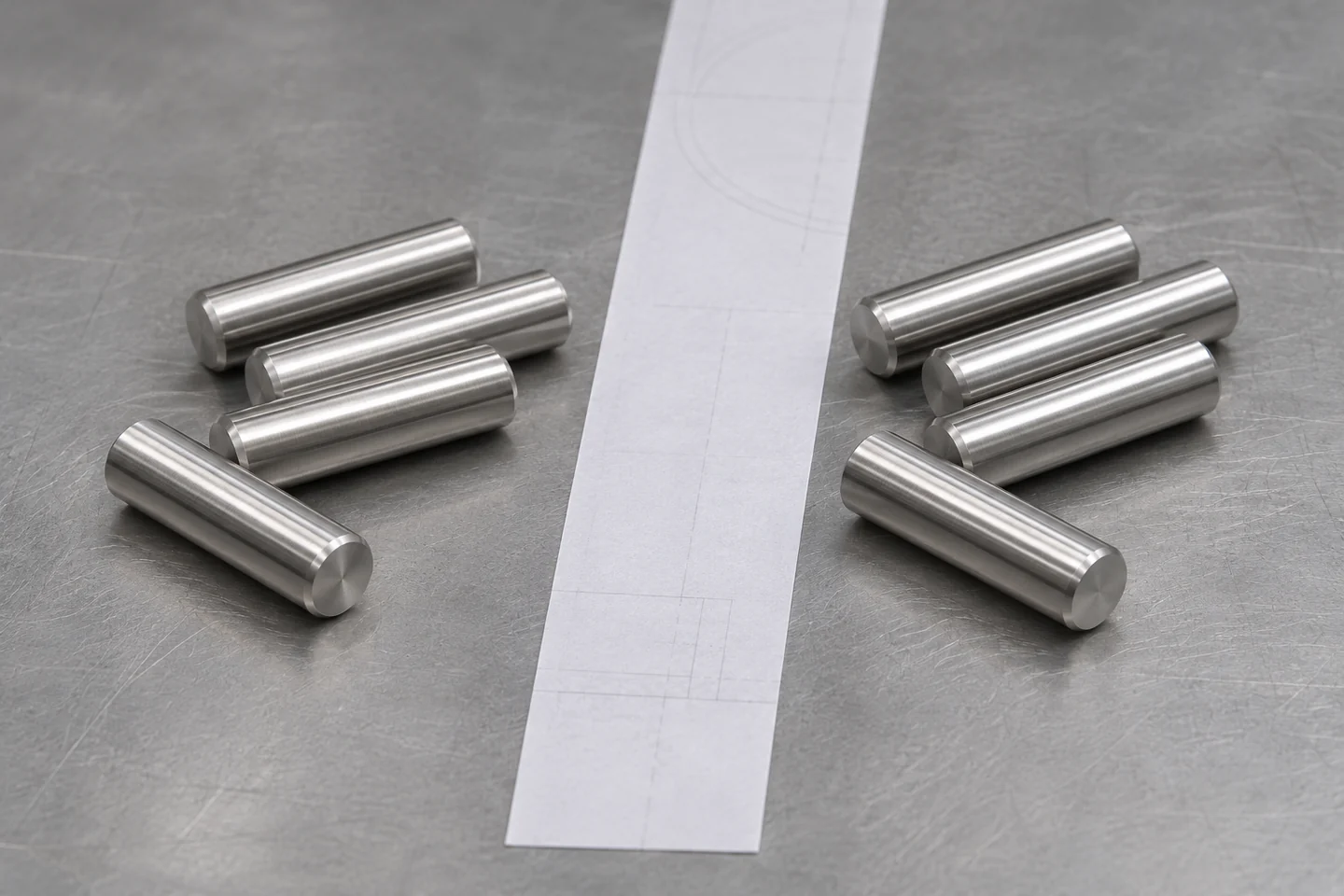
For a locating component, distinguish material condition from the fit requirement. The dowel pin sizes and fits guide addresses the size-and-assembly decision. Tempering does not, by itself, establish the correct pin diameter or mating-hole requirement.
Any coating or additional surface operation should remain visible in the same requirement package. Clarify its place relative to final inspection and identify the affected surfaces. A quote can then address the completed component rather than leaving the buyer to resolve an undefined final stage.
A surface color or visual similarity to an earlier batch does not provide the specified hardness or treatment evidence. If appearance is a requirement, define it separately. Do not use a color description to infer the complete time-temperature history of an unknown part.
This matters for material descriptions containing finish terms. Preserve the ordered condition and supporting records rather than treating a familiar blue, polished or dark appearance as proof of the mechanical state. The surface description and material-condition requirement have different jobs.
The following original matrix is a purchasing aid. It identifies the question each record is intended to answer. The actual order determines the required report content, representation and sampling; the matrix does not impose a universal inspection program.
| Requirement | Evidence to agree | Limit of that evidence |
|---|---|---|
| Steel identity | Material record linked to the supplied lot | Does not alone establish the final treated condition |
| Included treatment route | Required treatment declaration or processing record | Does not replace an ordered property result |
| Final hardness | Applicable result with scale, location and acceptance reference | Does not prove every mechanical property |
| Additional mechanical acceptance | Specifically ordered test and represented-material information | Applies within the test’s defined scope |
| Finished geometry | Results against the current drawing in the delivered state | Does not establish material grade or treatment history |
| Delivery identity | Consistent identifiers on packages and supporting records | Connects evidence to goods but does not replace the results |
A document called a heat-treatment certificate may describe a process without reporting the final property the buyer ordered. A dimensional report may identify the part correctly while omitting material-condition evidence. Read the listed requirements and results, not just the document heading.
Begin with the component reference, drawing revision and lot identifier. Establish that the record represents the received goods. If the connection is missing, resolve it before applying the reported result to a delivery that may have a different history.
Where the requirement calls for a result from a particular stage or location, confirm that the record addresses that point. A stock test and a finished-part test should not be treated as equivalent without an agreed basis. The evidence must answer the acceptance question actually written into the order.
A missing hardness record leaves the specified property unverified; it does not prove that the lot is soft or hard. An available result outside the accepted range is a different issue. Describe the specific gap so the supplier can provide evidence or propose a disposition against the affected requirement.
If a report is corrected, preserve what changed and why. A revised document should not silently replace the requirement against which the parts were ordered. This helps purchasing and receiving distinguish a clerical correction from a proposed change to the acceptance basis.
Consider a hypothetical buyer requesting a finished steel locating pin. The initial inquiry includes the geometry and grade but says only “harden and temper” for the material condition. One supplier quotes a finished component using its assumed condition. Another asks for the hardness requirement and report scope. These are illustrative quotation responses, not actual supplier offers.
The buyer should clarify the requirement before choosing the apparently simpler offer. A supplier’s willingness to quote does not establish that both parties have the same final state in mind. The missing information affects what is being purchased and how it will be accepted.
The buyer’s technical owner identifies the final material condition and the applicable hardness acceptance reference. It also confirms whether any additional mechanical evaluation is required. Purchasing sends that same clarification to both suppliers and asks each to state the included scope.
The revised request does not copy a generic furnace cycle from a material webpage. It identifies the outcome and asks the responsible supplier to confirm whether its proposed route supports it. Any proposed alternative is listed separately for review rather than being hidden inside the quotation.
The buyer marks the working diameter and shoulder features for the required dimensional report. It states that those results must represent the delivered condition after the operations included in the quotation. The supplier identifies whether final finishing is included or excluded.
If one offer is for a treated blank and the other is for a finished pin, purchasing separates the scopes. The blank option may still be useful if the buyer intends to complete the work, but its price is not compared as though it includes the same accepted component and records.
Suppose the preferred supplier offers a treatment declaration but has not included the ordered hardness result. The buyer asks for that defined result, including its agreed scale and location. It does not request an unrelated expanded certificate package simply to make the file look more complete.
If the supplier cannot support the requested evaluation, the exception remains visible. The technical owner can assess a proposed alternative before the order is released. Purchasing should not remove the requirement merely because the process description sounds credible.
The final order identifies the grade, delivered condition, finished drawing, agreed tests and required records. It retains any accepted clarification or deviation with the controlling revision. A later reorder can refer to that requirement rather than an informal description of the previous batch.
If a material or geometry revision arrives, the treatment and evidence assumptions are reviewed with it. The unchanged phrase “harden and temper” should not conceal a different final requirement. Keeping those changes visible helps the supplier quote the new task accurately.
Send the current drawing, exact steel specification, known starting condition and intended delivery stage. Include final hardness and other mechanical requirements, fit-critical dimensions, surface operations and the evidence needed for acceptance. Ask the supplier to identify any missing input or excluded operation.
For locating pins, spring components or another verified product family, the OEM and ODM inquiry service provides a relevant discussion path. Confirm the material, treatment and inspection scope for the specific order. A general description of tempering does not establish a supplier’s equipment, capacity or capability for an individual requirement.
HTS Technology Group: tempering process and material dependence